Comparing objects Extra Challenge Math Worksheets for Ages 4-6
3 filtered results
-
From - To
Introducing our "Comparing Objects Extra Challenge Math Worksheets for Ages 4-6", designed to nurture your child's critical thinking and observation skills. These engaging printable worksheets help young learners practice comparing sizes, lengths, quantities, and more through fun and interactive activities. Perfect for kindergarten and first-grade students, each worksheet offers a variety of tasks that make learning enjoyable and effective. Our expertly crafted exercises provide an extra challenge to boost your child’s confidence and math foundation. Download now to support your child's early math development with our stimulating and educational worksheets.
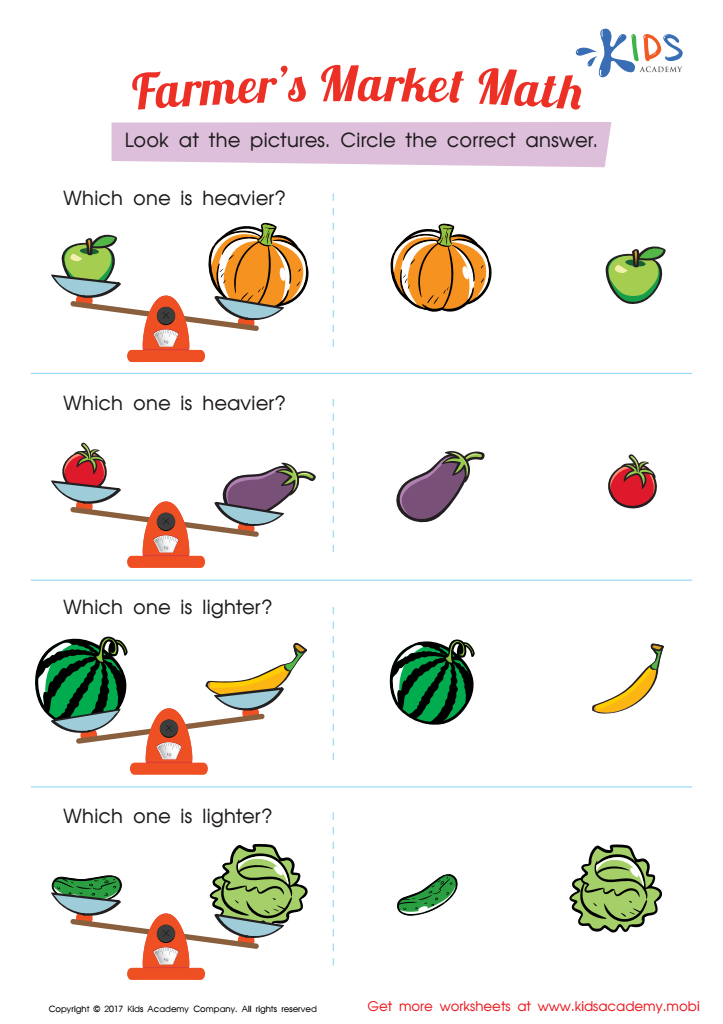
Which One Is Heavier Worksheet
 Assign to My Students
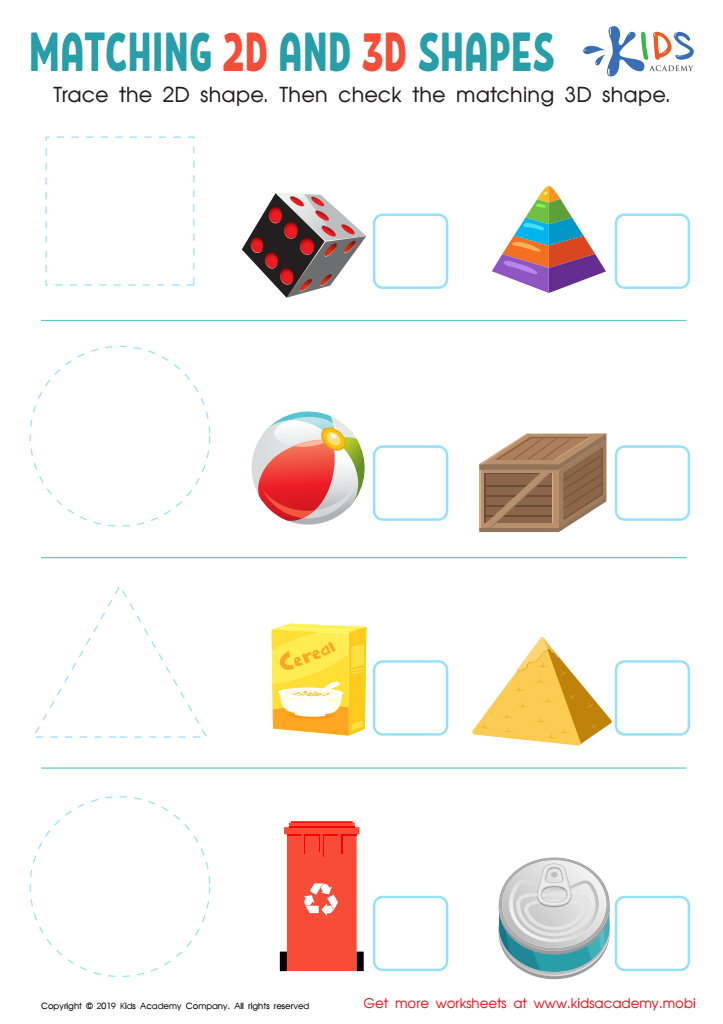
Matching 2D and 3D Shapes Worksheet
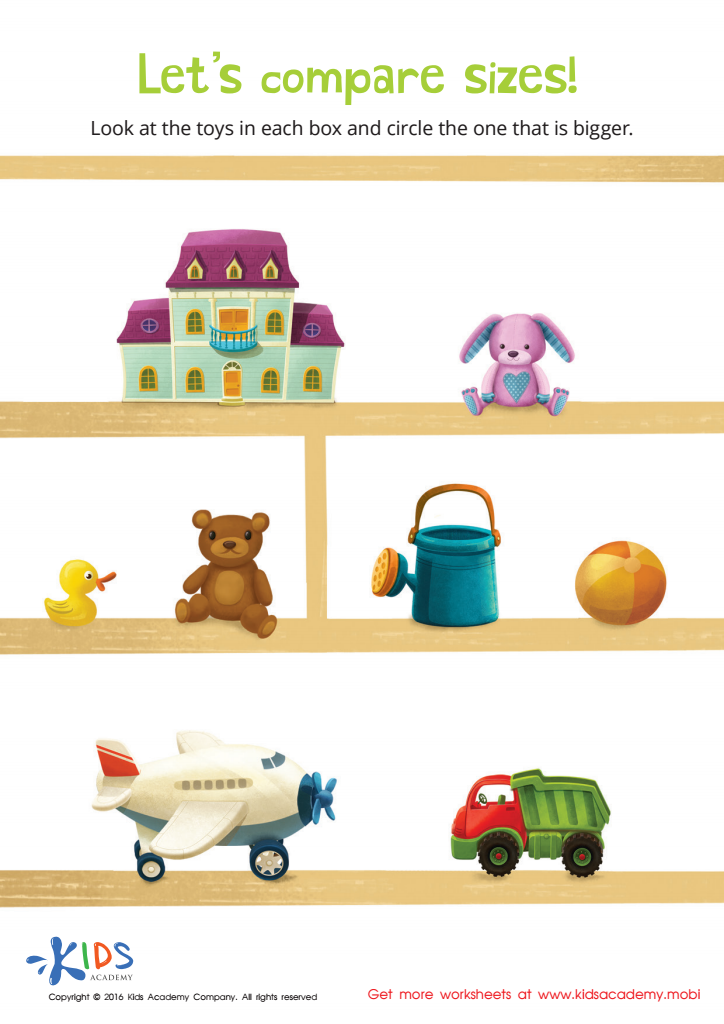
Classifying by Size Sorting Worksheet







Comparing objects in math for ages 4-6 is crucial because it lays the foundation for essential reasoning and analytical skills. During early childhood, children begin to develop mathematical thinking by understanding sizes, lengths, weights, and volumes. By engaging in comparing objects, children enhance their observational skills and learn to recognize differences and similarities. This helps them make sense of the world around them by categorizing and organizing information, a skill useful across all disciplines.
Furthermore, comparing objects fosters critical thinking. When children determine which object is bigger, smaller, heavier, or lighter, they’re encouraged to make thoughtful decisions based on their observations. These activities also support the development of vocabulary and language skills as children learn new terms like "taller," "shorter," "heavier," and "lighter."
Social skills are also nurtured as children often work with peers on such activities, learning to communicate their reasoning and understand others' perspectives. Additionally, comparing objects is foundational for future math concepts such as measurement, geometry, and data analysis. Parents and teachers should care about incorporating these challenges to support holistic development, ensuring children are well-prepared for more complex mathematical concepts and everyday problem-solving.








