
Observational skills Extra Challenge Worksheets for Ages 4-7
3 filtered results
Difficulty Level
Grade
Age
-
From - To
Subject
Activity
Standards
Enhance your child's observational skills with our engaging Extra Challenge Worksheets designed specifically for ages 4-7. These thoughtfully crafted activities promote children's ability to notice, interpret, and analyze their surroundings. By working through fun and interactive problems, young learners will sharpen their focus, improve attention to detail, and develop critical thinking abilities in a playful way. Each worksheet offers a unique challenge that encourages curiosity while aligning with developmental milestones. Perfect for both home learning and classroom settings, these worksheets will not only enrich your child's educational journey but also cultivate a deeper understanding of the world around them. Explore our collection today!
Favorites
With answer key
Interactive
 Assign to My Students
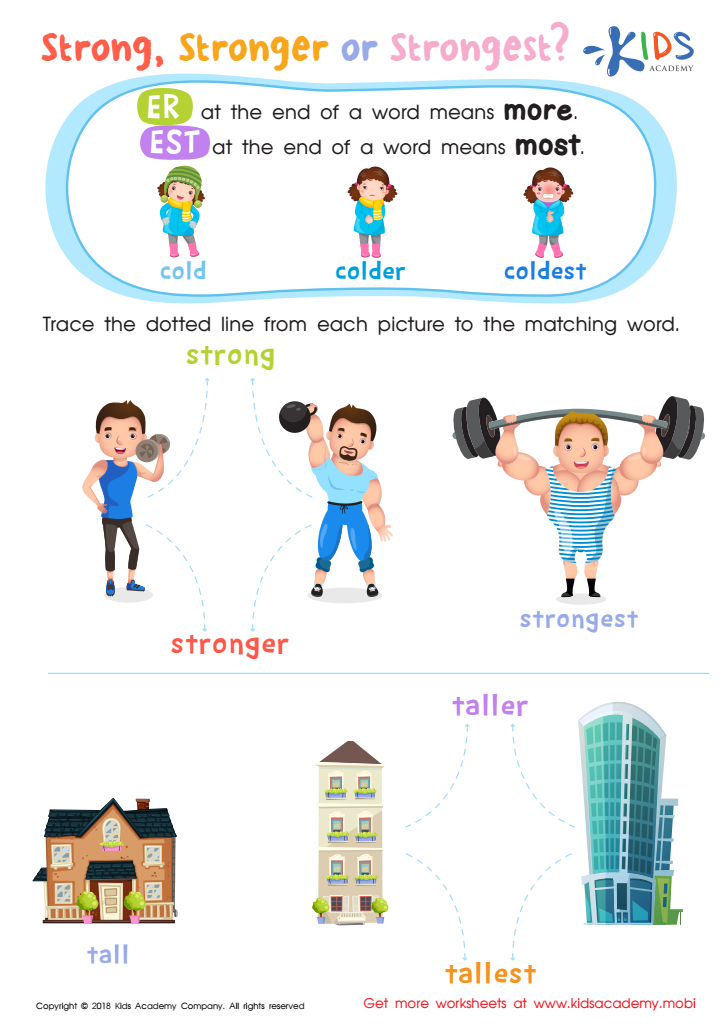
Strong or Stronger? Worksheet
Help your child understand the concept of size gradients with a fun worksheet. Explain to them that adding "-er" to words means "more" and "-est" means "most". Point to the pictures and have your little one trace the dotted line to the corresponding words to learn the concept of highest and lowest.
Strong or Stronger? Worksheet
Worksheet
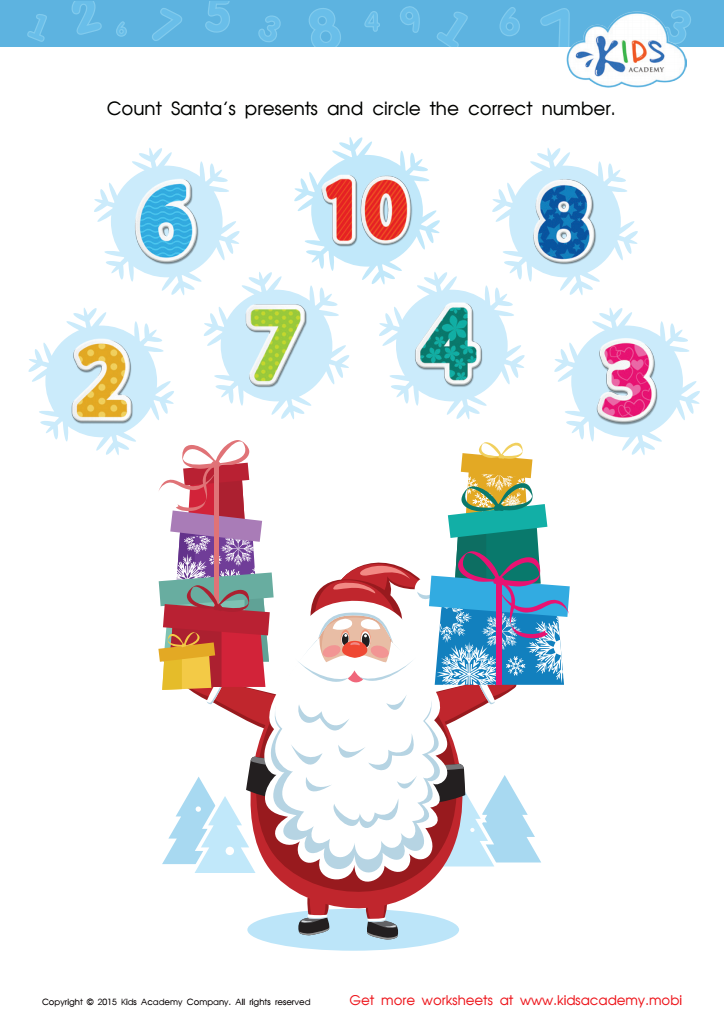
Count Santa's Presents Worksheet
With Kids Academy's free Christmas math worksheet, your kindergartener can help Santa count presents. The worksheet encourages recognizing and counting numbers, fostering the Christmas spirit. Print it out, have fun, and get ready to circle the right number! Get more math printables to learn numbers in a fun way.
Count Santa's Presents Worksheet
Worksheet
Join Kids Academy for Free
Who is primarily going to use this learning content?







Observational skills are crucial for children aged 4-7 as they form the foundation for learning and understanding the world around them. Parents and teachers should prioritize fostering these skills because they enhance cognitive abilities, social-emotional development, and critical thinking.
At this developmental stage, children learn primarily through play and exploration. Strong observational skills help them notice details in their environment, recognize patterns, and make connections between concepts. Engaging in activities that challenge their observational skills can boost their ability to focus and concentrate, vital for future academic success.
Additionally, cultivating observational skills fosters empathy and social interaction. Children who observe and interpret non-verbal cues are better equipped to navigate relationships, leading to improved social skills and cooperation. This becomes especially important as they enter school settings, where collaboration and teamwork are integral.
Encouraging observational skills through simple games and discussions about what they see fosters curiosity and a lifelong love of learning. When parents and teachers work together to nurture these abilities through engaging activities and challenges, they create a supportive environment that prepares children not only for school but also for their future interpersonal relationships and problem-solving tasks. Therefore, enhancing observational skills should be a priority for caregivers and educators alike.








