
Number Matching Extra Challenge Math Worksheets for Ages 4-9
4 filtered results
Difficulty Level
Grade
Age
-
From - To
Subject
Activity
Standards
Unlock your child's mathematical potential with our Number Matching Extra Challenge Math Worksheets, designed specifically for ages 4-9. These engaging worksheets provide the perfect balance of fun and challenge, helping kids to improve their number recognition, counting, and matching skills. Each worksheet is thoughtfully crafted to suit various learning paces, ensuring every child can progress confidently. With exciting, vibrant designs, children will be motivated to solve number puzzles and enhance their math abilities. Start your child's math journey with our Extra Challenge Worksheets and watch as their numerical skills flourish effortlessly!
Favorites
With answer key
Interactive
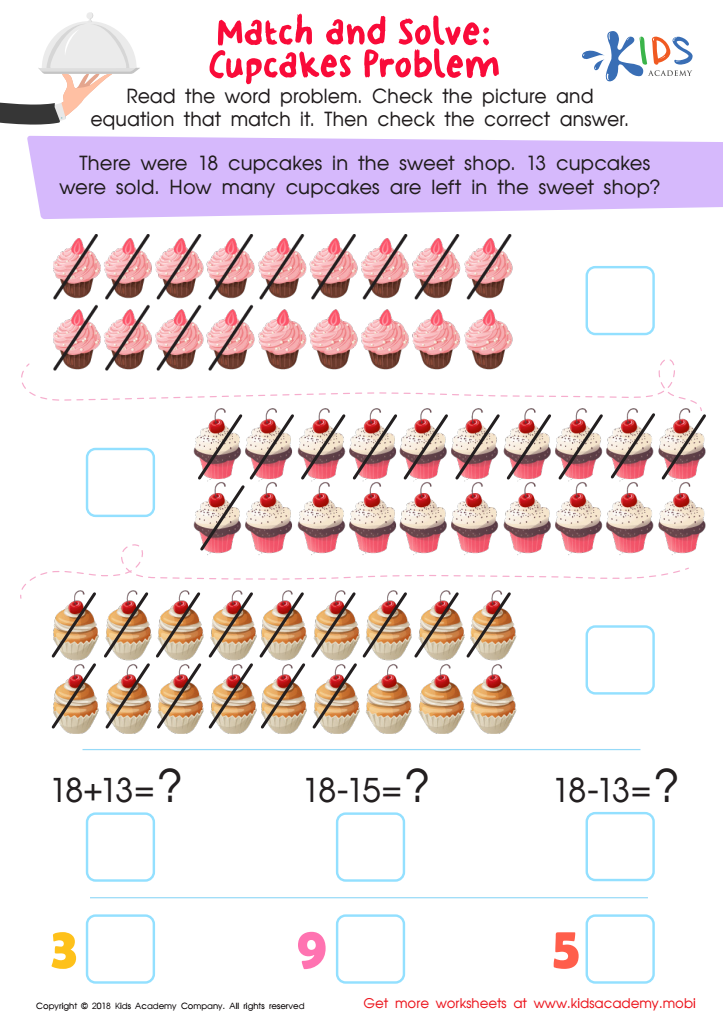
Match and Solve: Cupcakes Problem Worksheet
This math worksheet will excite your kid! Read the word problem and look at the cupcakes; the slashes mean some are being taken away. Select the picture that matches the text, then complete the equation to find the solution!
 Assign to My Students
Match and Solve: Cupcakes Problem Worksheet
Worksheet
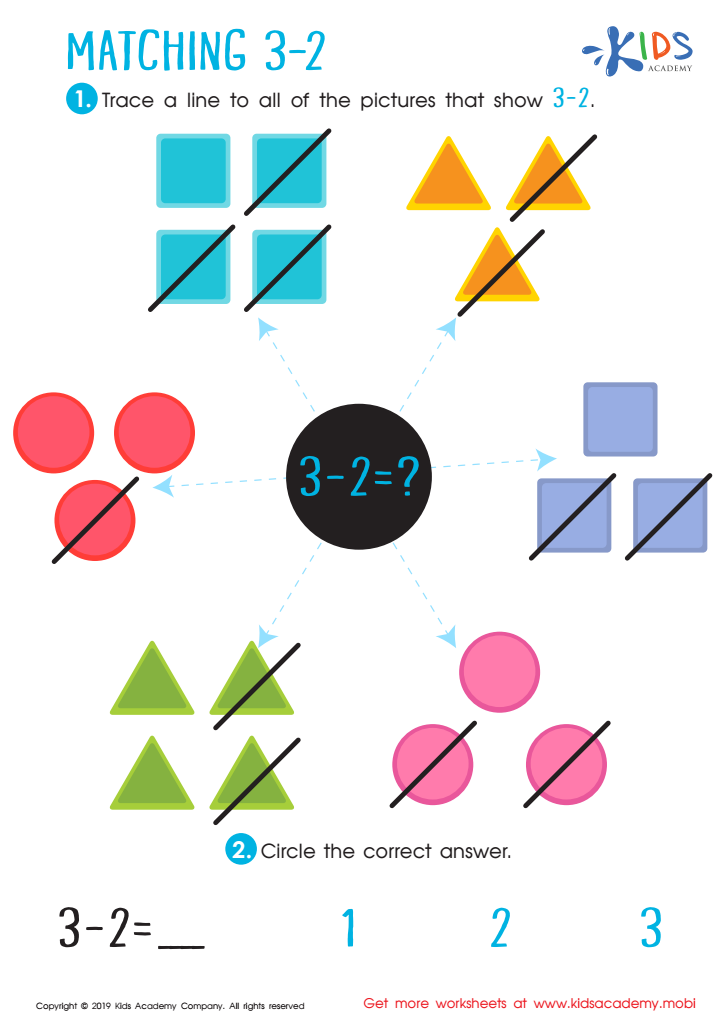
Matching 3-2 Worksheet
Subitizing is the ability to quickly identify sets of items without counting. It's a key skill for young learners to cultivate number sense. This worksheet takes it further, with 3-2=1 number sentences. Look at the sets of counters with slashes to decide which illustrate the sentence. Draw a line from the sentence in the middle to the right images to finish the page!
Matching 3-2 Worksheet
Worksheet
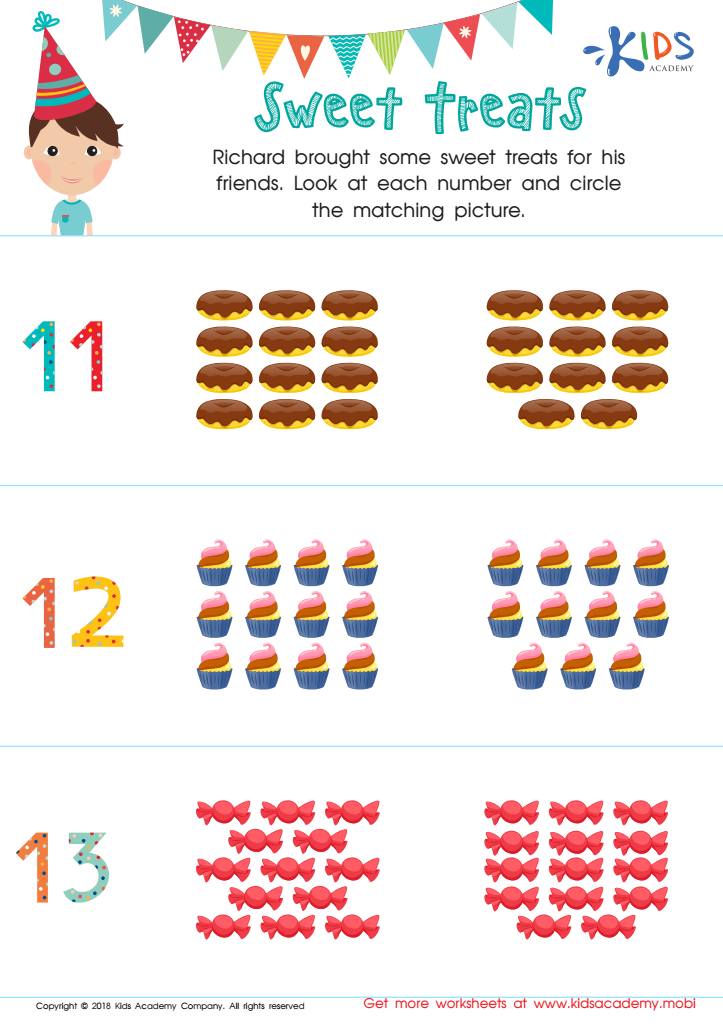
Kindergarten Math Worksheet Matching Numbers
Counting is fun with these kindergarten math worksheets! Richard brought cupcakes and candy - help your child count each treat and circle the picture that matches the number. Let the party begin!
Kindergarten Math Worksheet Matching Numbers
Worksheet
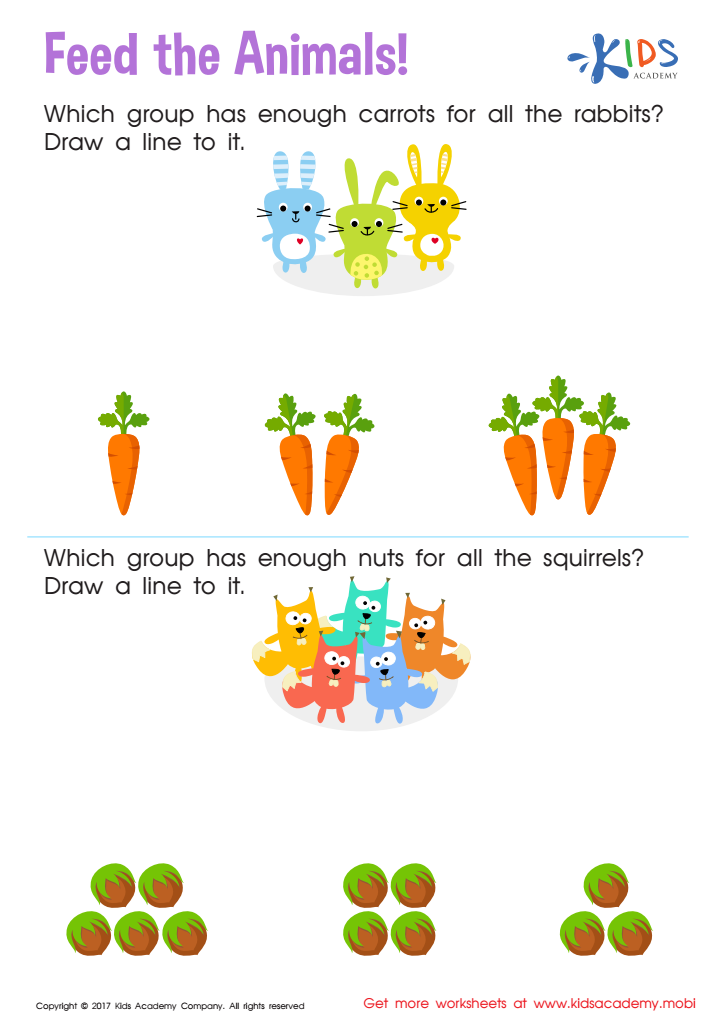
Count and Match: Feed the Animals Worksheet
Learning and growing involves more than just numbers, phonics and comparison. This Feed the Animals worksheet helps kids to exercise their reasoning skills. They must work out how many rabbits and carrots there are, and then repeat the process for the squirrels. This encourages problem solving and counting skills.
Count and Match: Feed the Animals Worksheet
Worksheet
Join Kids Academy for Free
Who is primarily going to use this learning content?








Number Matching Extra Challenge Math for ages 4-9 is essential for developing foundational math skills during the critical early learning years. Both parents and teachers should care about this because it stimulates a child’s cognitive abilities and supports their understanding of numerical concepts, which are vital for more advanced math studies later on.
Firstly, number matching activities enhance children's numerical recognition and counting abilities. Identifying numbers and matching them to quantities helps cement the concept of quantity-number correspondence. This foundational skill is crucial as it underpins more complex operations, such as addition, subtraction, and problem-solving.
Additionally, these activities enhance fine motor skills and hand-eye coordination as children often engage with manipulatives like cards or blocks. The hands-on aspect of number matching makes learning interactive and engaging, keeping children motivated and reducing math anxiety from an early age.
Number matching challenges also promote logical thinking and problem-solving skills. By working through these activities, children learn to follow patterns, develop strategies, and figure out solutions, which translates to better performance in other academic and real-life scenarios.
Finally, these activities foster a positive attitude toward math. By seeing math as a fun and achievable subject, children are more likely to engage with it enthusiastically throughout their educational journey, ensuring strong, sustained academic growth.








