
Understanding currency Extra Challenge Math Worksheets for 4-Year-Olds
3 filtered results
Difficulty Level
Grade
Age
-
From - To
Subject
Activity
Standards
Enhance your child's early math skills with our "Understanding Currency Extra Challenge Math Worksheets" designed specifically for 4-year-olds! These engaging, colorful worksheets introduce young learners to the concepts of money and currency in a fun and interactive way. Through various activities, children will explore coin recognition, counting, and simple transactions, fostering both math skills and financial literacy. Each worksheet is crafted to challenge and captivate, ensuring that your child remains excited about learning. Perfect for at-home practice or classroom use, these worksheets are a valuable resource for early educators seeking to enrich their students' mathematical foundation. Start your child's financial journey today!
Favorites
With answer key
Interactive
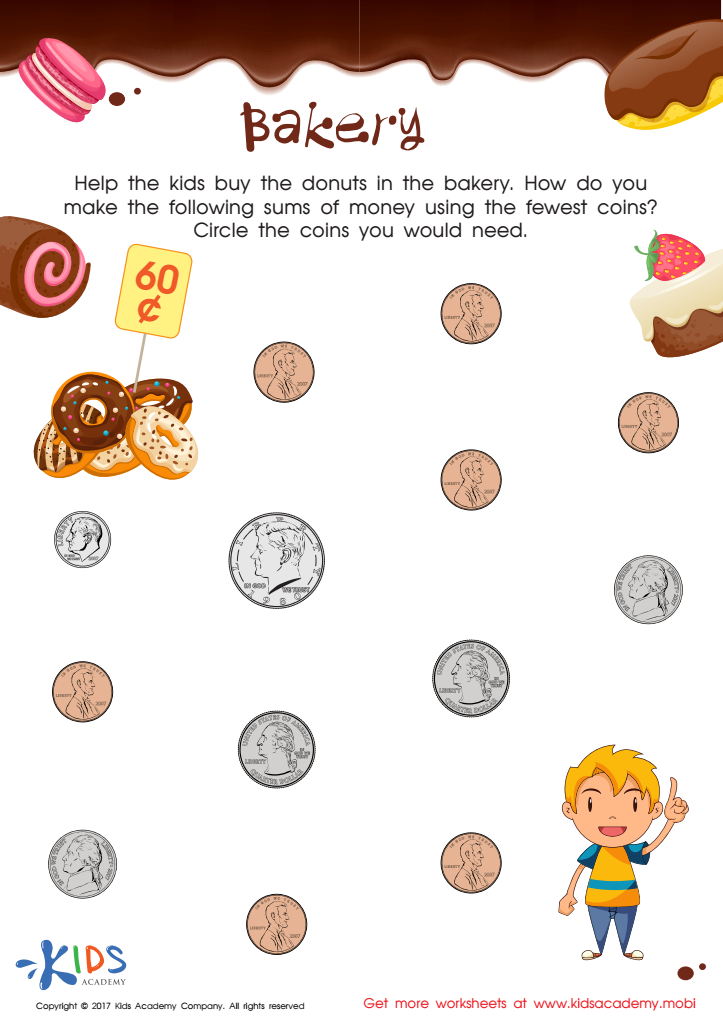
Counting Coins Worksheet
It will challenge them to spend a given amount using the least coins possible. Perfect for 2nd grade.
Help your child learn to count coins with this fun bakery-themed worksheet. It's perfect for 2nd graders and will challenge them to use the least coins possible to spend a set amount. Develop a valuable life skill and have fun while doing it!
 Assign to My Students
Counting Coins Worksheet
Worksheet
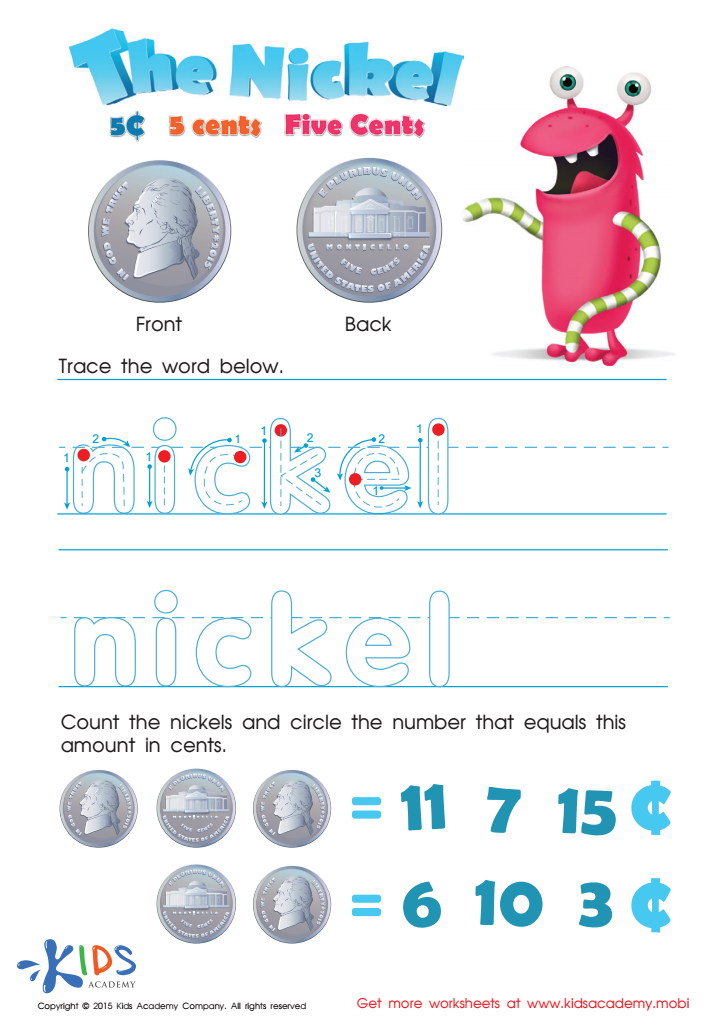
Five Cents or the Nickel Money Worksheet
Counting money games help kids make learning money fun and easy. Next up: the 5 cent coin, or nickel. Look at both sides and remember them. Then, trace the word "nickel" to help you remember. Finally, count the nickels and work out amounts in cents. Let's do this! Kids Academy helps make money learning easy and fun!
Five Cents or the Nickel Money Worksheet
Worksheet
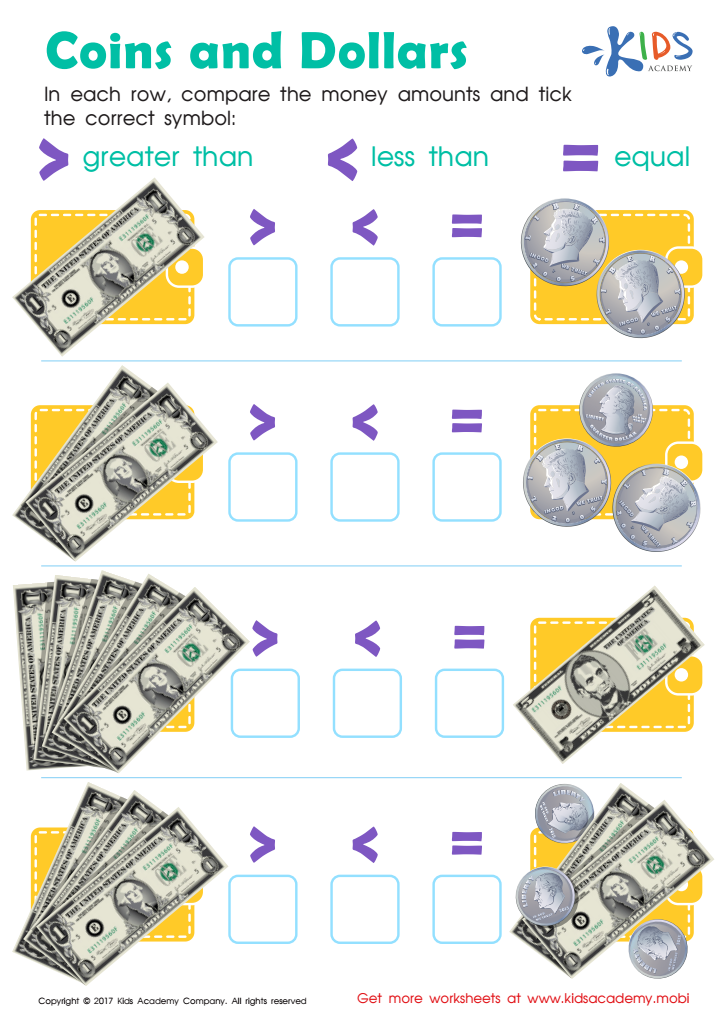
Money: Coins Dollars Printable
Motivate your kid to learn and practise essential math skills, like 'greater than' and 'less than', by introducing the importance of money! The money worksheet "Coins and Dollars" will give them a hands-on experience of counting coins and dollars, making math symbols more memorable.
Money: Coins Dollars Printable
Worksheet
Join Kids Academy for Free
Who is primarily going to use this learning content?







Understanding currency is a foundational math skill that greatly benefits young children, especially at the age of four. At this stage, children are naturally curious about the world around them, and introducing concepts of money early cultivates essential cognitive skills. Engaging them in "Understanding Currency" activities enhances their counting abilities, encourages problem-solving, and introduces basic financial literacy concepts.
For parents and teachers, fostering this understanding is not just about teaching the value of coins and bills; it’s about instilling critical thinking, recognizing patterns, and developing an appreciation for wealth management from an early age. When children participate in age-appropriate activities—such as role-playing shop scenarios or counting and sorting coins—they build a strong mathematical foundation in a playful context.
Moreover, early exposure to currency concepts can create a sense of responsibility and ownership. Children learn to differentiate between needs and wants, promoting social-emotional development. As they progress, these skills will become indispensable in real-life situations, shaping their future financial decision-making.
Incorporating "Understanding Currency" into early education enriches the child’s learning experience, preparing them not only for formal education—where these skills will be expanded—but also for responsible adulthood. Parents and teachers should champion this vital area of math to enrich children's development holistically.








