Understanding plurals Extra Challenge Grammar Worksheets for Ages 5-6
3 filtered results
Difficulty Level
Grade
Age
-
From - To
Subject
Activity
Standards
Introducing "Understanding Plurals Extra Challenge Grammar Worksheets for Ages 5-6" by Kids Academy! These engaging worksheets are designed to help young learners grasp the concept of plurals through dynamic and interactive activities. Perfectly tailored for kindergarteners and first graders, the exercises provide an extra challenge to boost their learning skills. Children will practice identifying and forming plural nouns, enhancing both writing and grammar proficiency. Ideal for classroom use or at-home practice, these worksheets make learning fun and effective. Empower your child’s language development today with these indispensable resources from Kids Academy!
Favorites
With answer key
Interactive
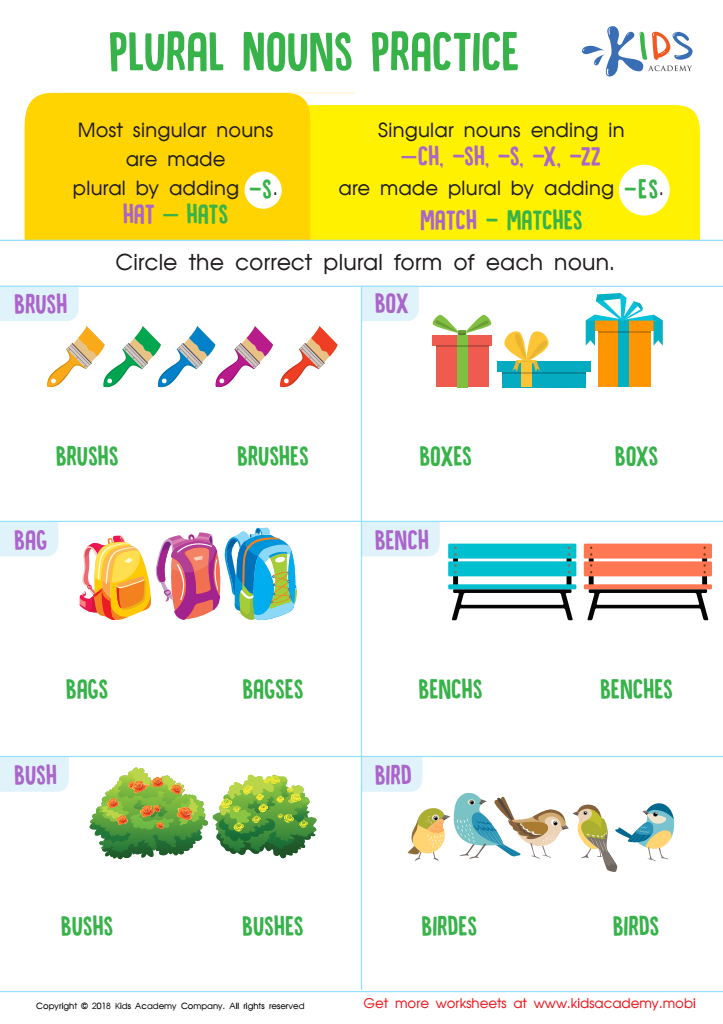
Plural Nouns Practice Worksheet
Explain to your child that most singular nouns become plural by adding "-s". E.g. "cat"->"cats". For words ending in "-ch", "-sh", "-s", "-x", or "-zz", add "-es". E.g. "buzz"->"buzzes". Then, get them to circle the right plural form of each noun on the worksheet.
 Assign to My Students
Plural Nouns Practice Worksheet
Worksheet
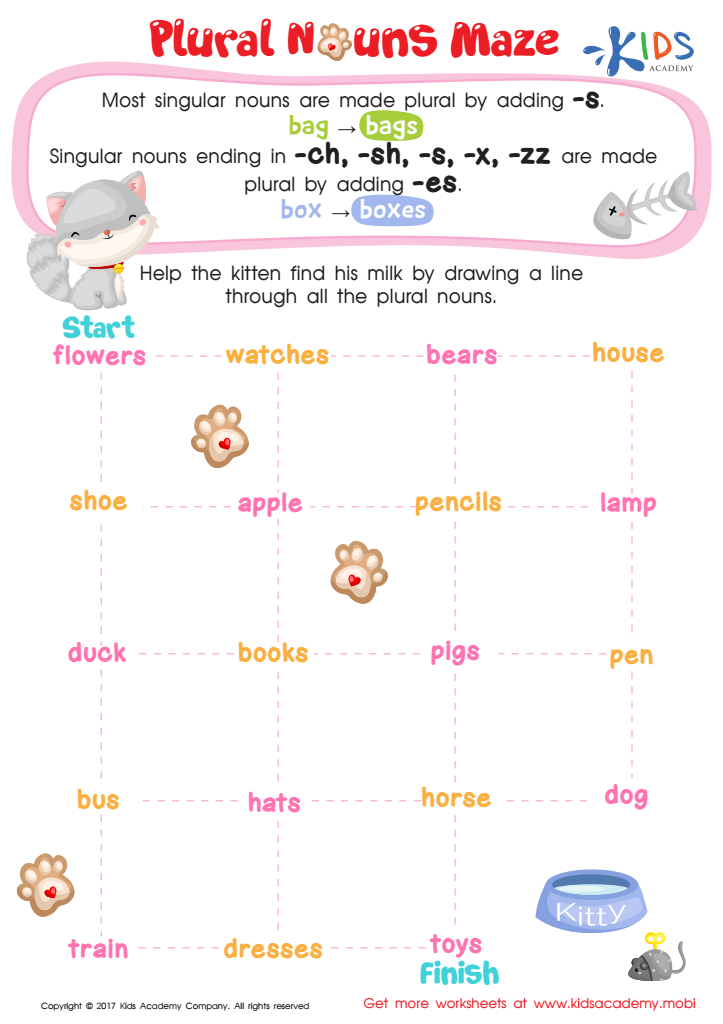
Plural Nouns Maze Worksheet
Oh no, the kitty needs her milk! Help your learner navigate the maze by drawing a line through the plural words. Review the grammar rules on -s and -es endings, then get to work to guide the kitten to her bowl! Download this PDF worksheet to start.
Plural Nouns Maze Worksheet
Worksheet
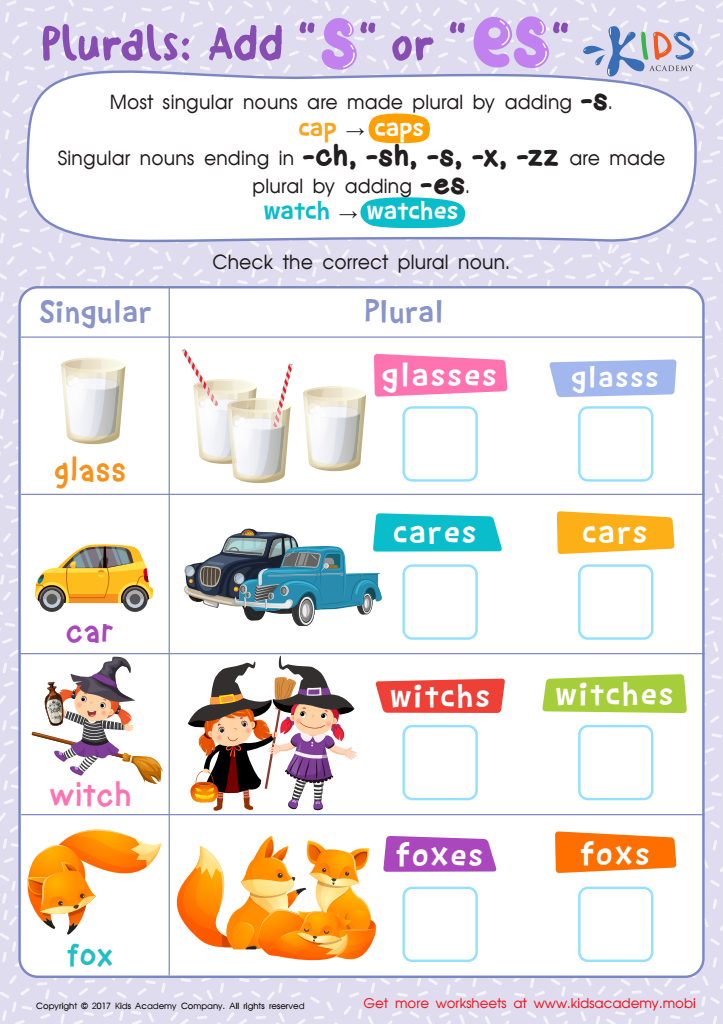
Plurals: "–es" or "–es"? Worksheet
Learning plural nouns can be tough for young readers. This worksheet shows them the difference between singular and plural spelling with cute images. Read each word and check the correct version. Remind them why the other ending can't be used.
Plurals: "–es" or "–es"? Worksheet
Worksheet
Join Kids Academy for Free
Who is primarily going to use this learning content?






Understanding plurals is a fundamental aspect of grammar that is crucial for children ages 5-6 as they develop their language skills. For parents and teachers, investing time in teaching this concept can yield significant long-term benefits.
Firstly, learning plurals helps children navigate and describe the world accurately. If a child knows how to use plurals correctly—such as "one cat" versus "two cats"—it enhances their ability to communicate effectively and be understood by others.
Secondly, mastering plurals aids in reading comprehension. When children encounter new words in plural forms, knowing the rules helps them decipher meaning and context more easily. This can lead to a smoother and richer reading experience, which is essential at this critical stage of learning to read.
Moreover, understanding plurals builds a strong foundation for more advanced grammar concepts. As children progress, they will encounter more complex sentence structures that require a grasp of singular and plural forms. Early mastery of plurals will assist in making these later lessons less challenging.
Finally, the extra challenge of understanding exceptions and irregular plurals—like "mice" instead of "mouses"—encourages critical thinking and problem-solving skills. These cognitive skills are invaluable across all areas of learning.
In summary, caring about understanding plurals at an early age equips children with the communication, reading, and cognitive skills required for ongoing academic success.