Basic Math Skills Extra Challenge Fractions of Shapes Worksheets for Ages 5-7
3 filtered results
Difficulty Level
Grade
Age
-
From - To
Subject
Activity
Standards
Enhance your child's understanding of fractions with our "Basic Math Skills Extra Challenge Fractions of Shapes Worksheets" designed for ages 5-7. These engaging and interactive worksheets focus on introducing young learners to the concept of fractions through visual representation of shapes. With colorful illustrations and clear instructions, children will explore various ways to identify and compare fractions, promoting critical thinking and problem-solving skills. Ideal for classroom use or home learning, these worksheets serve as an exciting challenge to reinforce foundational math skills while fostering a love for learning. Get started today and watch your child thrive in math!
Favorites
With answer key
Interactive
Pizza Party Equal Parts Worksheet
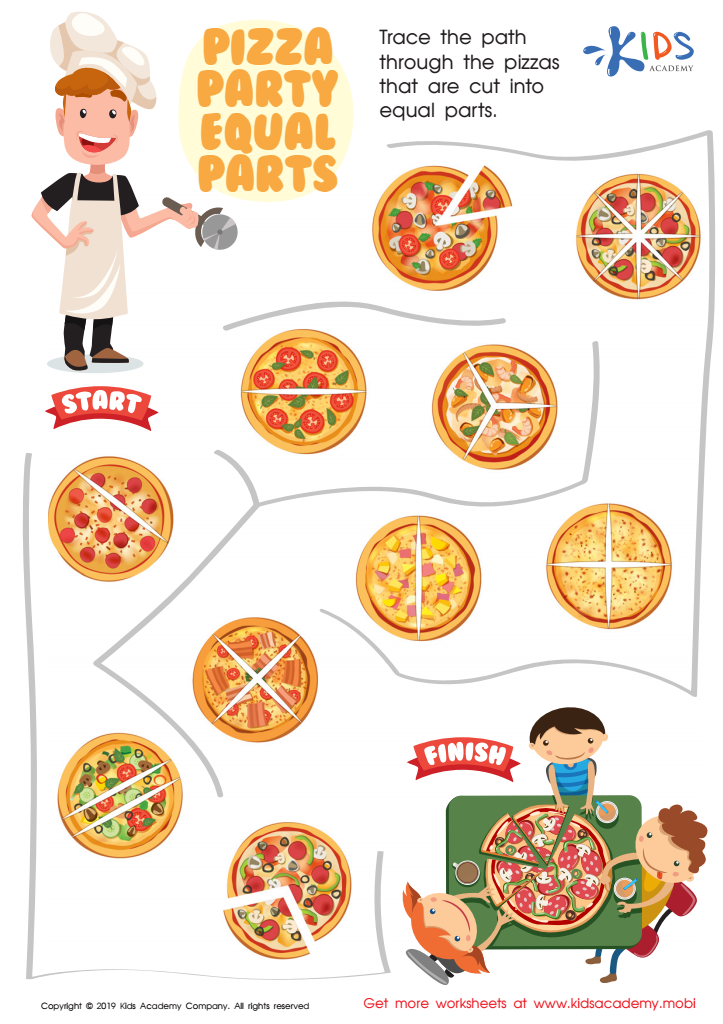
Love pizza? This printout is a great way to help kids learn about equal parts! Kids must identify pizzas cut into equal parts, then trace the path through the pizzas. It's an exciting maze - and a great way to help kids learn! Get the traceable pdf today and let the fun begin!
 Assign to My Students
Pizza Party Equal Parts Worksheet
Worksheet
Tire Thirds and Fourths Worksheet
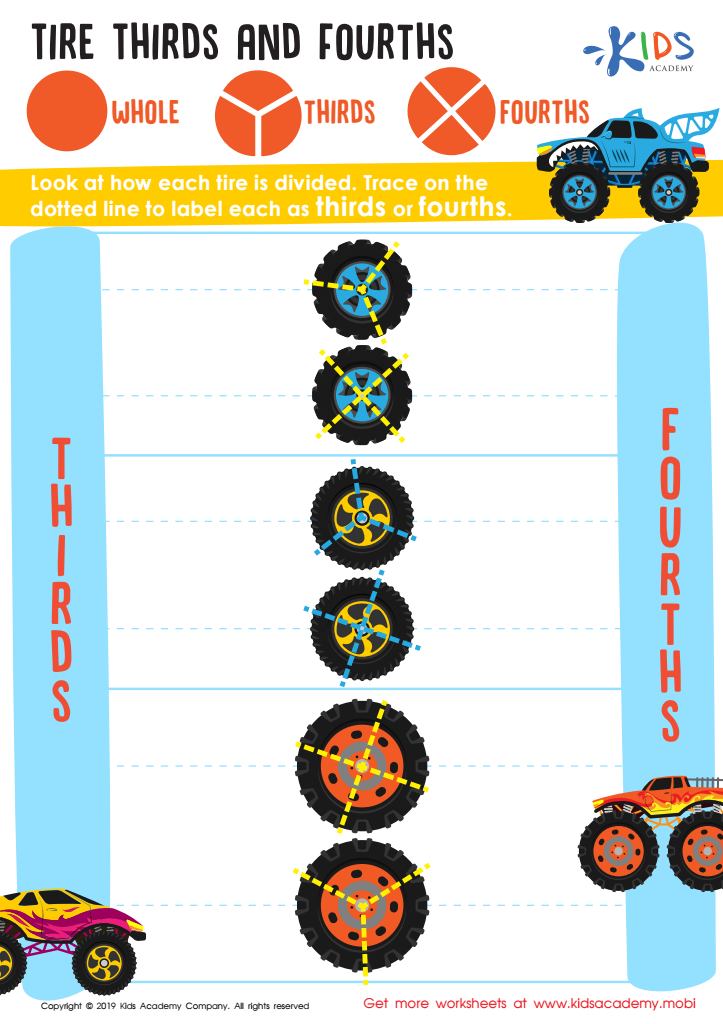
Learning geometry is key in your child's education. Have them identify and name shapes cut into 2, 3 and 4 parts. Test their knowledge with this worksheet - trace the dotted line to label each as third or fourth. Encourage them to keep learning!
Tire Thirds and Fourths Worksheet
Worksheet
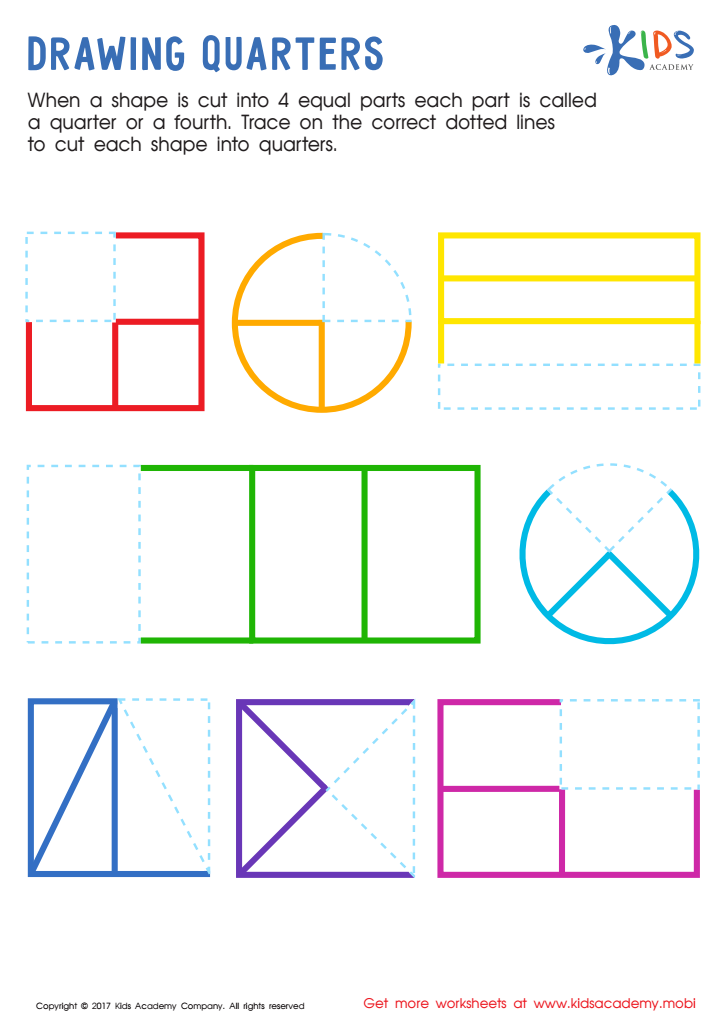
Drawing Quarters Worksheet
Help your kids divide shapes into quarters! Have them trace dotted lines to cut each shape into 4 equal parts. Each of the 4 parts is called a quarter or a fourth. This worksheet will help kids learn more about dividing shapes into four equal parts.
Drawing Quarters Worksheet
Worksheet
Join Kids Academy for Free
Who is primarily going to use this learning content?








Parents and teachers should prioritize the development of basic math skills, particularly in fractions for children aged 5-7, as this foundational knowledge has lasting implications for mathematical understanding. Introducing fractions through the manipulation of shapes helps young learners grasp abstract concepts in a tangible way, making math more relatable and less intimidating.
Understanding fractions enhances a child's ability to make sense of divided parts, sharing, and comparing quantities, which are essential life skills. For example, a child can learn how to share a pizza fairly or understand portions in cooking and baking. Moreover, engaging with fractions of shapes nurtures critical thinking and problem-solving skills, encouraging children to visualize and conceptualize math in their everyday experiences.
At an age where curiosity is high, offering extra challenges in fractions can stimulate interest and motivation in mathematics; with hands-on activities and visual representations, children are more likely to stay engaged. By emphasizing these essential skills now, parents and teachers set the stage for future success in more advanced math topics, creating a strong academic foundation that supports lifelong learning and confidence in mathematical competence. Overall, the development of basic math skills in young children is crucial for their cognitive and social development.