
Listening skills Extra Challenge Worksheets for Ages 5-8
3 filtered results
Difficulty Level
Grade
Age
-
From - To
Subject
Activity
Standards
Enhance your child's auditory abilities with our "Listening Skills Extra Challenge Worksheets for Ages 5-8." These engaging worksheets are designed to sharpen listening skills through fun, interactive activities. Suitable for kids aged 5-8, each worksheet aims to improve comprehension, attention to detail, and the ability to follow directions. By integrating playful tasks and colorful illustrations, learning becomes an enjoyable experience, promoting active participation and focused listening. Ideal for use in classrooms or at home, our worksheets provide an excellent resource for parents and educators looking to boost early learning and communication skills. Explore now for better hearing and understanding!
Favorites
With answer key
Interactive
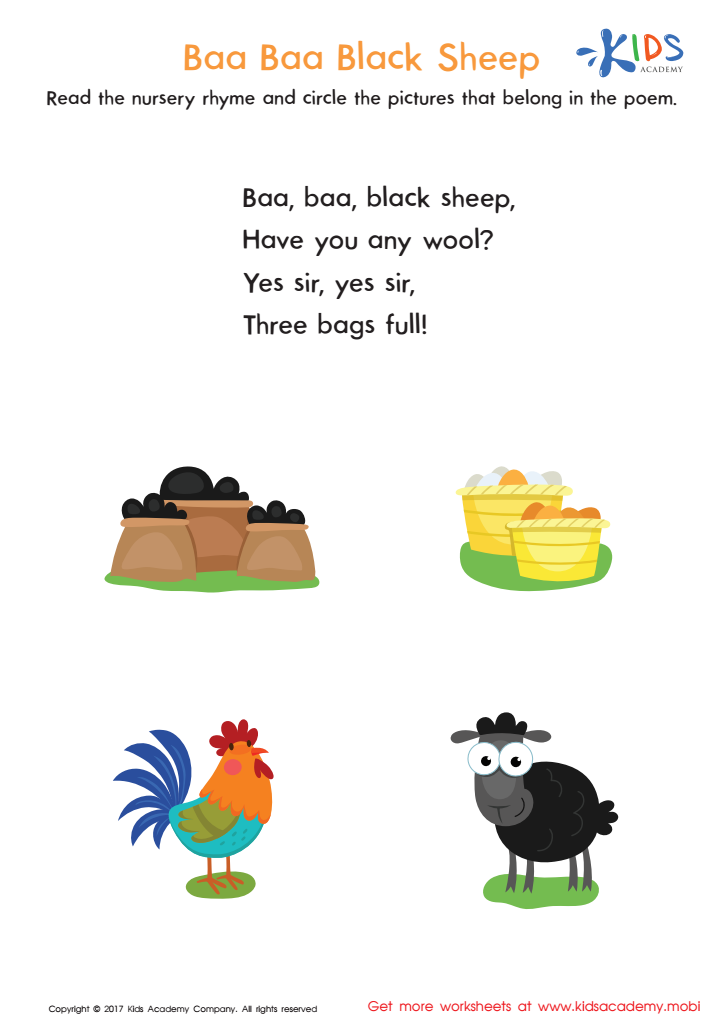
Baa Baa Black Sheep Printable
Jumpstart your child's reading skills with this printable Baa Baa Black Sheep worksheet! Recite the lines with them, then have them select the pictures associated with the poem to test comprehension. Fun and educational!
 Assign to My Students
Baa Baa Black Sheep Printable
Worksheet
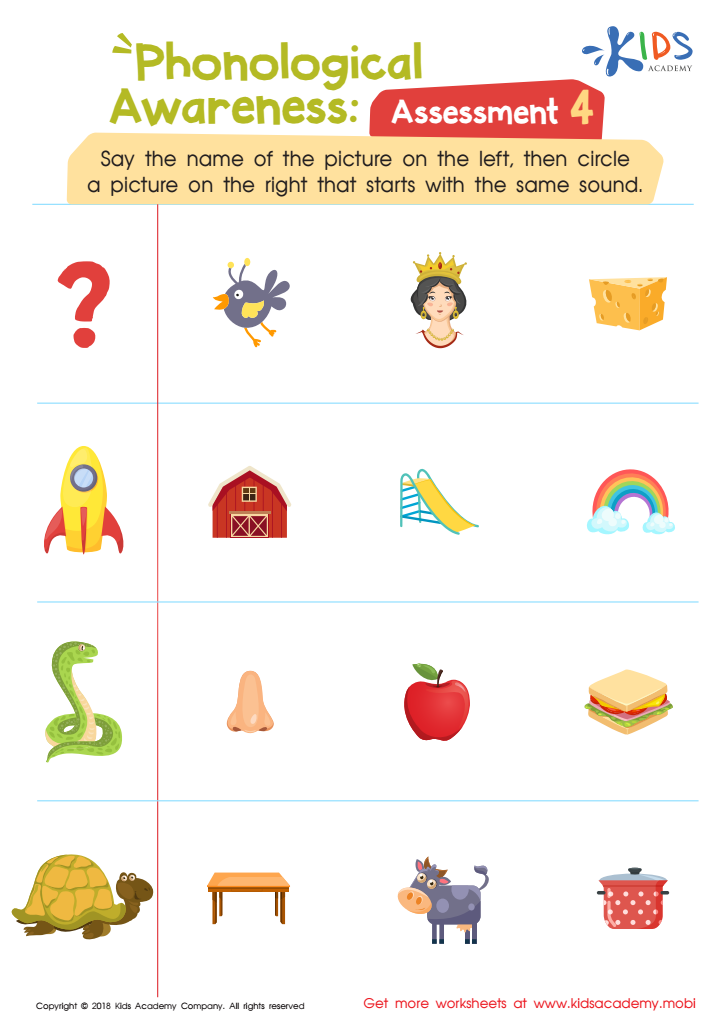
Phonological Awareness: Assessment 4 Worksheet
It can be tricky for young readers to differentiate between sounds in words. Make it fun with this downloadable worksheet! Ask your child to name each picture on the left and match the starting sound with an image on the right. This helps assess their phonics skills and make learning enjoyable.
Phonological Awareness: Assessment 4 Worksheet
Worksheet
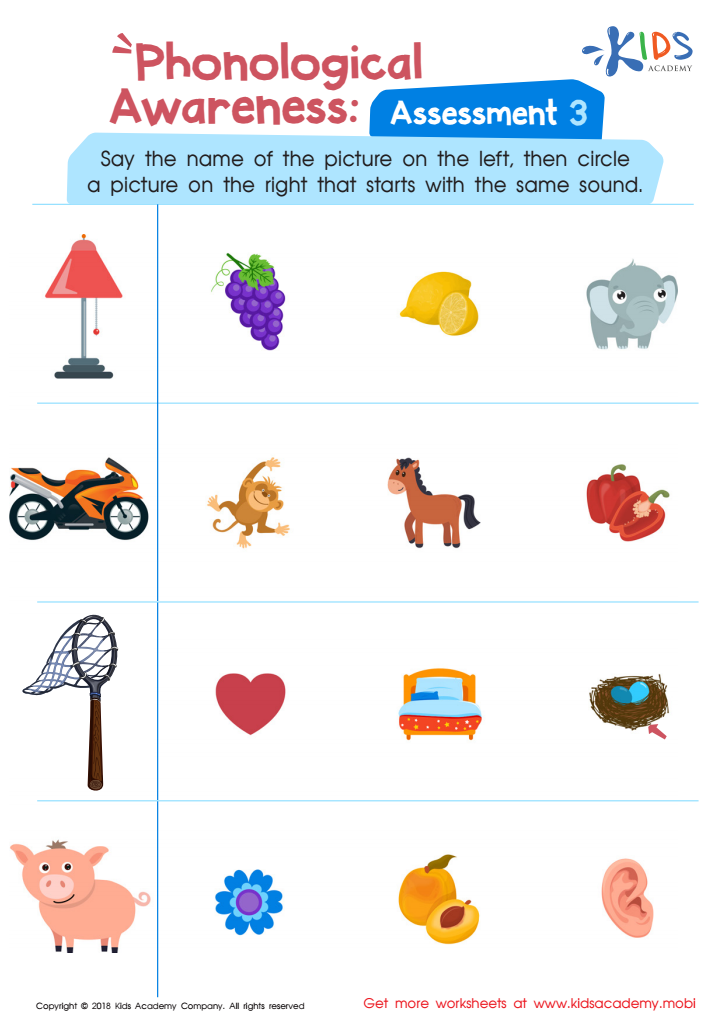
Phonological Awareness: Assessment 3 Worksheet
Test kids' reading readiness with a phonological awareness worksheet! With this PDF exercise, encourage children to name each picture aloud and match left to right. Help them learn to recognize word sounds at the start, middle and end of words. They'll be sure to remember that lamp doesn't sound like elephant!
Phonological Awareness: Assessment 3 Worksheet
Worksheet
Join Kids Academy for Free
Who is primarily going to use this learning content?







Listening skills are crucial for young children's development, forming the foundation for future learning and social interaction. For ages 5-8, honing these skills is particularly significant because this is a formative period when children are transitioning from early to more complex forms of communication and learning.
When parents and teachers emphasize listening skills through extra challenges, they are helping children enhance comprehension and retention. Active listening enables children to follow instructions accurately, understand stories, and participate meaningfully in discussions, which are all vital for effective learning in school.
Furthermore, good listening skills are essential for building strong relationships. By listening carefully, children learn to respond appropriately to others' emotions and viewpoints, fostering empathy and social coordination. This ability to empathize ultimately leads to better cooperation and fewer conflicts with peers.
Through listening challenges, children also develop critical thinking as they interpret and analyze information. These activities bolster attention spans and patience, encouraging children to focus and think before responding—skills that are beneficial for academic success.
In essence, focusing on listening skills for ages 5-8 is not merely about hearing words but cultivating a robust foundation for lifelong learning, effective communication, and emotional intelligence. Therefore, parents and teachers should prioritize this developmental aspect to support children's holistic growth.








