Spatial awareness Extra Challenge 2D Shapes Worksheets for Ages 5-8
3 filtered results
Difficulty Level
Grade
Age
-
From - To
Subject
Activity
Standards
Enhance your child's spatial awareness with our Extra Challenge 2D Shapes Worksheets, designed for children ages 5-8. These engaging and educational worksheets help kids recognize, compare, and analyze 2D shapes, fostering crucial geometry skills. With a variety of activities, including shape sorting, matching, and pattern creation, young learners will improve their visual-spatial reasoning in a fun and interactive way. Our carefully crafted worksheets not only keep children challenged but also make learning enjoyable and effective. Boost your child's confidence in math and shape recognition by incorporating these expertly designed worksheets into their daily learning routine.
Favorites
With answer key
Interactive
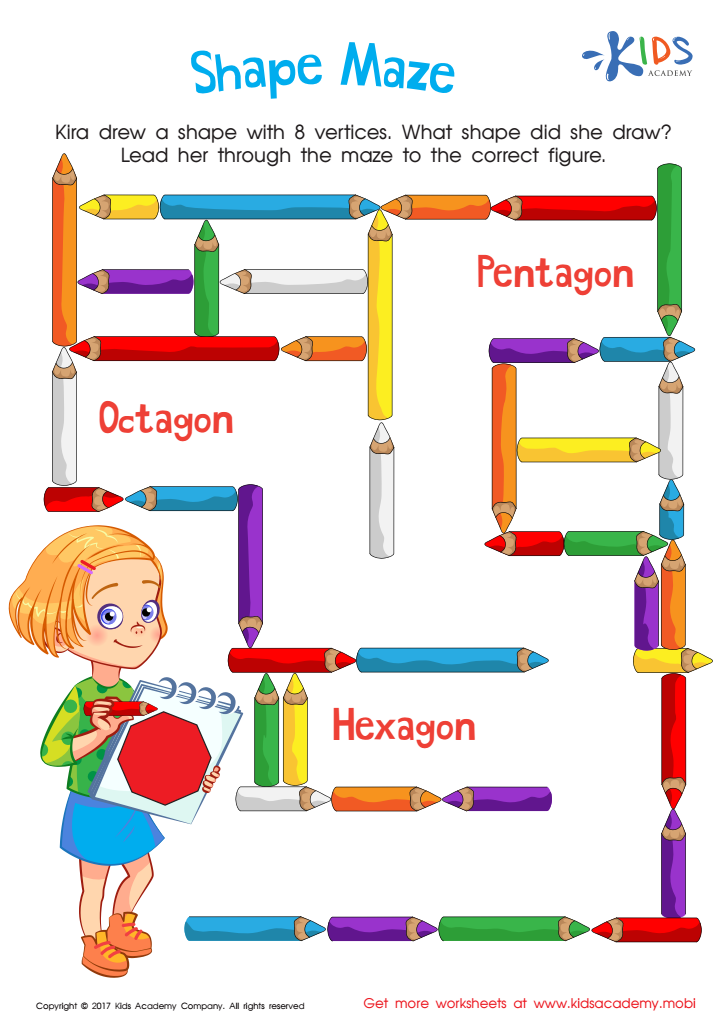
Shape Maze Worksheet
Test your child's geometry knowledge with this fun printable maze! They'll need to identify shapes with 8 vertices to find their way through the maze and get the correct answer.
 Assign to My Students
Shape Maze Worksheet
Worksheet


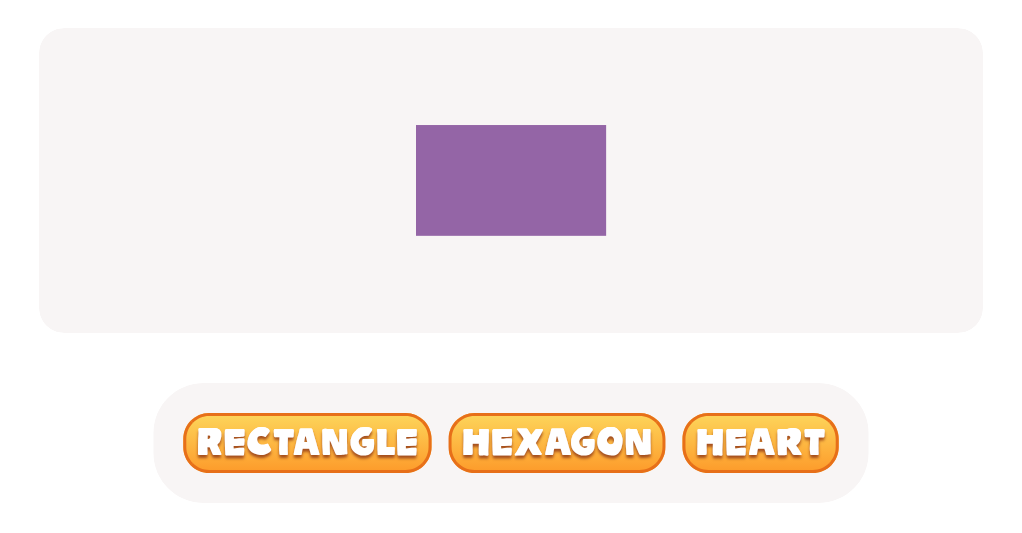
Congruent Shapes Worksheet
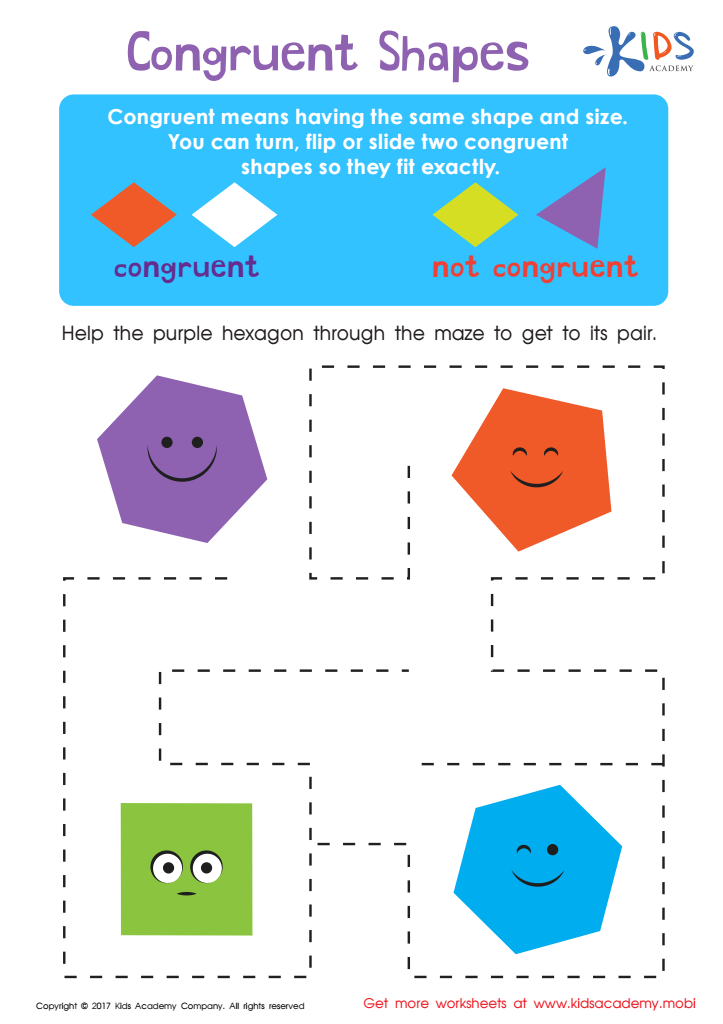
Help your child find the twin of the purple hexagon! This congruent shapes worksheet is great for increasing vocabulary while challenging mental rotation skills.
Congruent Shapes Worksheet
Worksheet
2D and 3D Shapes Worksheet
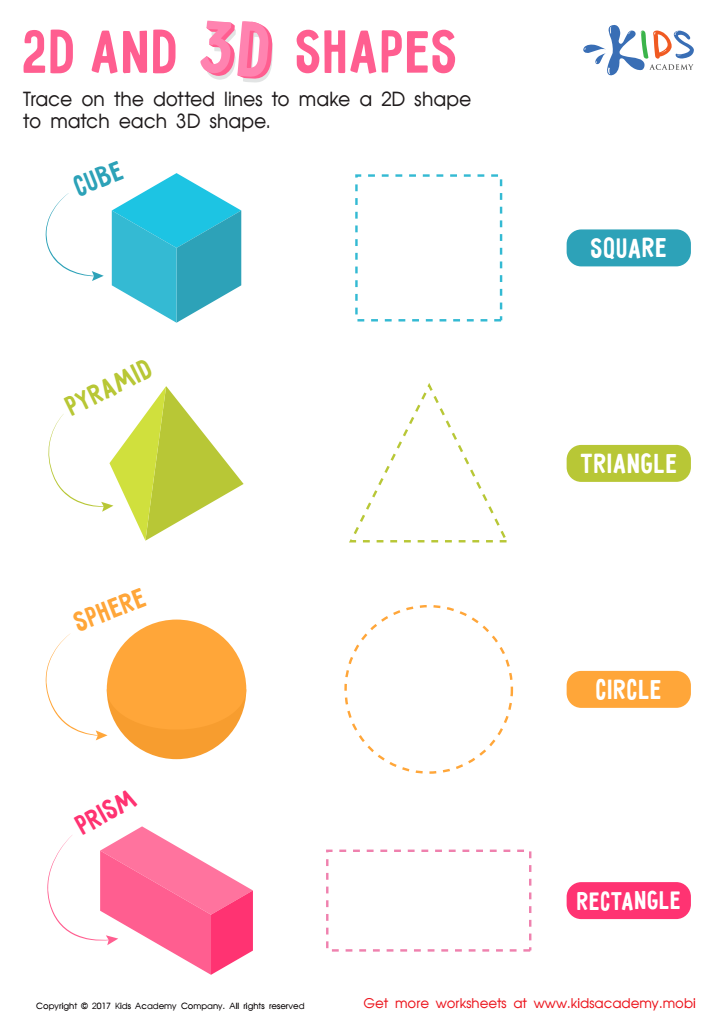
Introduce your child to 3D and 2D with this traceable worksheet. With dotted lines, help them trace and make a 2D shape for each 3D shape: square, triangle, rectangle, and circle. Show them there's more than one way to draw! You may have taken them to a 3D movie, or they've seen some fantastic 3D art. Now they can wonder no more.
2D and 3D Shapes Worksheet
Worksheet
Join Kids Academy for Free
Who is primarily going to use this learning content?








Spatial awareness and familiarity with 2D shapes for children ages 5 to 8 are foundational skills that impact various aspects of their development. One reason parents and teachers should care about spatial awareness exercises is that they significantly contribute to a child’s cognitive development. These activities enhance the brain's ability to understand and remember the locations and positions of objects, a key aspect of learning math and science concepts in later grades.
Moreover, interacting with 2D shapes helps children develop critical problem-solving skills. By manipulating shapes to fit them together or recognize patterns, children learn to think strategically and make decisions. These experiences lay a groundwork for geometry, which they will encounter in more complexity as they advance in their education.
Particularly for young children, engaging with 2D shapes also refines motor skills. Cutting out shapes, drawing them, or building with shape blocks improves their ability to perform tasks requiring hand-eye coordination and fine motor control, which are essential for writing and other daily activities.
Finally, spatial awareness and 2D shape recognition encourage creativity. Children often create pictures, structures, and stories using shapes, which nurtures their imagination and artistic skills. Therefore, fostering these skills through extra challenges is not only academically beneficial but also imperative for holistic child development.