
Counting practice Extra Challenge Money Worksheets for Ages 6-7
4 filtered results
Difficulty Level
Grade
Age
-
From - To
Subject
Activity
Standards
Boost your child's counting and money management skills with our Counting Practice Extra Challenge Money Worksheets for Ages 6-7! Designed to provide an exciting challenge, these worksheets help young learners identify coins and bills while practicing their addition and subtraction skills. With engaging exercises and vibrant illustrations, children will enjoy hours of educational fun. Ideal for parents and teachers alike, our worksheets aim to enhance mathematical confidence and real-life financial understanding. Perfect for classroom use or at-home practice, these resources provide a solid foundation in math while making learning enjoyable for kids ages 6 to 7.
Favorites
With answer key
Interactive
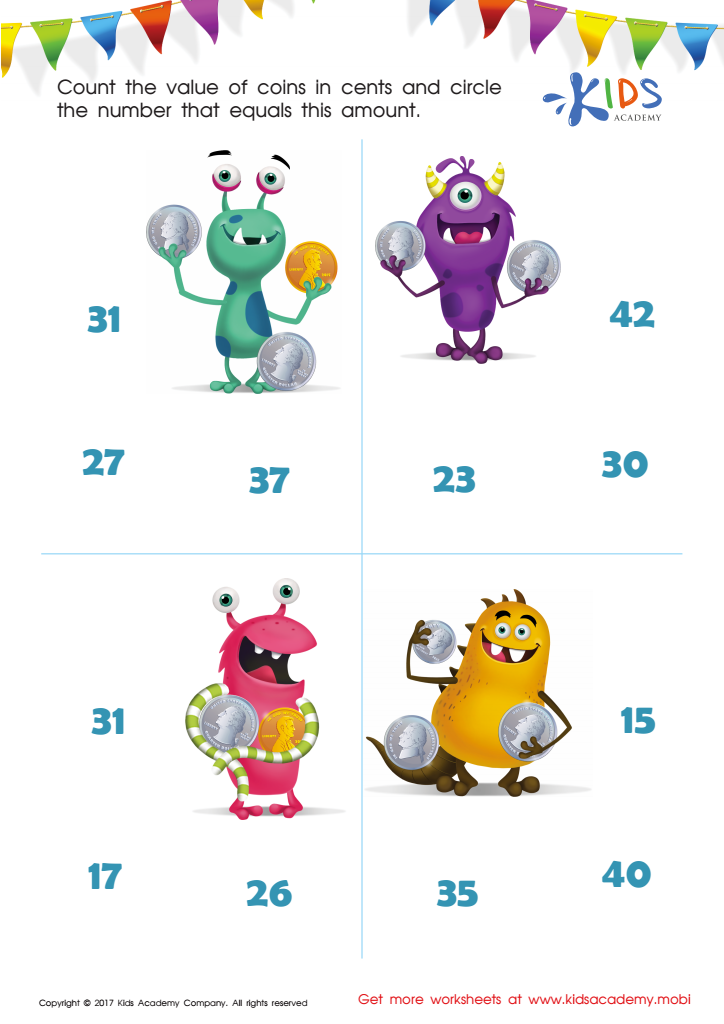
How Many Coins Money Worksheet
Have fun while counting coins: look at the monsters and count the coins in their hands. Challenge your little learners to count and write down the number of coins each one has. Enjoy the time together!
 Assign to My Students
How Many Coins Money Worksheet
Worksheet
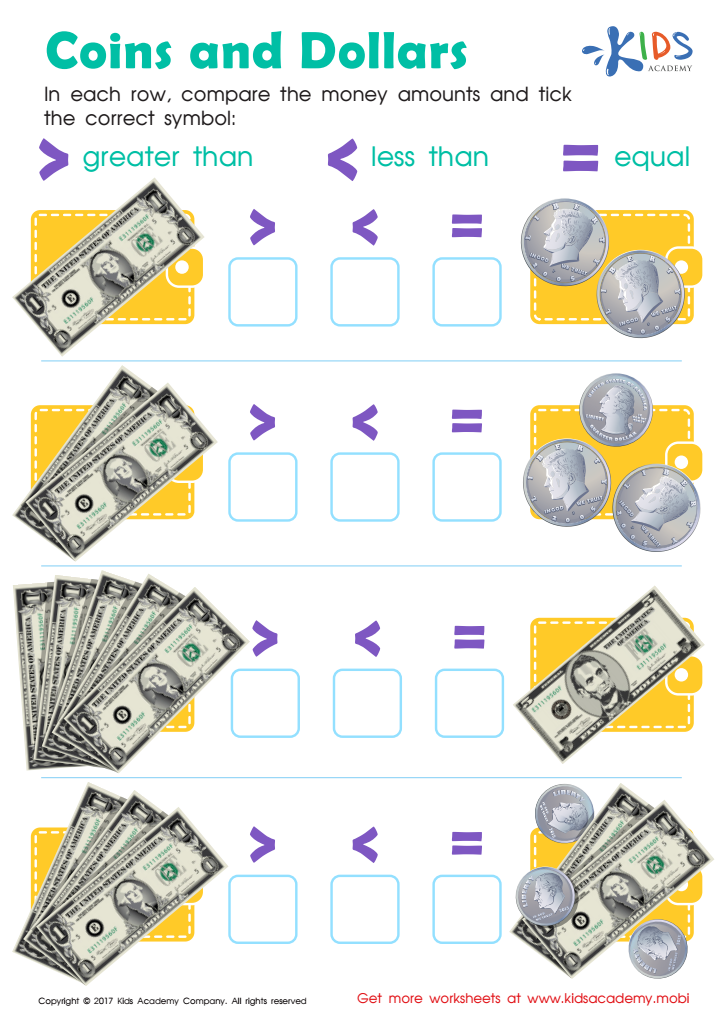
Money: Coins Dollars Printable
Motivate your kid to learn and practise essential math skills, like 'greater than' and 'less than', by introducing the importance of money! The money worksheet "Coins and Dollars" will give them a hands-on experience of counting coins and dollars, making math symbols more memorable.
Money: Coins Dollars Printable
Worksheet
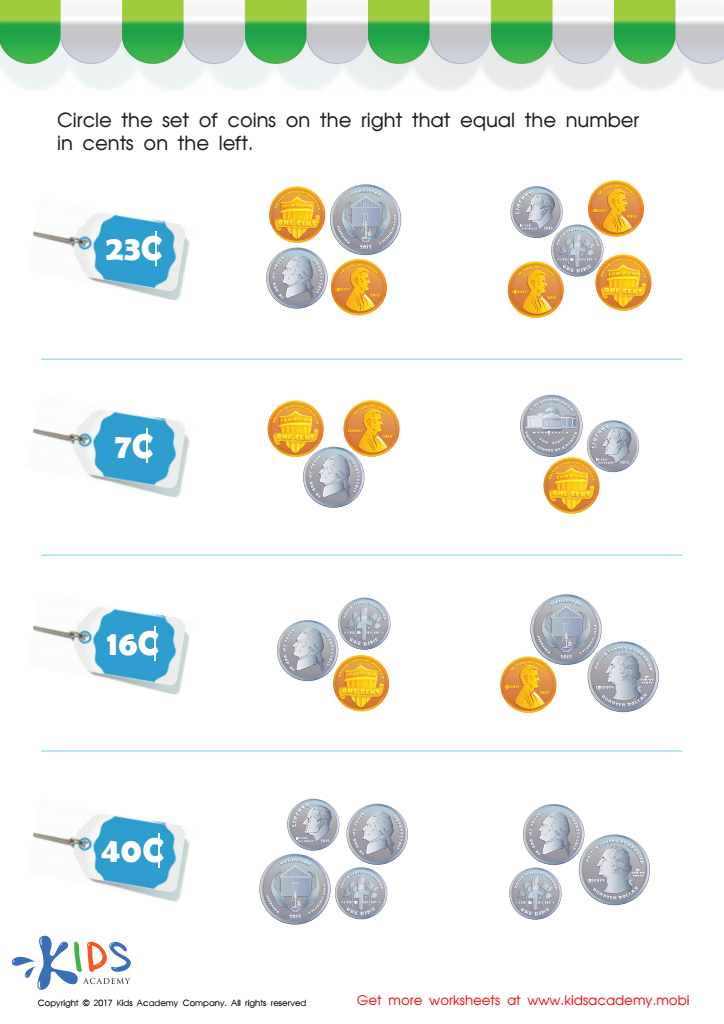
Picking the Coins You Need Money Worksheet
Let's learn to count money with Parents and Kids Academy! Investigate a real shop together: buy a globe, pencils, books, and a school bag using coins. Then, circle the coins you'll need. Visit our website for more free and fun money games for kids!
Picking the Coins You Need Money Worksheet
Worksheet
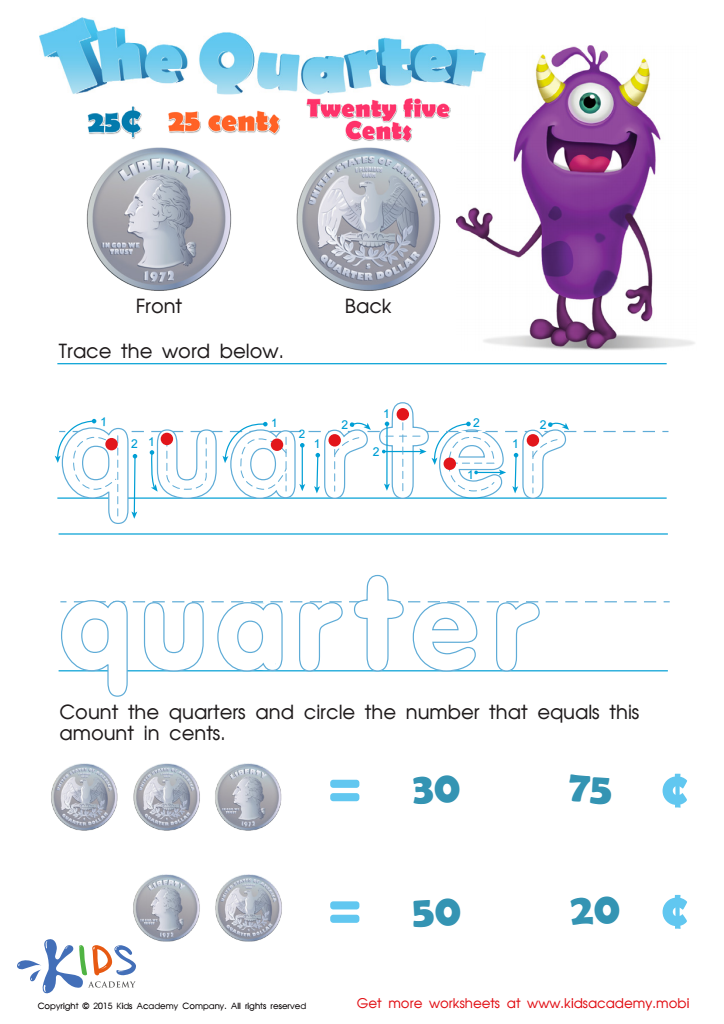
Twenty Five Cents or the Quarter Money Worksheet
Check out our new printable money games - learn to count money easily! With quarters, trace the word, count them and calculate the amount in cents. More worksheets at our website. Give it a try!
Twenty Five Cents or the Quarter Money Worksheet
Worksheet
Join Kids Academy for Free
Who is primarily going to use this learning content?








Counting practice, especially involving money, is crucial for children aged 6-7. At this foundational age, kids are beginning to understand numerical relationships and the concept of value. Engaging them with an "Extra Challenge Money" routine sharpens their counting skills and introduces them to real-world applications of math.
First, counting money helps solidify basic arithmetic skills such as addition and subtraction. When children handle actual coins and bills, they can visualize the transaction process, making abstract concepts more tangible and fostering cognitive development.
Second, understanding money instills essential life skills early on. As kids learn to count and manage money, they gain insights into financial literacy - a cornerstone for responsible future behavior. They start to grasp the value of saving and spending wisely, which are critical for their personal development.
Furthermore, incorporating money into counting practice can enhance problem-solving skills. For example, tasks that require making change or budgeting for a small "purchase" pose more complex challenges than simple counting, encouraging kids to think critically and make decisions.
Parents and teachers play vital roles in ensuring children develop these critical skills. An early start with counting money sets a robust foundation for academic success and practical life skills, promoting confidence and competence in mathematical scenarios that children will encounter throughout their lives.








