Counting skills Extra Challenge Money Worksheets for Ages 6-7
3 filtered results
-
From - To
Our "Counting Skills Extra Challenge Money Worksheets" are designed for children ages 6-7 to master essential counting and money skills. These engaging activities provide an extra challenge, helping kids confidently identify, count, and manage money through fun, interactive exercises. A perfect blend of math practice and real-world application, these worksheets aim at enhancing their numerical literacy. Tailored to support early learning standards, the vibrant format maintains motivation and interest. Empower your child's financial understanding and mathematical confidence with these expertly crafted resources. Suitable for classroom use or at-home learning, ensuring continuous development in counting abilities.
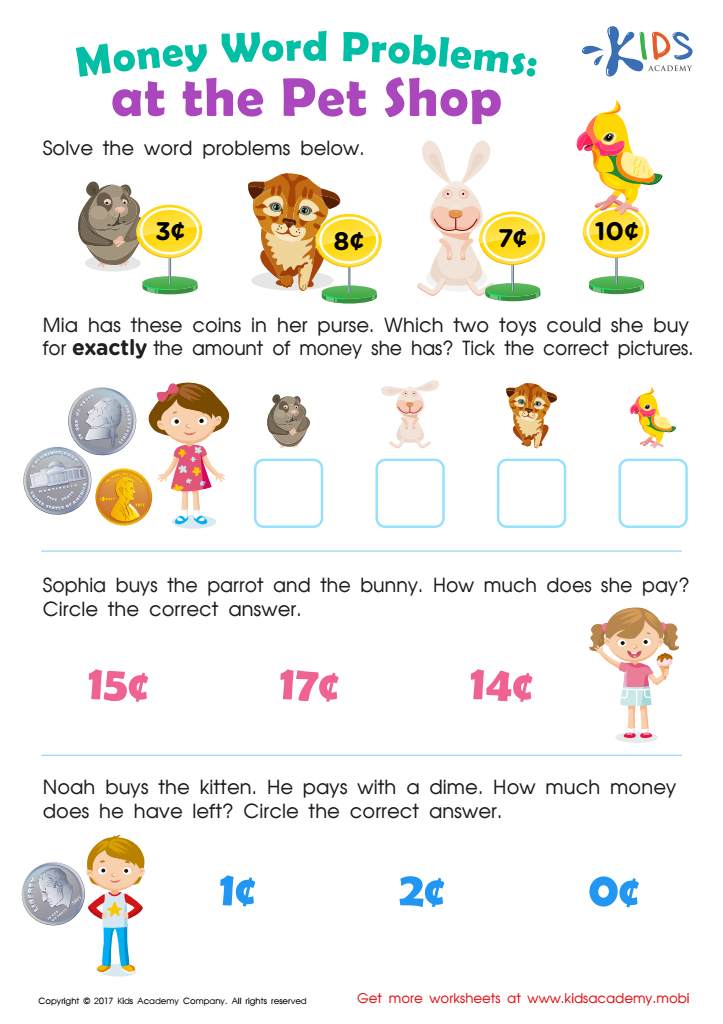
Pet Shop Worksheet
 Assign to My Students
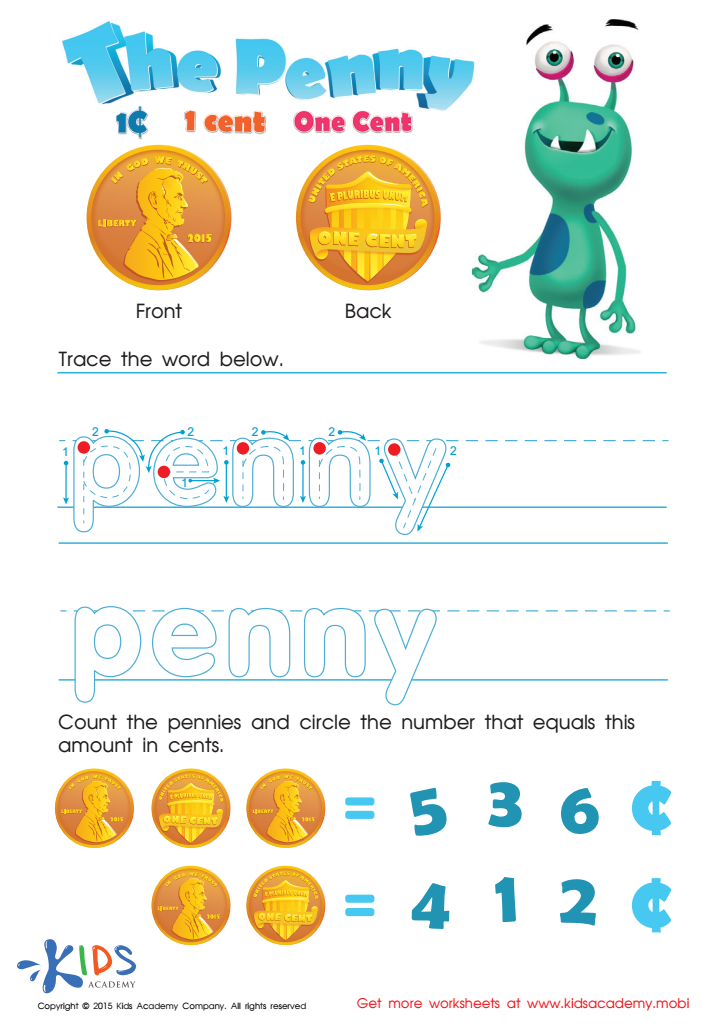
One Cent or the Penny Money Worksheet
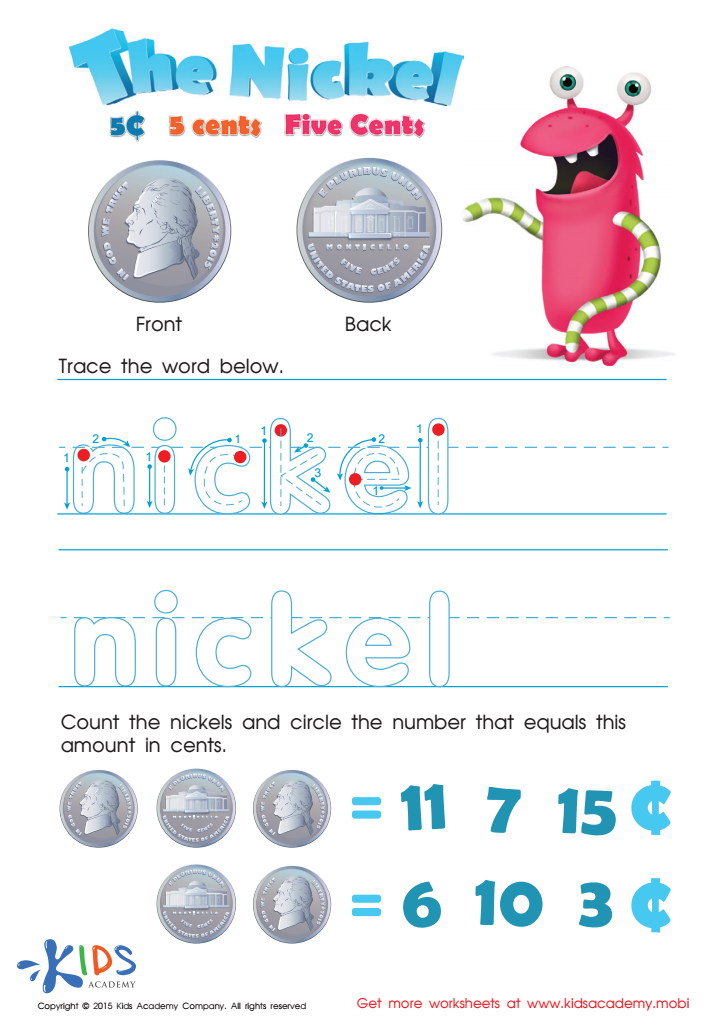
Five Cents or the Nickel Money Worksheet








Counting skills are a bedrock of early mathematics education and fundamental for children's overall cognitive development. For children aged 6-7, employing extra challenges such as counting money can provide significant benefits for their academic and real-world readiness. Parents and educators should prioritize these activities because they promote numerical fluency, facilitate better understanding of value and numbers, and reinforce addition and subtraction skills.
First, counting different denominations of coins or bills helps children hone their ability to recognize numbers and understand their order and value. These activities go beyond rote learning and engage children in meaningful problem-solving scenarios, making math more tangible and practical. It provides a context that can enhance memory retention compared to abstract exercises.
Moreover, counting money encourages critical thinking and decision-making, as children determine how many coins are needed to buy items or figure out the correct change. This can foster early financial literacy, a crucial skill for adult life. It also touches on life skills such as budgeting and savings, laying the groundwork for responsible financial behaviors later on.
By utilizing money in counting exercises, parents and teachers nurture a well-rounded mathematical understanding in children, setting a robust foundation for more complex mathematical concepts and real-life applications in the future.