
Enhancing critical thinking Extra Challenge Worksheets for Ages 6-9
4 filtered results
Difficulty Level
Grade
Age
-
From - To
Subject
Activity
Standards
Unlock your child's potential with our "Enhancing Critical Thinking Extra Challenge Worksheets" designed specifically for ages 6-9. These engaging worksheets encourage young learners to think independently, solve problems creatively, and develop essential analytical skills. Covering a range of fun topics tailored to captivate their curiosity, these activities promote deeper understanding and critical reasoning. Suitable for both home learning and classroom settings, our worksheets provide the perfect extra challenge for budding thinkers. Help your child build confidence while mastering critical thinking skills that will benefit them throughout their educational journey. Explore our collection today and inspire a love for learning!
Favorites
With answer key
Interactive
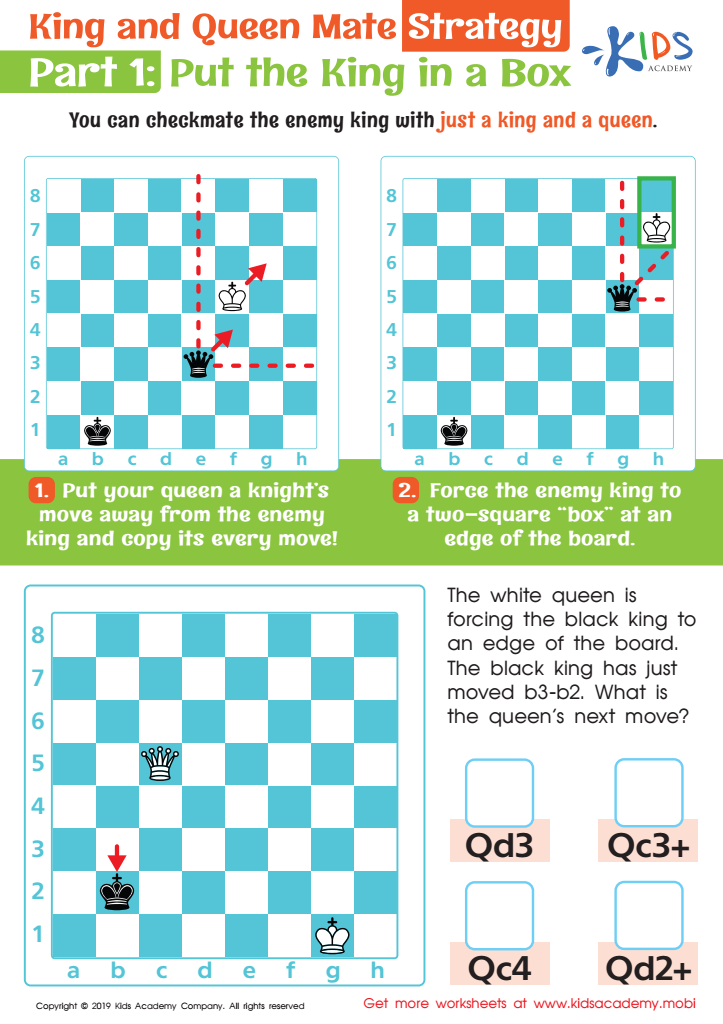
King and Queen Mate Strategy: Part 1 Worksheet
This worksheet will help your young chess player strategize. They’ll learn how to checkmate the opponent’s king using just a king and a queen. Descriptive sample boards will show them the strategy and then a practice board will test their knowledge. Allowing them to plan the queen’s next move to checkmate the opposing king.
 Assign to My Students
King and Queen Mate Strategy: Part 1 Worksheet
Worksheet
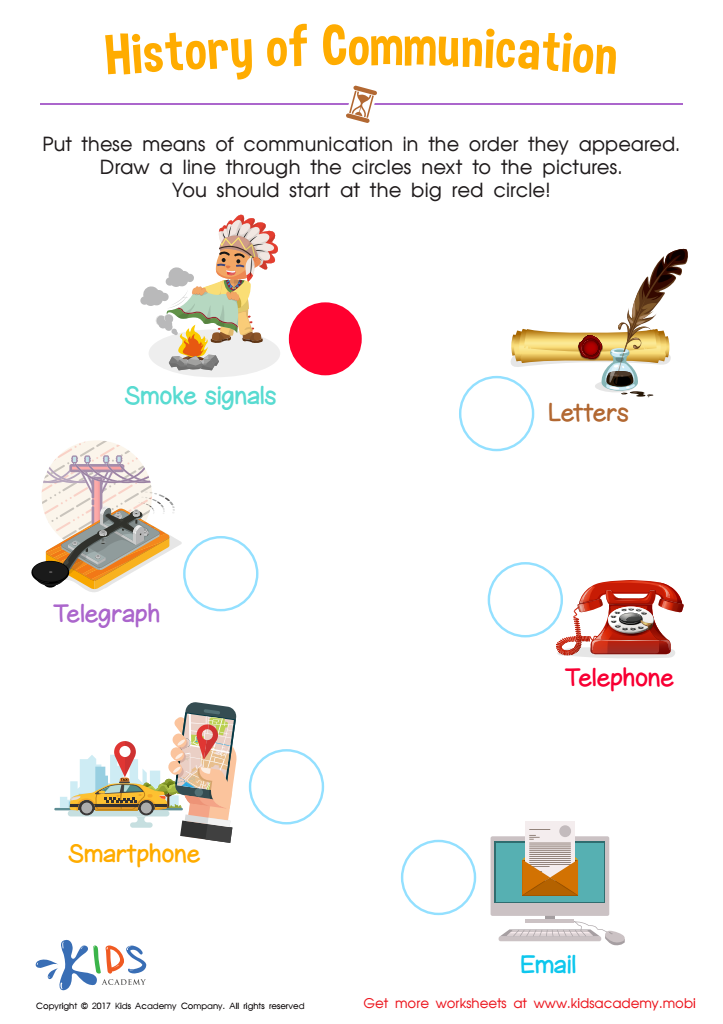
History of Communication Worksheet
Help your child understand history's communication evolution! With this worksheet, your child will learn about the various ways people communicated over time, and how that compares to today. It'll also foster an interest in history and bring the past to life!
History of Communication Worksheet
Worksheet
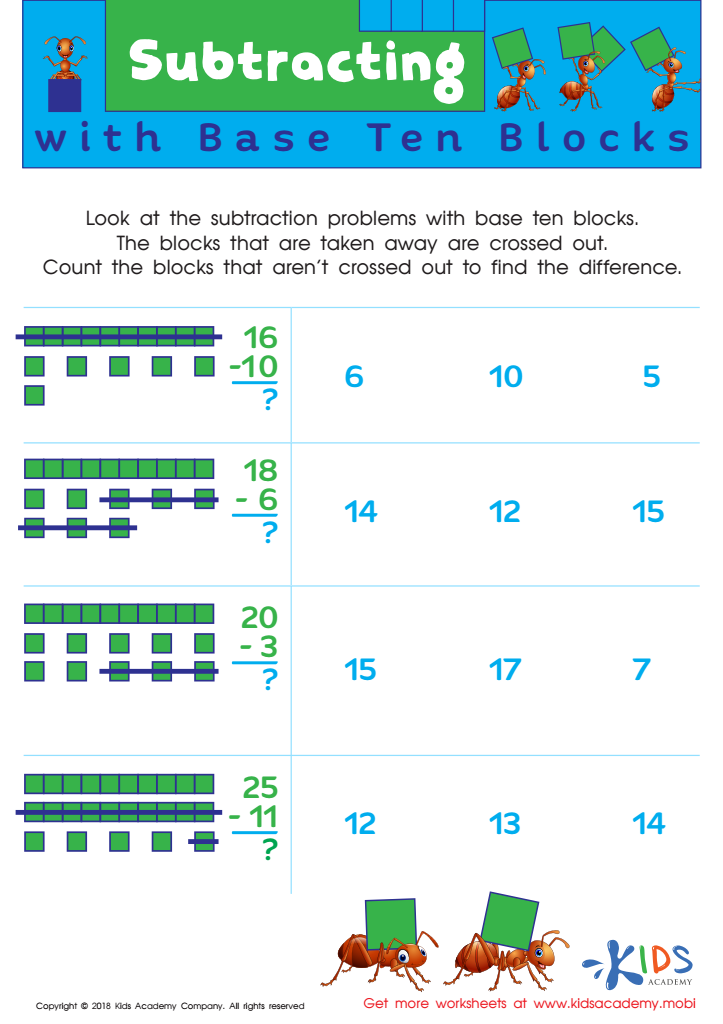
Subtracting with Base Blocks Worksheet
Little mathematicians can use base ten blocks to understand place value for subtraction. This worksheet helps them cross out blocks to solve problems with accuracy. Seeing equations like this boosts their number reasoning skills and helps them work with larger numbers.
Subtracting with Base Blocks Worksheet
Worksheet
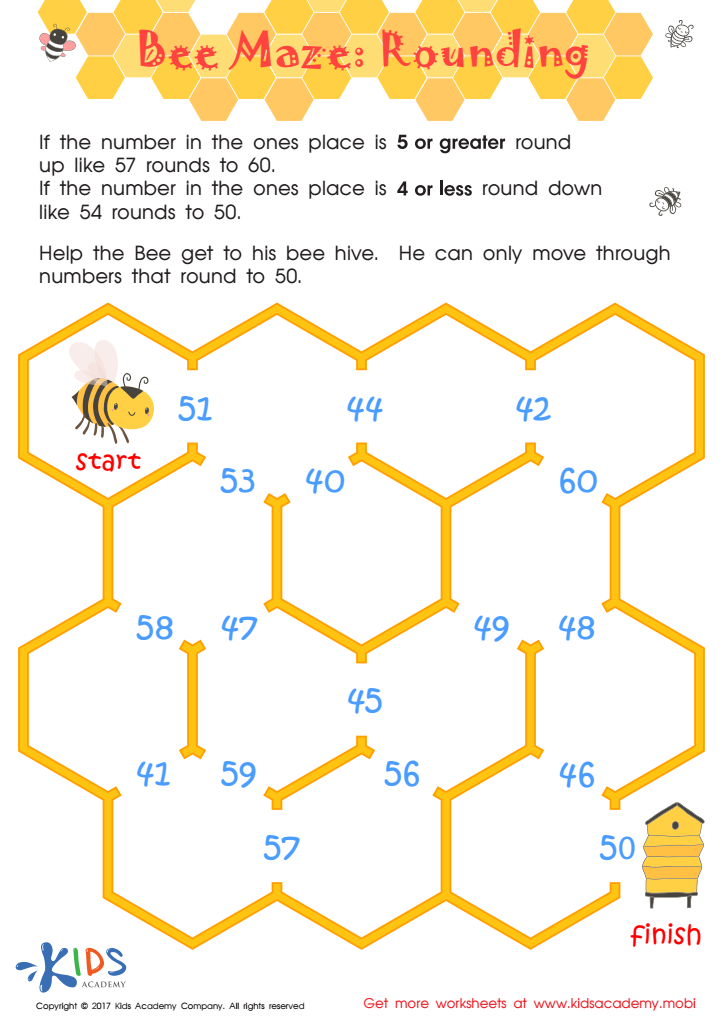
Bee Maze Worksheet
Help the bee find his way to the hive by rounding to the nearest 50!
Help the bee get to his hive with this fun, tricky rounding puzzle! This PDF worksheet challenges your child to round numbers up or down to 50. It reinforces the rules for rounding numbers and leads the bee through a maze. Get your child to help the bee reach the hive by rounding to 50!
Bee Maze Worksheet
Worksheet
Learning Skills
Enhancing critical thinking
Problem-solving skills development
Tactical thinking improvement
Chess strategy learning
Understanding game rules
Understanding communication history
Recognizing technological advancements
Developing analytical skills
Improving reading comprehension
Developing calculation skills
Join Kids Academy for Free
Who is primarily going to use this learning content?








Enhancing critical thinking skills is essential for children aged 6-9, as it lays a strong foundation for their future learning and problem-solving abilities. Parents and teachers should care about this crucial developmental aspect because critical thinking encourages children to analyze situations, assess information, and make reasoned decisions. This skill not only boosts academic performance but also nurtures curiosity and confidence in exploring new ideas.
In an age where information is abundant yet often misleading, fostering critical thinking helps children discern what's true and valuable. It empowers them to ask questions, challenge assumptions, and approach problems creatively and logically. Moreover, it promotes independence, enabling kids to take responsibility for their learning and choices.
Activities that enhance critical thinking can be integrated seamlessly into everyday experiences, making learning both enjoyable and effective. By engaging in discussions, exploring real-world scenarios, and participating in problem-solving activities, children learn to think deeply and persistently.
Ultimately, investing time in developing critical thinking is indispensable for shaping informed, thoughtful citizens who can navigate complexities in an increasingly interconnected world. Supporting this essential skill not only benefits the individual child but also strengthens society by cultivating a generation of insightful and capable thinkers.








