Understanding fact families Extra Challenge Worksheets for Ages 6-9
3 filtered results
-
From - To
Explore our "Understanding Fact Families Extra Challenge Worksheets" designed for students ages 6-9! These engaging worksheets help young learners deepen their numerical understanding of addition and subtraction relationships. By practicing fact families, children enhance their mathematical fluency and problem-solving skills. Each worksheet introduces fun activities and challenges that encourage critical thinking, ensuring students not only grasp concepts but also retain information effectively. Tailored to support various learning styles, these resources are perfect for home learning or classroom enrichment. Enhance math readiness and boost confidence in young mathematicians with our thoughtfully designed worksheets—because learning should always be a fun adventure!
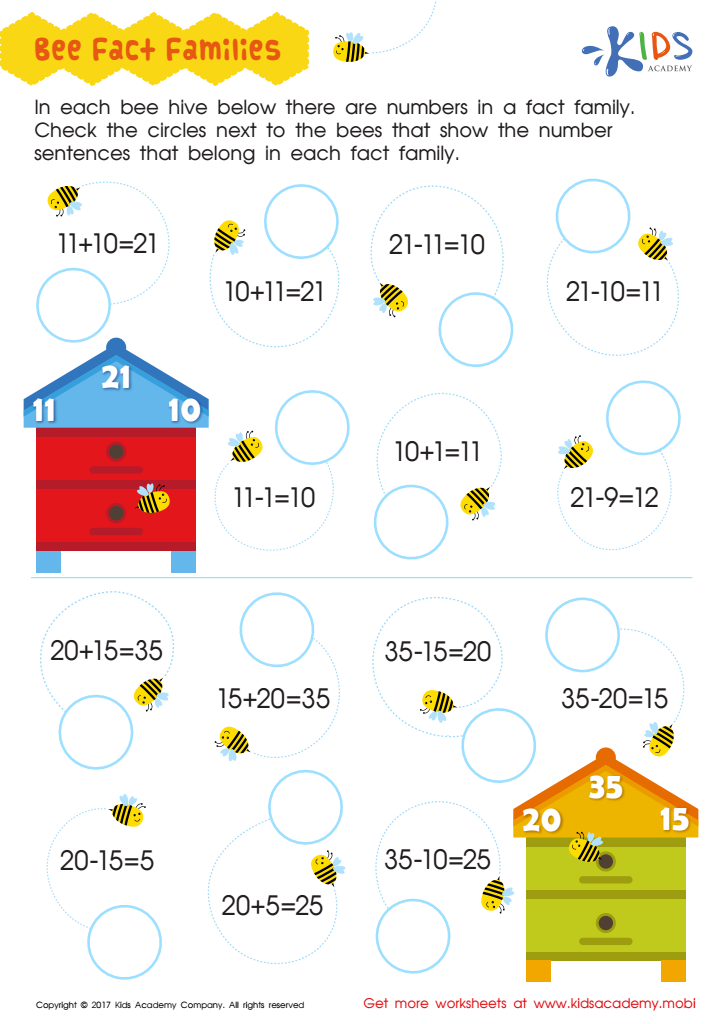
Fact Families Worksheet
 Assign to My Students
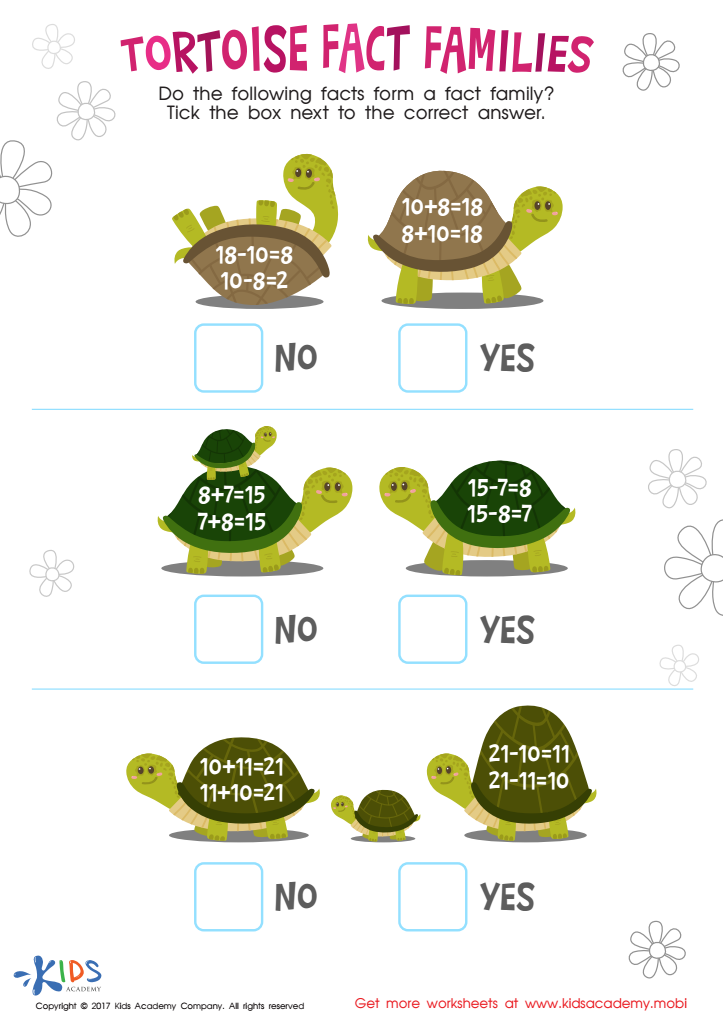
Tortoise Fact Families Printable
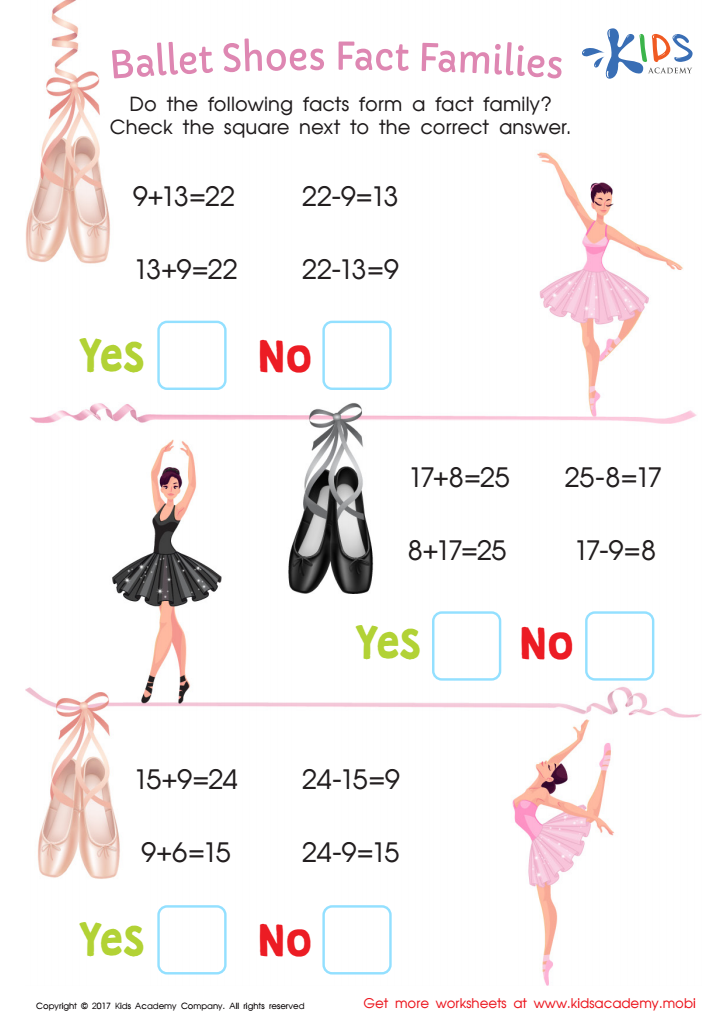
Ballet Shoes Fact Family Printable






Understanding fact families is crucial for young learners aged 6-9 because it lays the foundation for essential mathematical skills. Fact families are sets of related addition and subtraction equations that develop a child's number sense. For instance, the numbers 3, 4, and 7 show relationships like 3 + 4 = 7 and 7 - 4 = 3.
By teaching children about fact families, parents and teachers help them recognize the connections between numbers, fostering mathematical flexibility and problem-solving skills. This is particularly beneficial when children encounter word problems or more complex operations in the future. Comprehending fact families aids in the development of mental math strategies, reducing reliance on counting or external tools.
Additionally, using fact families promotes critical thinking as children learn to see patterns in numbers. Importantly, early mastery of these concepts can boost a child's confidence, making them more willing to tackle challenges in math. When parents and teachers emphasize understanding fact families, they create a strong numerical foundation from which children can smoothly transition to more advanced math concepts, ultimately enriching their overall academic experience. Encouraging this understanding can result in a lasting positive attitude towards math.








