
Understanding subtraction Extra Challenge Worksheets for Ages 6-9
3 filtered results
Difficulty Level
Grade
Age
-
From - To
Subject
Activity
Standards
Explore our "Understanding Subtraction Extra Challenge Worksheets" designed specifically for children ages 6-9! These engaging worksheets help enhance subtraction skills while encouraging critical thinking and problem-solving. Featuring a variety of challenging problems, our resources promote deeper comprehension and mastery of subtraction concepts. Children will work on single and multi-digit problems, word problems, and creative exercises that make learning fun. Perfect for homeschooling, classroom activities, or extra practice at home, these worksheets cater to all learning styles. Give your child the tools they need to succeed in mathematics and develop a solid foundation in subtraction with our exciting challenges today!
Favorites
With answer key
Interactive
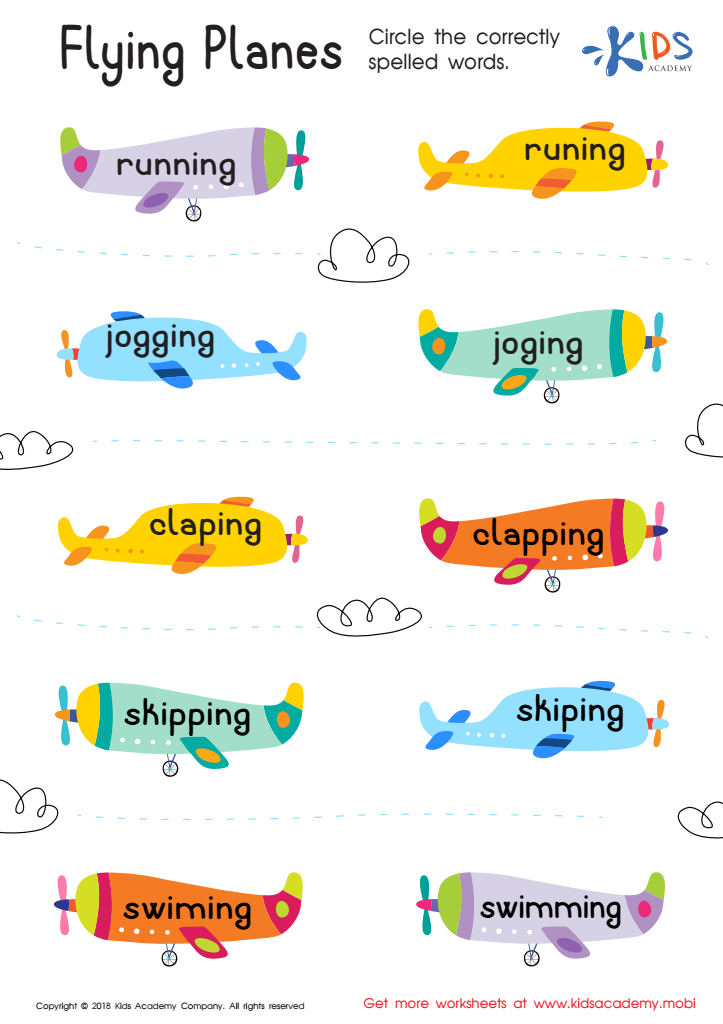
Flying Planes Worksheet
Adding the -ing suffix to verbs is a breeze with this fun worksheet! Colorful planes help your child spot the correct spelling of words that end in consonants - double the consonant, add -ing! Kids can compare correctly and incorrectly spelled words, giving them a better understanding of how the word looks correctly. Download the free PDF and get spelling!
 Assign to My Students
Flying Planes Worksheet
Worksheet
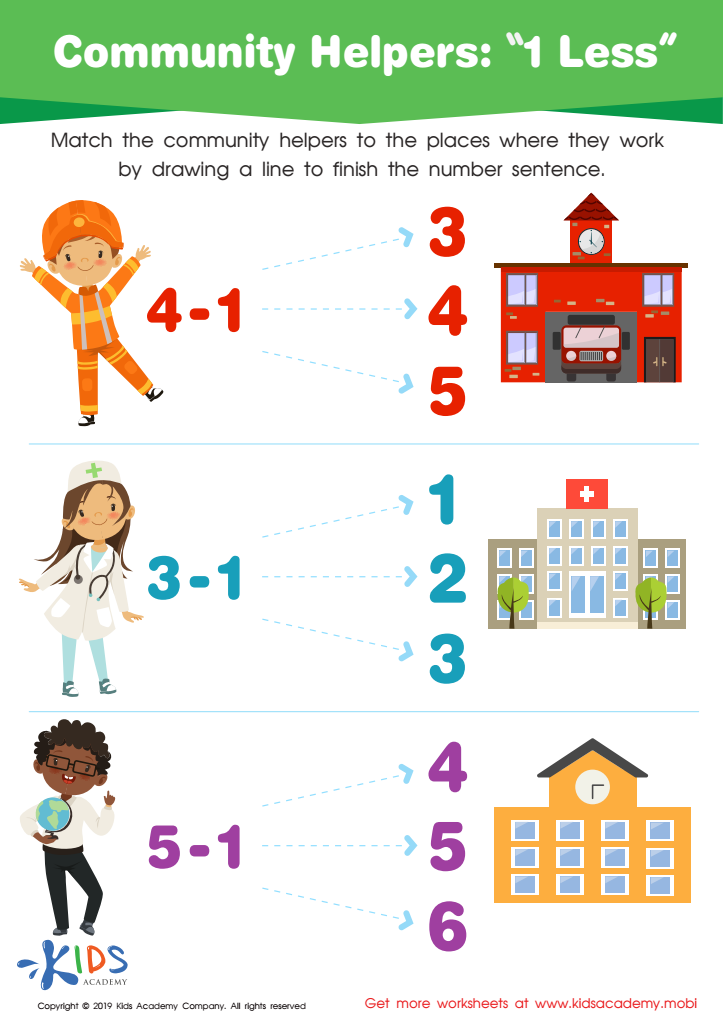
Community Helpers: 1 less Worksheet
Look at this worksheet with your child and ask them to identify the different community helpers. Match them to the places where they work by drawing a line to finish the number sentence. This helps them identify the people that help keep the community organized and running smoothly. Examples of community helpers include doctors, police officers, firefighters, teachers, etc.
Community Helpers: 1 less Worksheet
Worksheet
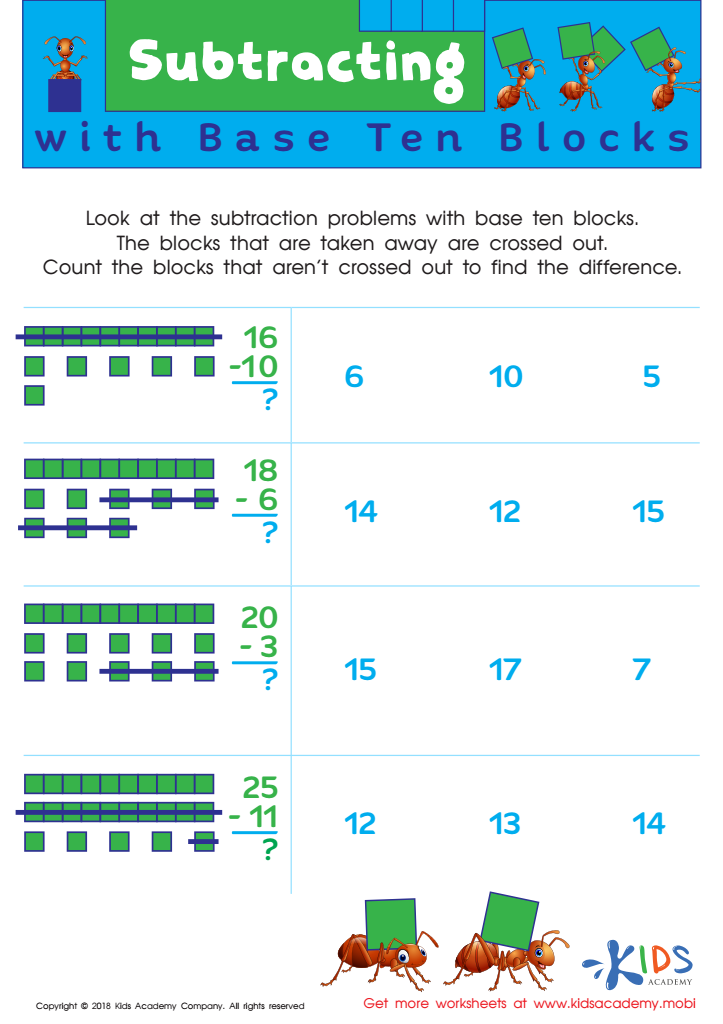
Subtracting with Base Blocks Worksheet
Little mathematicians can use base ten blocks to understand place value for subtraction. This worksheet helps them cross out blocks to solve problems with accuracy. Seeing equations like this boosts their number reasoning skills and helps them work with larger numbers.
Subtracting with Base Blocks Worksheet
Worksheet
Join Kids Academy for Free
Who is primarily going to use this learning content?







Understanding subtraction is crucial for children ages 6-9 as it forms the foundation of their mathematical learning and critical thinking skills. At this stage, children are transitioning from simple number recognition to more complex problem-solving abilities. By fostering a thorough comprehension of subtraction, parents and teachers provide children with essential tools for everyday situations and future academic challenges.
Engaging with concepts like “Understanding Subtraction Extra Challenge” encourages deeper cognitive connections. It helps students grasp the inverse relationship between addition and subtraction, promoting fluency in both operations. This understanding not only aids in arithmetic but also sets the stage for more advanced topics, such as fractions and algebra, which rely on a solid grasp of these basic concepts.
Moreover, mastering subtraction fosters confidence in young learners. When children tackle ‘extra challenges,’ they learn persistence and resilience, qualities that are vital for lifelong learning. Educational activities promoting subtraction also enhance problem-solving skills, encouraging students to approach challenges methodically.
Ultimately, early experiences with subtraction—especially creative and engaging ones—shape not just mathematical understanding, but also overall cognitive development and love for learning. Therefore, it’s imperative for both parents and teachers to prioritize this vital area in their children’s education.








