Spatial awareness Extra Challenge 2D Shapes Worksheets for Ages 6-9
3 filtered results
Difficulty Level
Grade
Age
-
From - To
Subject
Activity
Standards
Enhance your child's spatial awareness with our engaging Extra Challenge 2D Shapes Worksheets, designed for ages 6-9. These printable worksheets offer a fun, interactive way to deepen understanding of 2D shapes and their properties. Through a variety of exercises, children will learn to recognize, manipulate, and compare different shapes, all while building critical problem-solving skills. Ideal for school or at-home learning, these worksheets will keep young minds stimulated and challenged. Foster creativity and boost confidence in geometry with our hands-on activities that encourage exploration and discovery in the world of shapes. Start their journey to spatial mastery today!
Favorites
With answer key
Interactive
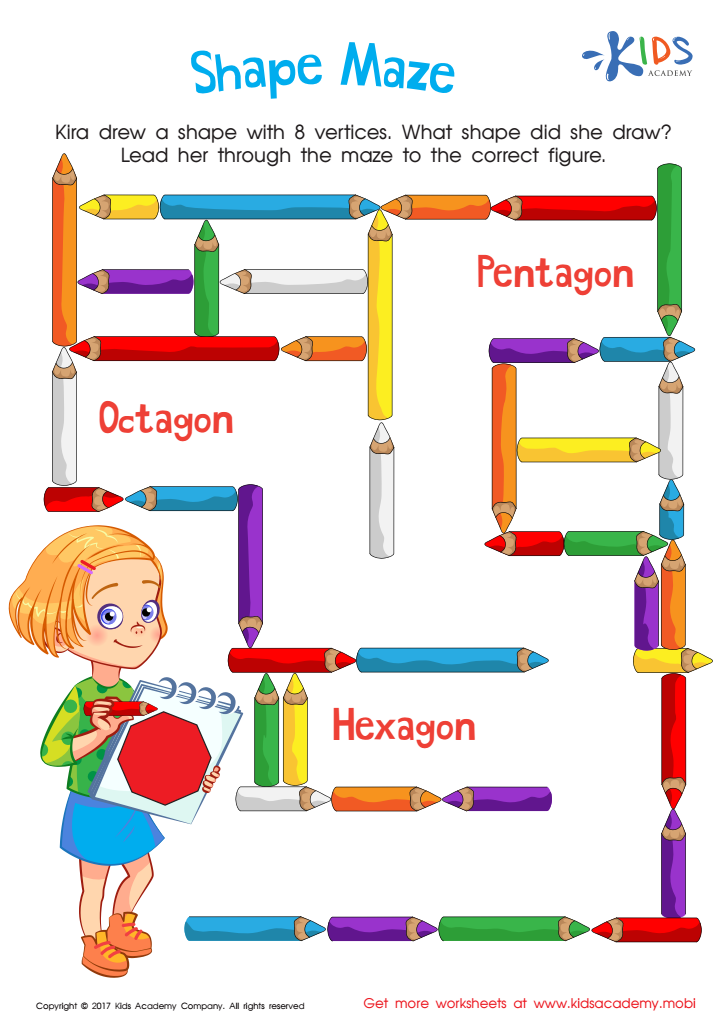
Shape Maze Worksheet
Test your child's geometry knowledge with this fun printable maze! They'll need to identify shapes with 8 vertices to find their way through the maze and get the correct answer.
 Assign to My Students
Shape Maze Worksheet
Worksheet

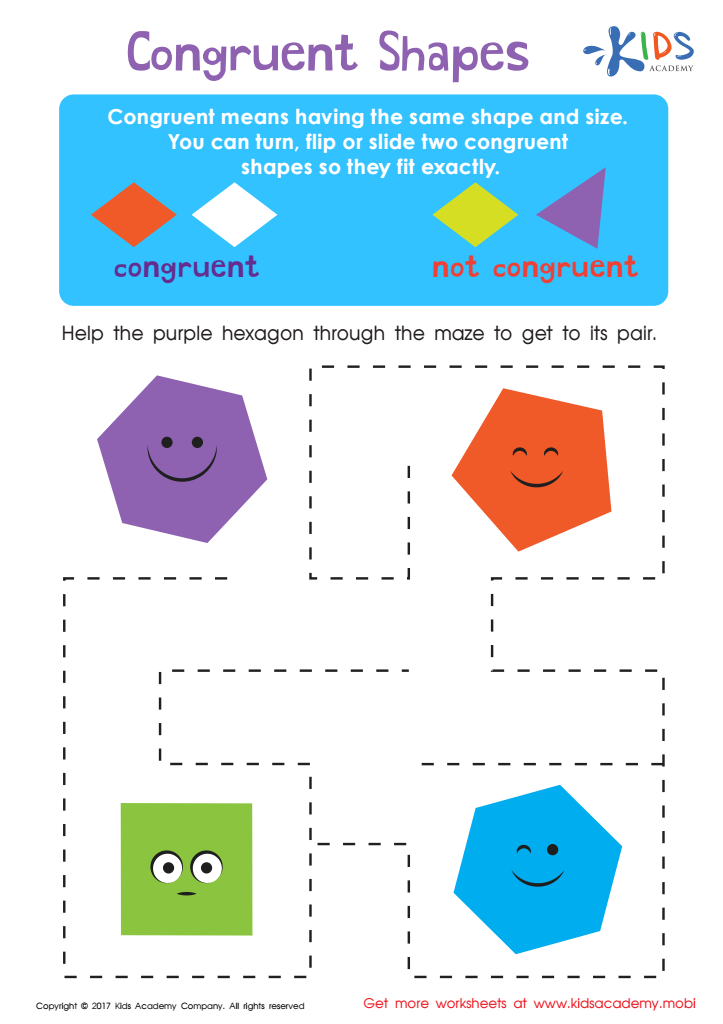
Congruent Shapes Worksheet
Help your child find the twin of the purple hexagon! This congruent shapes worksheet is great for increasing vocabulary while challenging mental rotation skills.
Congruent Shapes Worksheet
Worksheet
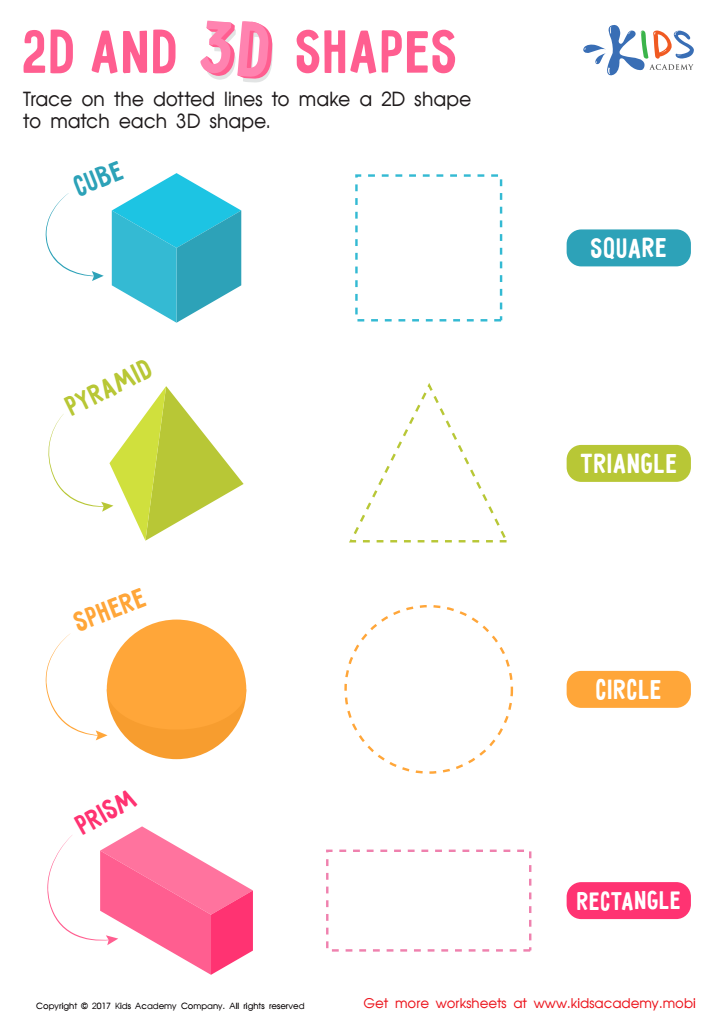
2D and 3D Shapes Worksheet
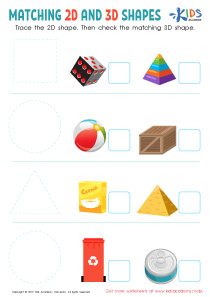
Introduce your child to 3D and 2D with this traceable worksheet. With dotted lines, help them trace and make a 2D shape for each 3D shape: square, triangle, rectangle, and circle. Show them there's more than one way to draw! You may have taken them to a 3D movie, or they've seen some fantastic 3D art. Now they can wonder no more.
2D and 3D Shapes Worksheet
Worksheet
Join Kids Academy for Free
Who is primarily going to use this learning content?








Spatial awareness is a critical skill that benefits children significantly, especially for those ages 6-9, where foundational cognitive development occurs. Understanding 2D shapes is not merely about recognizing circles, squares, or triangles; it's about building a framework for future learning in math, science, and everyday problem-solving.
Parents and teachers should care about fostering spatial awareness because it enhances children's ability to visualize and manipulate objects in space, which lays the groundwork for more complex concepts like geometry and measurement. When children engage in activities that emphasize 2D shapes, they develop critical thinking skills, improve their ability to solve problems, and learn to communicate about spatial relationships effectively.
Moreover, spatial awareness has real-world applications. Whether navigating a playground or an art project, children use these spatial skills daily. By nurturing this awareness, adults equip children with the confidence and tools necessary to tackle challenges, helping them to excel academically and socially.
Encouraging exercises like drawing, playing with blocks, and exploring geometry in creative ways can cultivate this important skill. Thus, investing time in spatial awareness is essential for cognitive development, making it a priority for both parents and educators.