Spatial awareness Extra Challenge 2D Shapes Worksheets for Ages 7-8
3 filtered results
Difficulty Level
Grade
Age
-
From - To
Subject
Activity
Standards
Boost your child's spatial reasoning with our "Spatial Awareness Extra Challenge 2D Shapes Worksheets" designed for ages 7-8. These expertly crafted worksheets provide engaging activities that enhance kids' understanding of 2D shapes, their properties, and spatial relationships. Perfect for young learners ready for an extra challenge, these exercises help develop critical thinking and problem-solving skills. With a focus on making learning fun and interactive, children will enjoy tasks like shape identification, symmetry analysis, and pattern recognition. Encourage your child's growth in math and spatial awareness by integrating these worksheets into their study routine.
Favorites
With answer key
Interactive
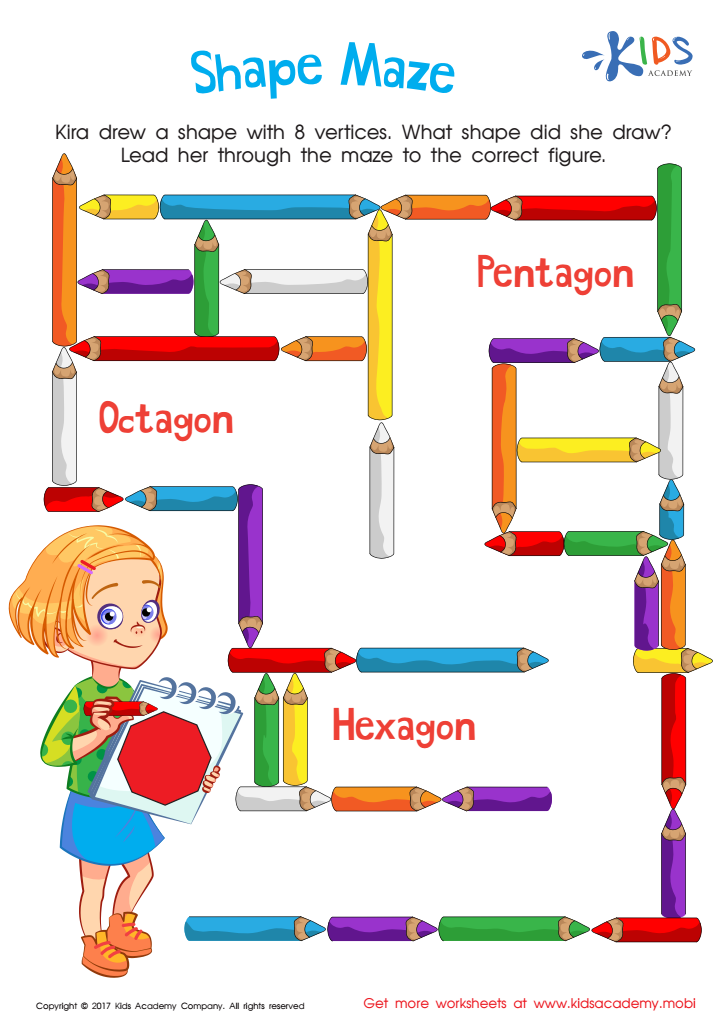
Shape Maze Worksheet
Test your child's geometry knowledge with this fun printable maze! They'll need to identify shapes with 8 vertices to find their way through the maze and get the correct answer.
 Assign to My Students
Shape Maze Worksheet
Worksheet











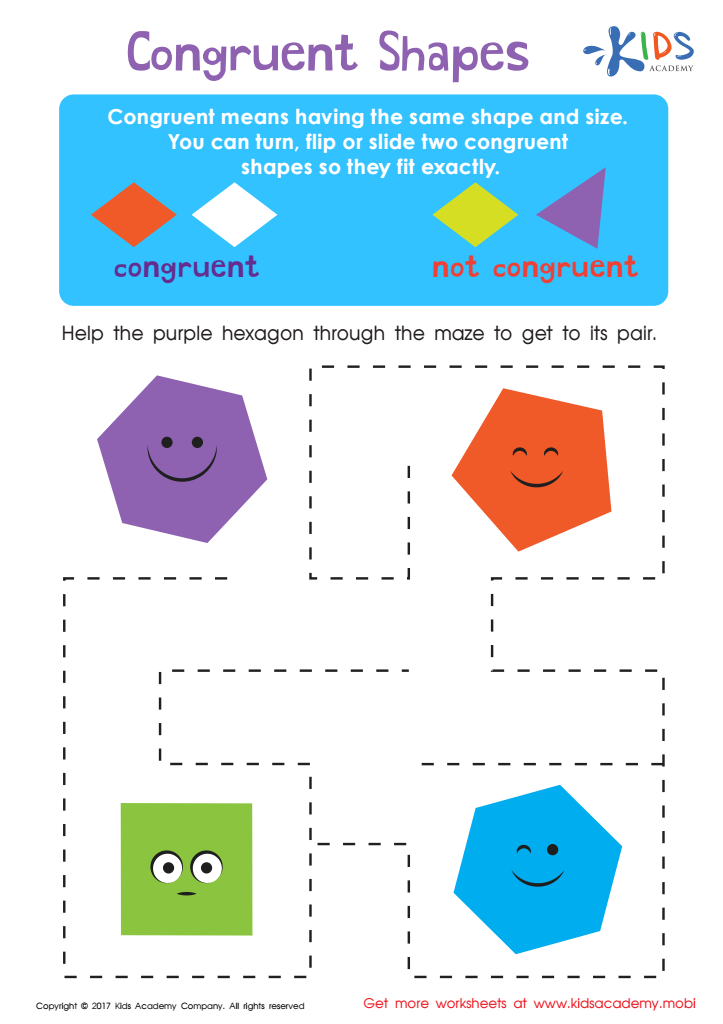
Congruent Shapes Worksheet
Help your child find the twin of the purple hexagon! This congruent shapes worksheet is great for increasing vocabulary while challenging mental rotation skills.
Congruent Shapes Worksheet
Worksheet
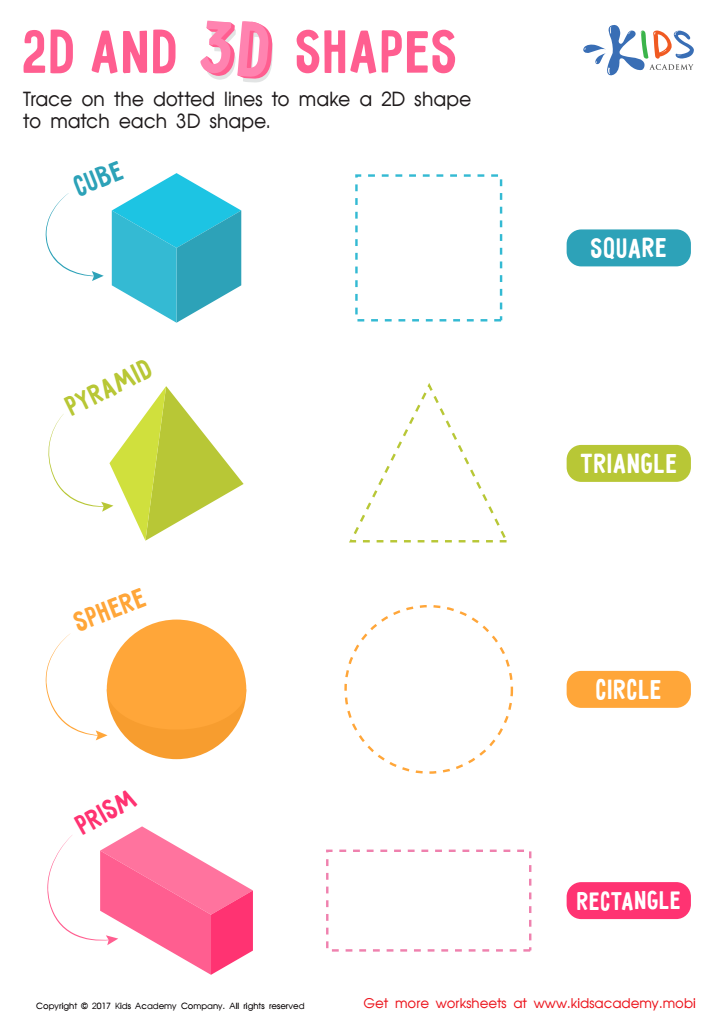
2D and 3D Shapes Worksheet
Introduce your child to 3D and 2D with this traceable worksheet. With dotted lines, help them trace and make a 2D shape for each 3D shape: square, triangle, rectangle, and circle. Show them there's more than one way to draw! You may have taken them to a 3D movie, or they've seen some fantastic 3D art. Now they can wonder no more.
2D and 3D Shapes Worksheet
Worksheet
Join Kids Academy for Free
Who is primarily going to use this learning content?








Parents and teachers should pay special attention to spatial awareness and 2D shape challenges for children aged 7-8 because these skills are foundational to a child's cognitive development and academic success. Spatial awareness — understanding where objects are in space in relation to oneself and to each other — is integral to a wide range of subjects, from mathematics to reading comprehension. Engaging in 2D shape activities enhances critical thinking and problem-solving abilities by requiring children to manipulate and visualize shapes, predict outcomes, and recognize patterns.
Spatial understanding helps in geometry, where children learn to classify shapes by their properties. It also has applications in everyday tasks like reading maps, solving puzzles, and even in sports where judging distances is crucial. Efforts to improve spatial skills have a lasting impact on later concepts in science, technology, engineering, and math (STEM) education.
Moreover, children with strong spatial skills tend to do better in reading, as they can visualize the physical layout of text and better understand the structure of stories. For young learners, making connections between shapes on paper and real objects boosts their ability to transfer classroom learning to real-world experiences.
Overall, cultivating spatial awareness and 2D shape recognition not only bolsters a wide array of academic disciplines but also enhances everyday functional skills, making it an essential area of focus for developmental growth.