Fraction visualization Extra Challenge Fractions of Shapes Worksheets for Ages 7-9
3 filtered results
Difficulty Level
Grade
Age
-
From - To
Subject
Activity
Standards
Engage your 7-9-year-olds with our stimulating Fraction Visualization Extra Challenge worksheets! Designed to deepen understanding, these worksheets help students master fractions through partitioned shapes and visualization techniques. Ideal for classroom or home activities, each sheet offers expressions suited for diverse learning styles, emphasizing fraction concepts while enhancing math skills. Enhance your child's ability to identify, compare, and convert fractions through engaging visual challenges. Download now to provide advanced practice and reinforce essential mathematical foundations.
Favorites
With answer key
Interactive
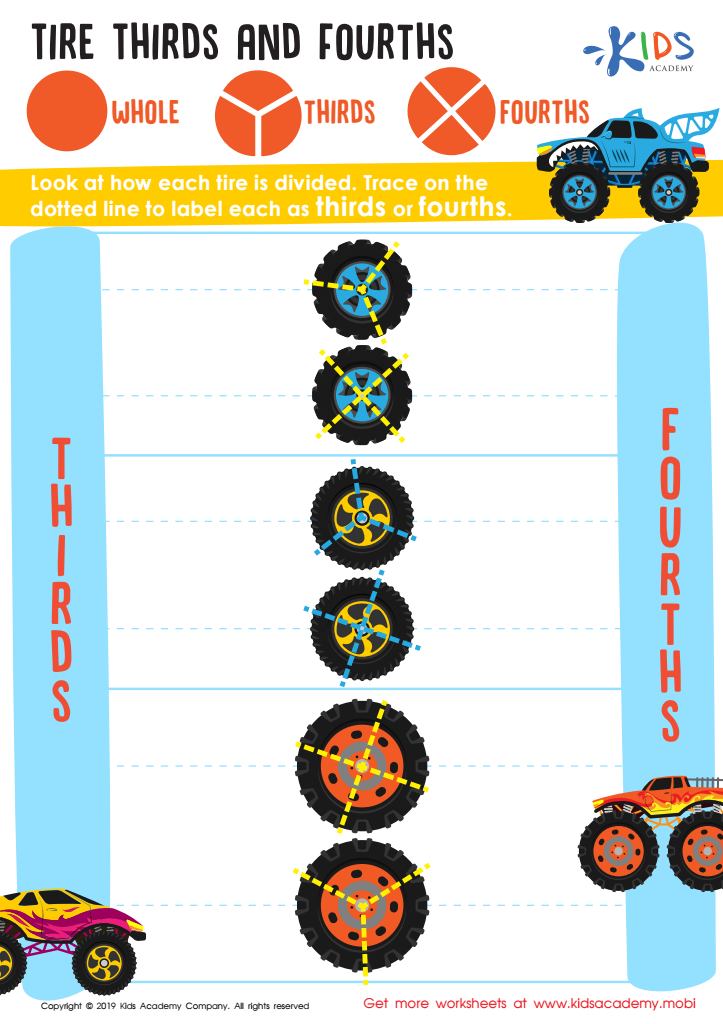
Tire Thirds and Fourths Worksheet
Learning geometry is key in your child's education. Have them identify and name shapes cut into 2, 3 and 4 parts. Test their knowledge with this worksheet - trace the dotted line to label each as third or fourth. Encourage them to keep learning!
 Assign to My Students
Tire Thirds and Fourths Worksheet
Worksheet
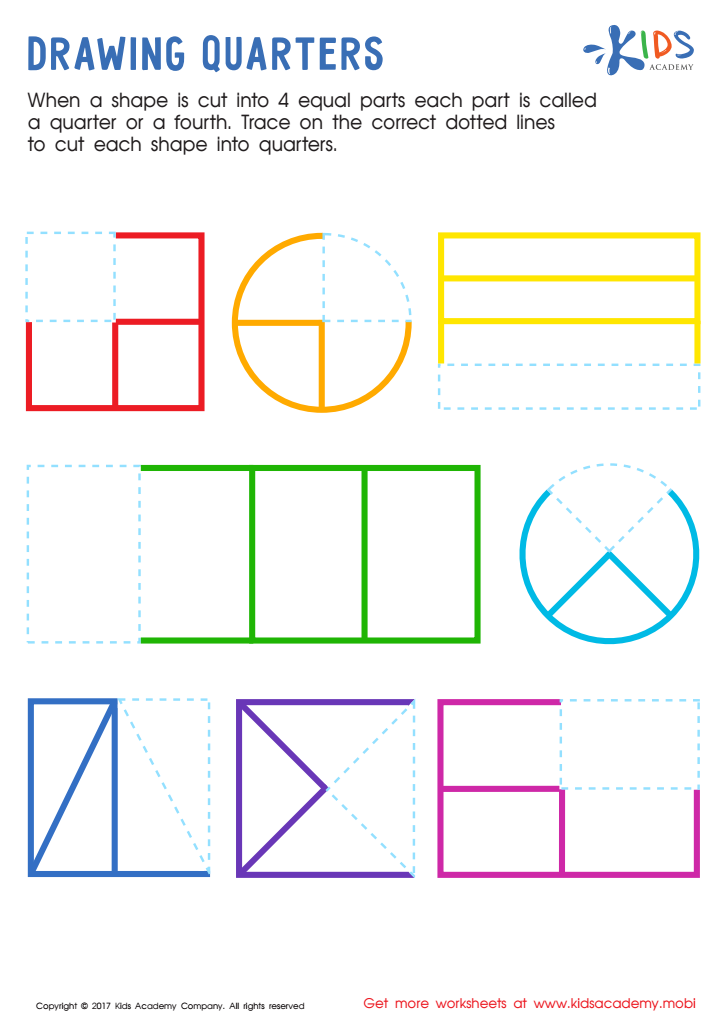
Drawing Quarters Worksheet
Help your kids divide shapes into quarters! Have them trace dotted lines to cut each shape into 4 equal parts. Each of the 4 parts is called a quarter or a fourth. This worksheet will help kids learn more about dividing shapes into four equal parts.
Drawing Quarters Worksheet
Worksheet
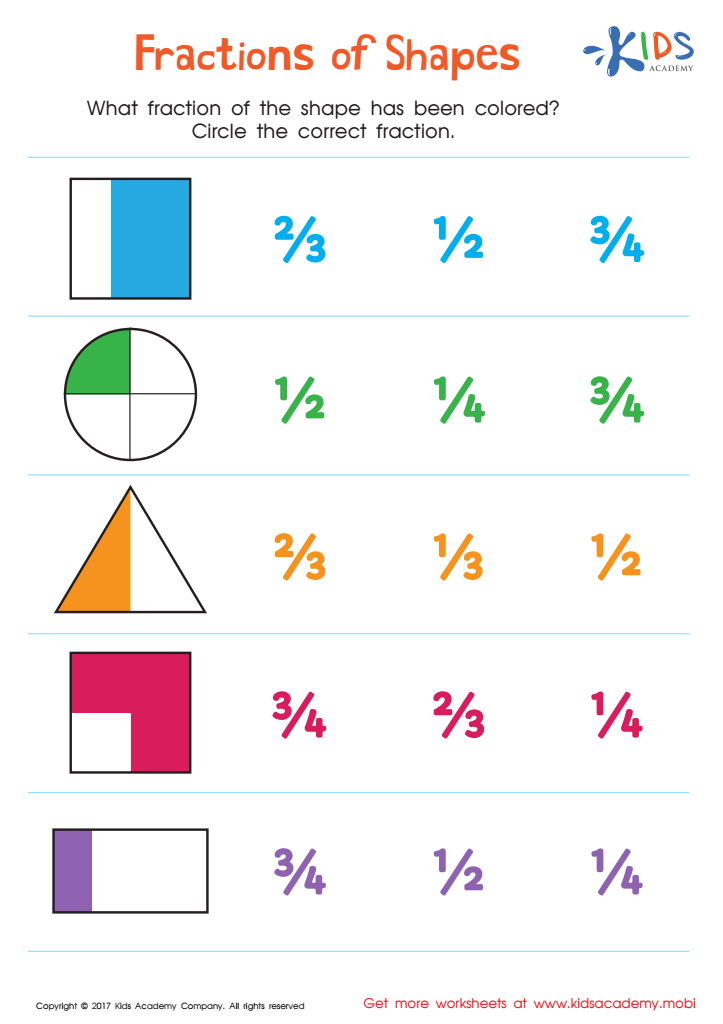
Fractions of Shapes: Math Concept Worksheet
Fractions can be tricky, but with pictures to illustrate them, they become much easier to understand. Our fractions of shapes worksheet is a great way to help children visualize fractions and gain a better understanding of them.
Fractions of Shapes: Math Concept Worksheet
Worksheet
Join Kids Academy for Free
Who is primarily going to use this learning content?








Understanding fractions is foundational for mathematical proficiency, and early introduction to these concepts greatly impacts a child's future learning. Fraction visualization, particularly through interactive challenges like "Extra Challenge Fractions of Shapes" for ages 7-9, fosters critical mathematical skills. During these formative years, children typically transition from concrete to more abstract thinking. This activity uses visual aids, making fractions more understandable by allowing children to see how a whole shape can be divided into parts.
Visual representation helps demystify complex ideas such as half, third, and quarter, turning abstract fractions into tangible tools that children can manipulate and comprehend. By engaging with fractions in a playful yet educational context, children not only gain confidence but also improve their problem-solving and spatial reasoning skills. Given that fractions often underpin topics like division, ratios, and proportions, a solid grasp early on sets children up for success in more advanced math courses.
Moreover, these activities encourage a growth mindset by providing opportunities for trial and error. Parents and teachers who support and facilitate these extra challenges contribute significantly to the development of a child's depth of understanding and enthusiasm for math. Ultimately, investing time and energy into fraction visualization exercises promotes a lifelong appreciation and comprehension of mathematics.