Mental math skills Extra Challenge Mixed Times Tables Worksheets for Ages 7-9
3 filtered results
-
From - To
Elevate your child's math abilities with our "Mental Math Skills Extra Challenge Mixed Times Tables Worksheets" tailored for ages 7-9. These engaging worksheets offer rigorous challenges that make mastering multiplication fun and effective. Perfectly designed to boost mental arithmetic, each worksheet features mixed times tables to ensure comprehensive learning and improved problem-solving skills. Ideal for young learners, our resources support and nurture key educational development, promote confidence, and encourage independent thinking. Empower your children to excel with complex multiplication through stimulating activities that transform learning into an exciting journey! Download now to supercharge your child’s mental math capabilities.
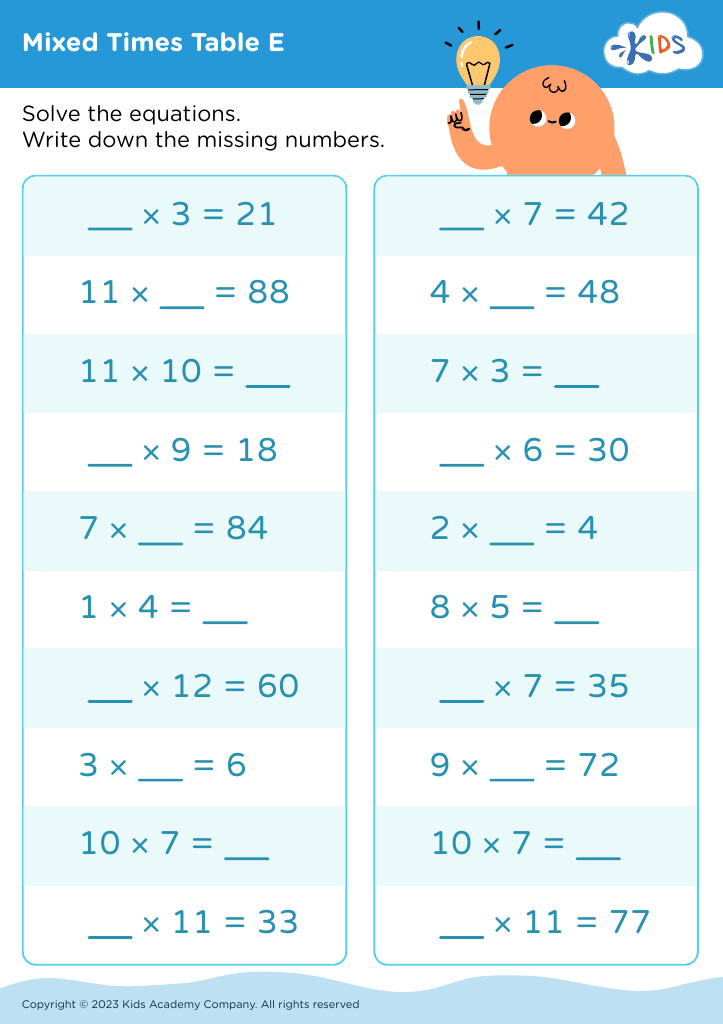
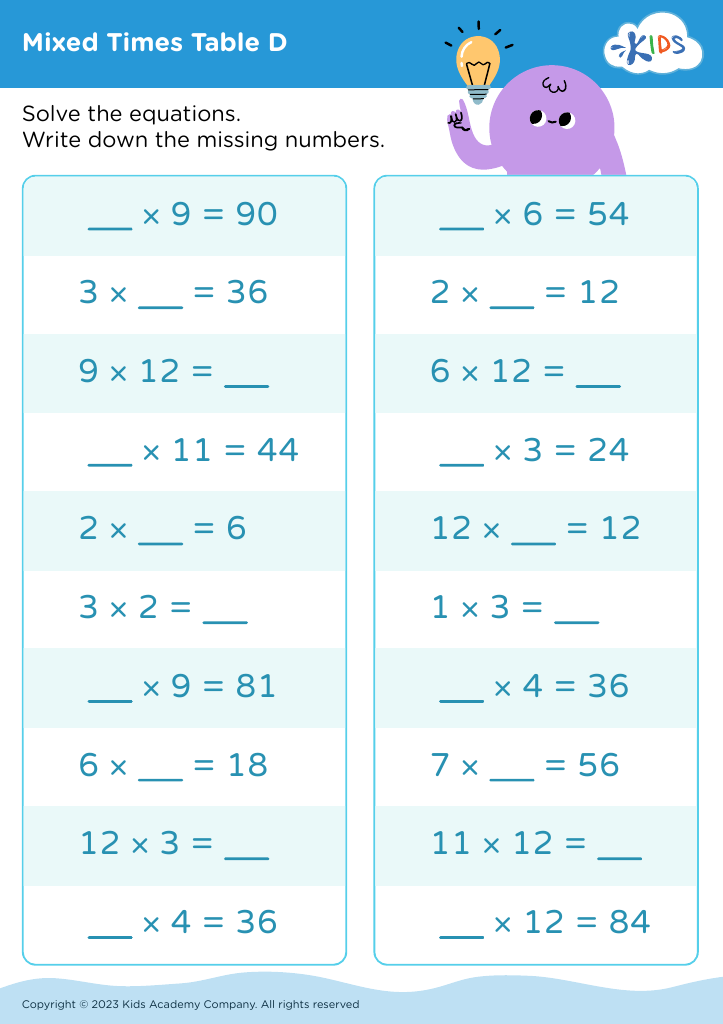
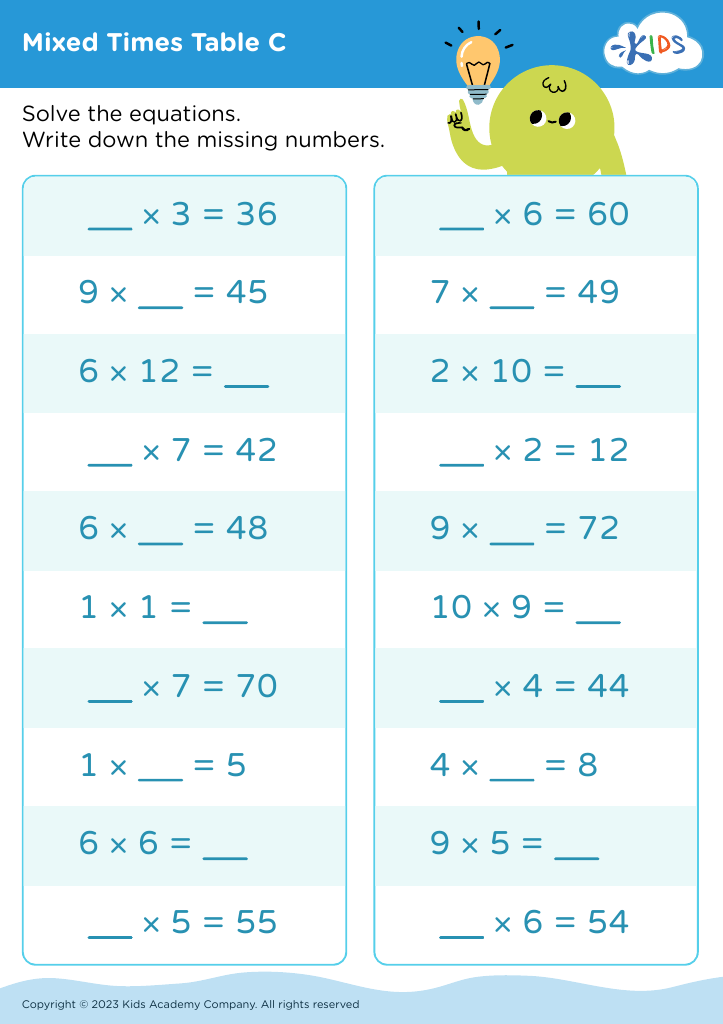


Parents and teachers should care about Mental Math Skills Extra Challenge Mixed Times Tables for ages 7-9 because they cultivate a strong mathematics foundation critical for academic success and practical life skills. At this developmental stage, children’s brains are exceptionally plastic, meaning they are highly receptive to learning and retaining new information. Engaging in mental math exercises enhances cognitive abilities such as memory, problem-solving, and critical thinking.
Mixed times tables introduce complexity that encourages mastering basic multiplication while also applying these skills in varied contexts. This is crucial for building number sense, which is the understanding of how numbers relate, operate, and can be manipulated. Mastery of times tables provides a cornerstone for more advanced topics in mathematics, including division, fractions, and algebra.
Moreover, mental math boosts self-confidence and quick thinking, reducing reliance on devices and aids for simple calculations. This autonomy can translate to improved performance not only within mathematics but across other academic disciplines. Mental agility achieved through these exercises often results in better performance on standardized tests and classroom activities.
Lastly, the habit of continuous mental challenge promotes lifelong learning and intellectual curiosity, qualities beneficial beyond school into future careers and everyday problem-solving scenarios. Encouraging mental math at an early age is an investment in a child's overall cognitive and academic development.








