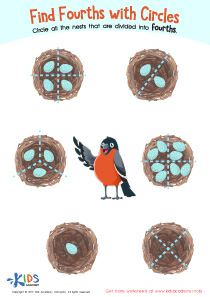
Spatial awareness Extra Challenge 2D Shapes Worksheets for 7-Year-Olds
3 filtered results
Difficulty Level
Grade
Age
-
From - To
Subject
Activity
Standards
Enhance your 7-year-old's spatial awareness with our engaging Extra Challenge 2D Shapes Worksheets! Designed to stimulate critical thinking and creativity, these worksheets offer a variety of fun activities focusing on recognition, manipulation, and arrangement of 2D shapes. Through interactive exercises, children will improve their ability to visualize and understand how shapes relate to one another in space. Perfect for reinforcing geometry concepts, our worksheets cater to diverse learning styles and keep kids motivated. Whether at home or in the classroom, these resources offer an enjoyable way to enhance essential math skills and foster a love for learning. Download now and start exploring!
Favorites
With answer key
Interactive
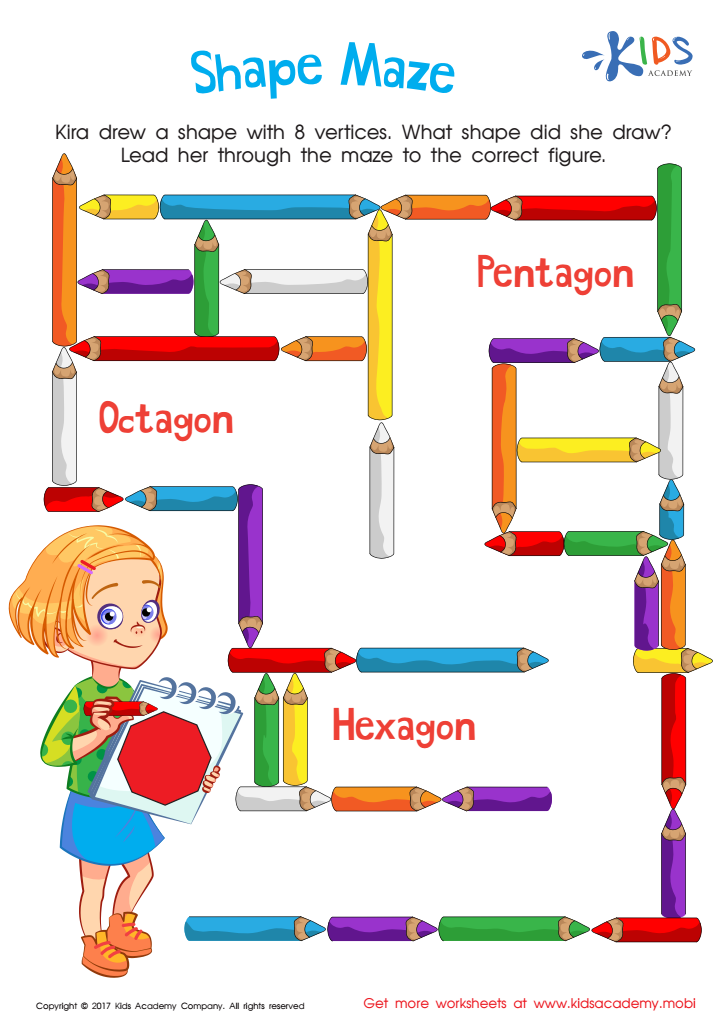
Shape Maze Worksheet
Test your child's geometry knowledge with this fun printable maze! They'll need to identify shapes with 8 vertices to find their way through the maze and get the correct answer.
 Assign to My Students
Shape Maze Worksheet
Worksheet











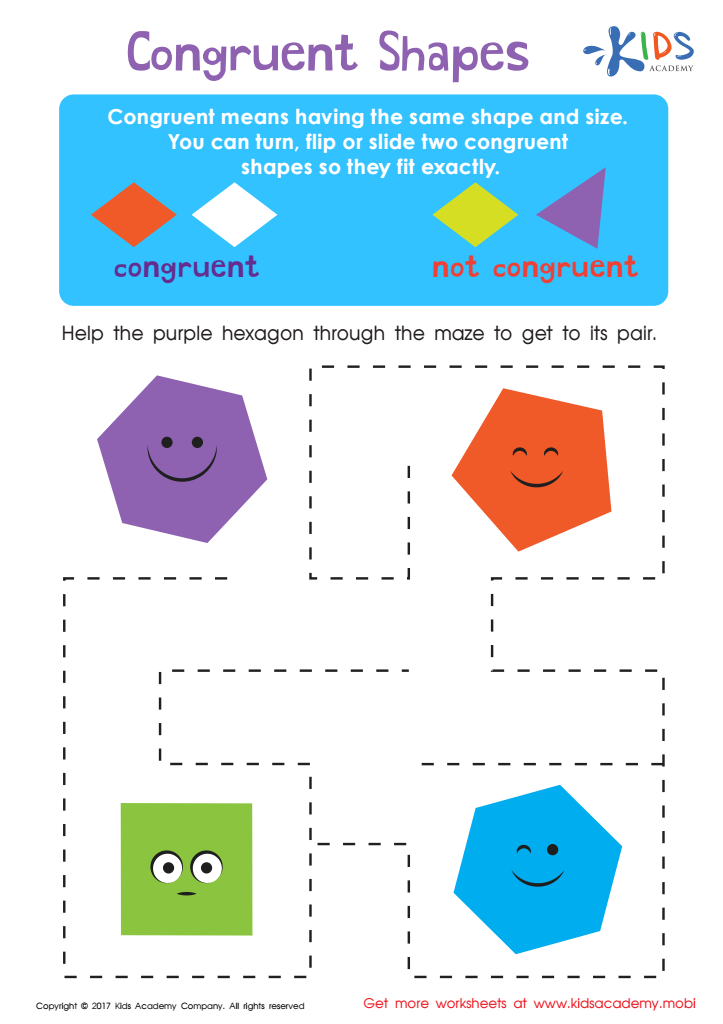
Congruent Shapes Worksheet
Help your child find the twin of the purple hexagon! This congruent shapes worksheet is great for increasing vocabulary while challenging mental rotation skills.
Congruent Shapes Worksheet
Worksheet
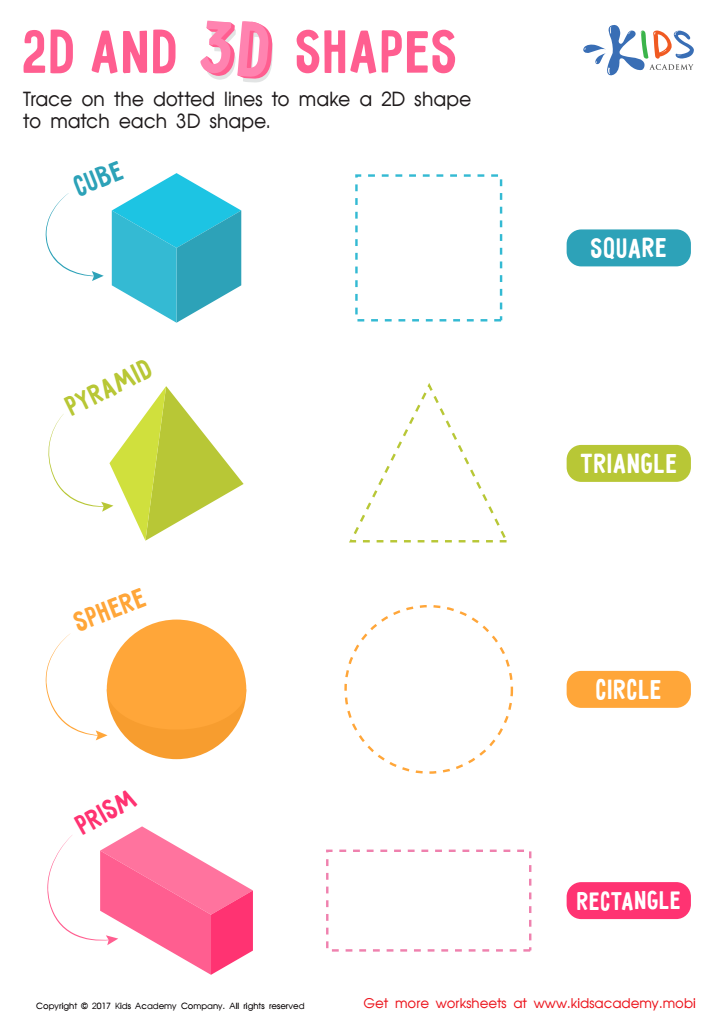
2D and 3D Shapes Worksheet
Introduce your child to 3D and 2D with this traceable worksheet. With dotted lines, help them trace and make a 2D shape for each 3D shape: square, triangle, rectangle, and circle. Show them there's more than one way to draw! You may have taken them to a 3D movie, or they've seen some fantastic 3D art. Now they can wonder no more.
2D and 3D Shapes Worksheet
Worksheet
Join Kids Academy for Free
Who is primarily going to use this learning content?








Spatial awareness and an understanding of 2D shapes are crucial components of early childhood education, particularly for 7-year-olds. As children interact with their physical environment, spatial awareness allows them to navigate spaces, understand relationships between objects, and develop problem-solving skills. When parents and teachers prioritize these skills, they lay a strong foundation for more complex mathematical concepts and critical thinking.
At this age, grasping 2D shapes such as squares, circles, and triangles enhances a child’s ability to visualize and manipulate objects mentally. This foundational understanding contributes not only to geometry but also to literacy through shape recognition in everyday contexts like reading maps or interpreting diagrams.
Moreover, developmental milestones point to children’s increased abilities to reason about space and shape. Engaging them in activities like puzzles, drawing, building, or even playing educational games fosters these skills organically. Parents and educators should care because enhanced spatial awareness not only boosts a child’s academic prowess but also correlates with real-world applications in science, art, and everyday problem-solving. By nurturing these skills, adults invest in a child’s intellectual growth, instilling confidence and curiosity as they explore their surroundings.