Spatial awareness Extra Challenge Geometry Worksheets for 8-Year-Olds
4 filtered results
Difficulty Level
Grade
Age
-
From - To
Subject
Activity
Standards
Nurture your child's spatial awareness with our Extra Challenge Geometry Worksheets, specifically designed for 8-year-olds. These engaging and challenging worksheets enhance cognitive skills, helping your child understand shapes, patterns, and spatial relationships more deeply. Through a variety of exercises such as puzzles and advanced geometry problems, kids will boost their visual-spatial intelligence while having fun. Perfect for children who are ready to go beyond basic geometry, these worksheets foster critical thinking and problem-solving abilities. Support your child's educational journey by adding these stimulating resources to their learning routine today!
Favorites
With answer key
Interactive
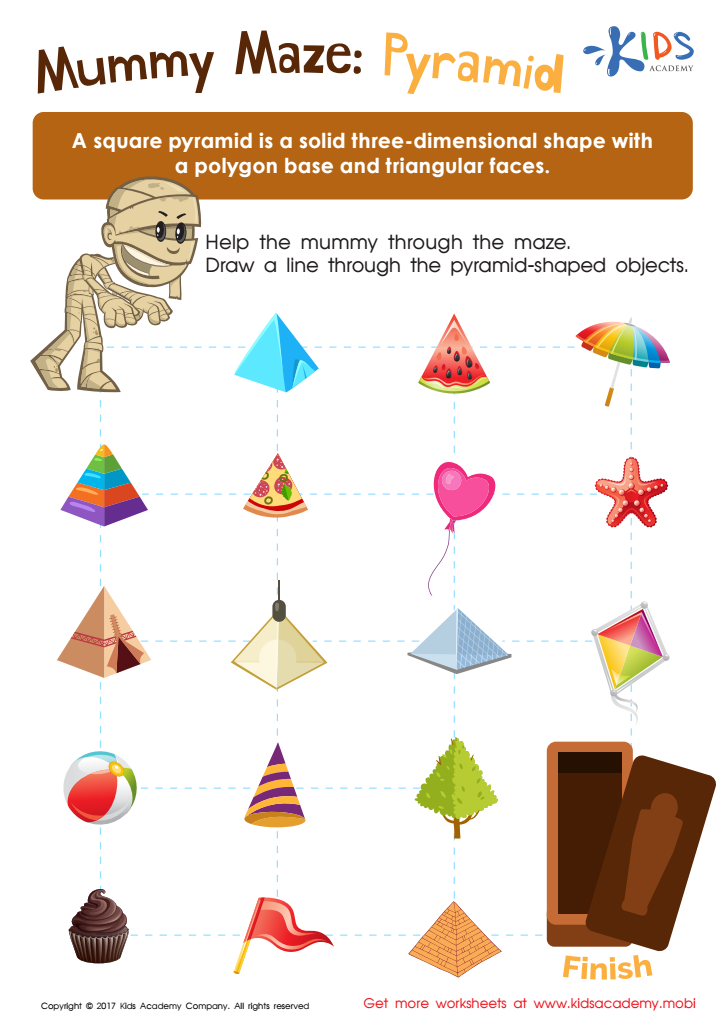
Mummy Maze: Pyramid Printable
Let's learn to spot 3D shapes, such as the iconic pyramid! This fun pyramid geometry worksheet PDF provides interesting illustrations and a maze to help your child identify pyramids in the pictures.
 Assign to My Students
Mummy Maze: Pyramid Printable
Worksheet











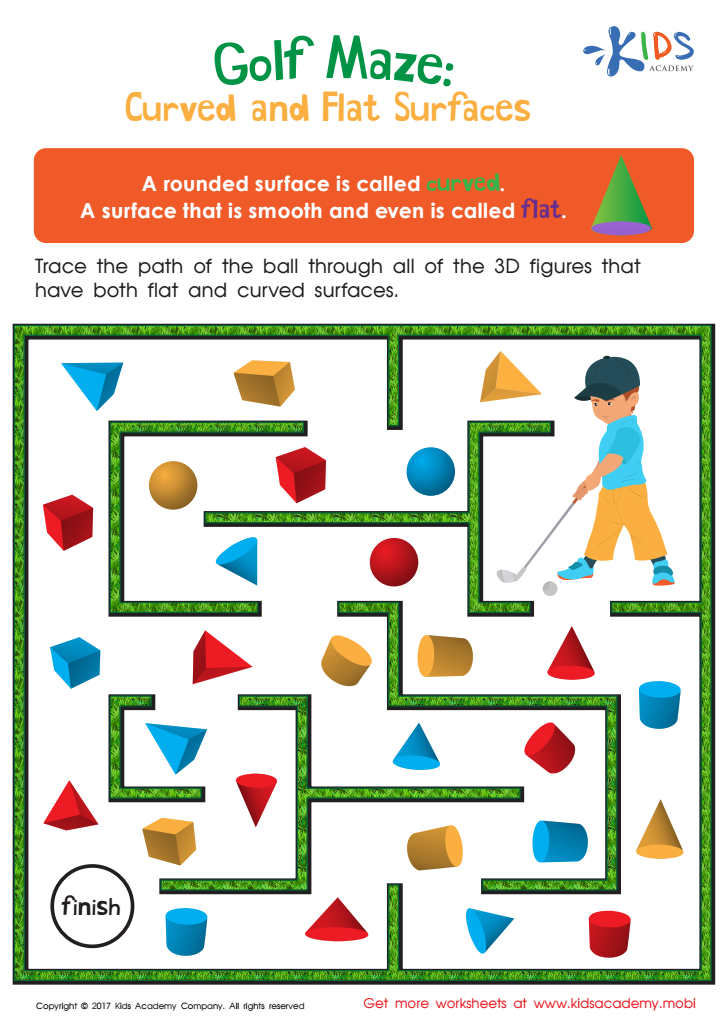
Golf Maze: Curved and Flat Surfaces Worksheet
Give your child a fun and educational challenge with this geometry maze! Your child will navigate 3D shapes to find objects with flat and curved surfaces, while learning important math concepts.
Golf Maze: Curved and Flat Surfaces Worksheet
Worksheet
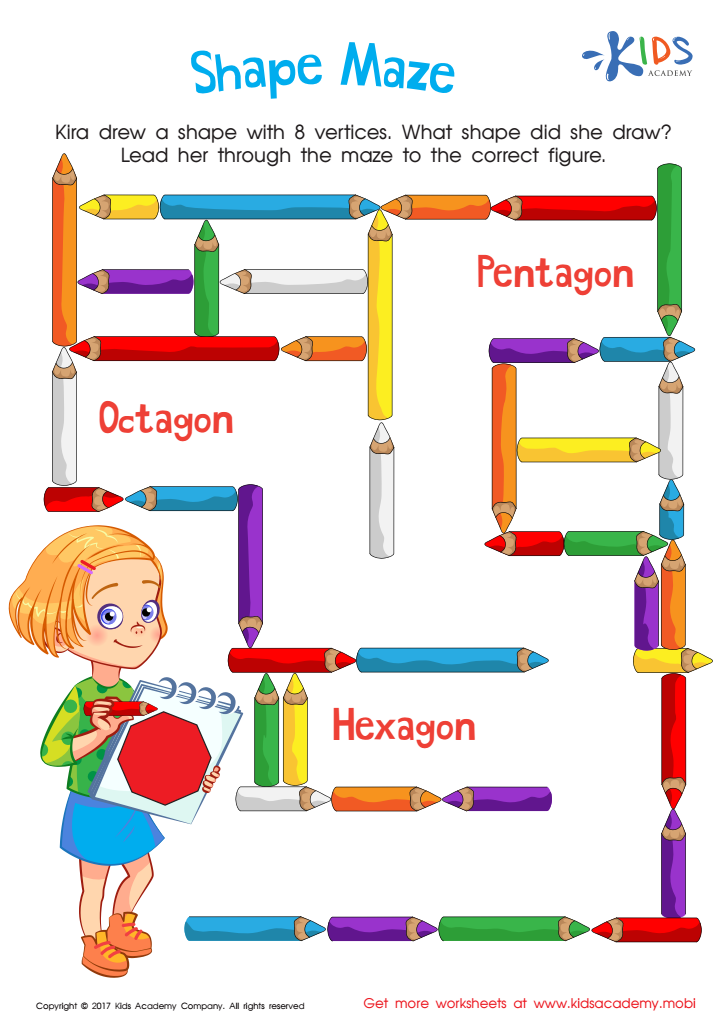
Shape Maze Worksheet
Test your child's geometry knowledge with this fun printable maze! They'll need to identify shapes with 8 vertices to find their way through the maze and get the correct answer.
Shape Maze Worksheet
Worksheet
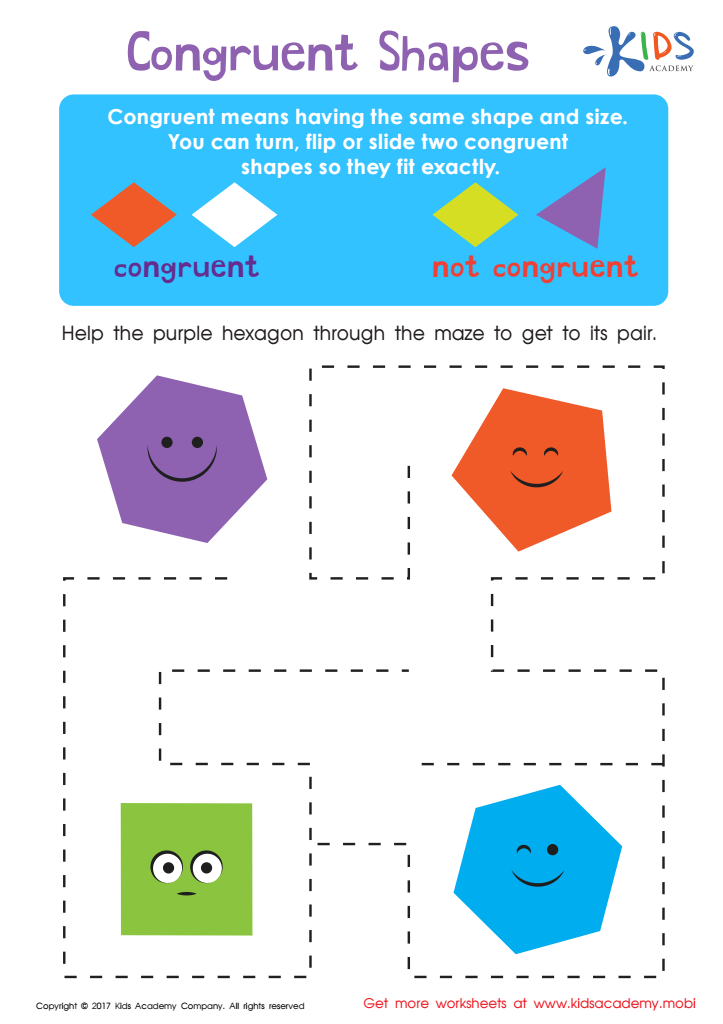
Congruent Shapes Worksheet
Help your child find the twin of the purple hexagon! This congruent shapes worksheet is great for increasing vocabulary while challenging mental rotation skills.
Congruent Shapes Worksheet
Worksheet
Join Kids Academy for Free
Who is primarily going to use this learning content?








Developing spatial awareness and geometry skills in 8-year-olds is vital for several reasons. Firstly, spatial awareness fosters a child's ability to understand and navigate the physical world. This cognitive ability is directly linked to everyday tasks such as reading maps, assembling puzzles, and even understanding the relation of objects in space - critical skills that enhance problem-solving and logical thinking.
Integrating geometry into early education bolsters not just mathematical understanding, but also creative and analytical thinking. Geometry helps children grasp fundamental mathematical concepts such as shape, size, relative position, and properties of space, forming a foundation for more complex math topics they will encounter later in school. When children tackle spatial awareness challenges, it improves their ability to visualize and manipulate objects mentally, leading to better performance in STEM (Science, Technology, Engineering, and Mathematics) disciplines.
Moreover, honing these skills early on can also impact socio-emotional development. Successful engagement in tasks involving spatial reasoning requires patience, perseverance, and attention to detail, which are essential life skills. Enhanced confidence in handling mathematical problems often translates into a more positive attitude towards school and learning overall.
Thus, paying attention to spatial awareness and geometry through extra challenges not only supports mathematical proficiency but also contributes to a child's holistic cognitive and emotional development, preparing them for future academic and real-world challenges.