Shape Recognition Extra Challenge Kindergarten 2D Shapes Worksheets
4 filtered results
Difficulty Level
Grade
Age
-
From - To
Subject
Activity
Standards
Boost your child's shape recognition with our Shape Recognition Extra Challenge Kindergarten 2D Shapes Worksheets! Perfect for young learners, these engaging worksheets offer a fun and educational way to master 2D shapes like circles, triangles, squares, and more. Designed to build confidence and enhance geometry skills, each worksheet provides colorful, kid-friendly activities that challenge and entertain. Ideal for classroom use or at-home practice, our worksheets help children identify, compare, and trace shapes, paving the way for future math success. Encourage your kindergartner's learning adventure with our expertly crafted resources. Explore and download today!
Favorites
With answer key
Interactive
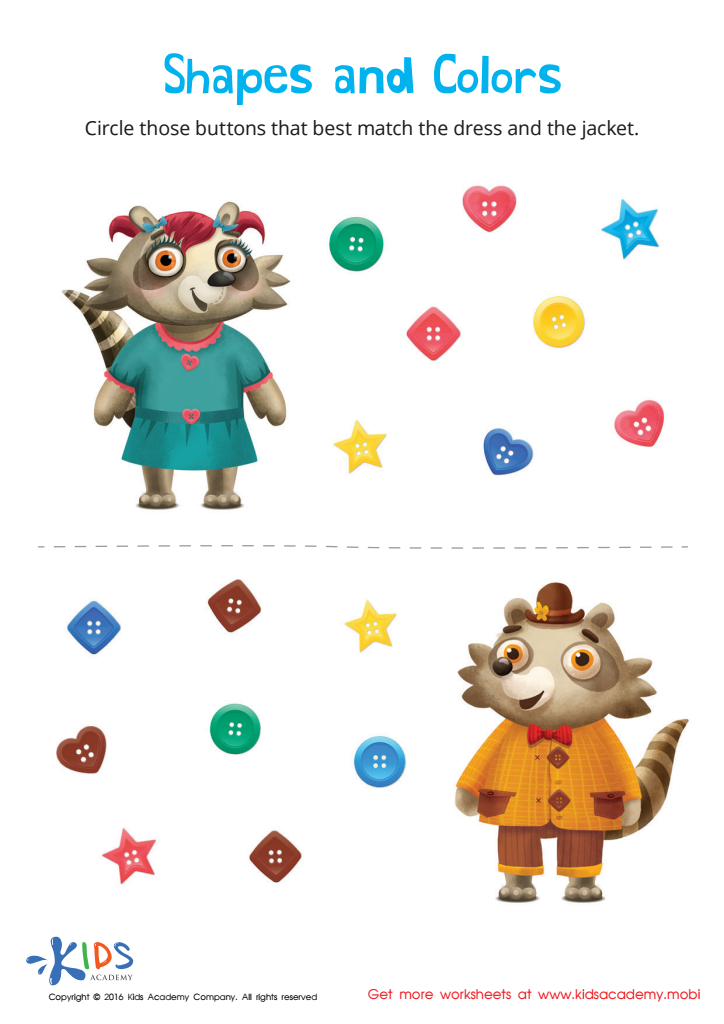
Matching: Shapes and Colors Worksheet
Help Mr. and Mrs. Raccoon find the right buttons to match their shirts! Kids will identify shapes and colors and learn to match them correctly.
 Assign to My Students
Matching: Shapes and Colors Worksheet
Worksheet
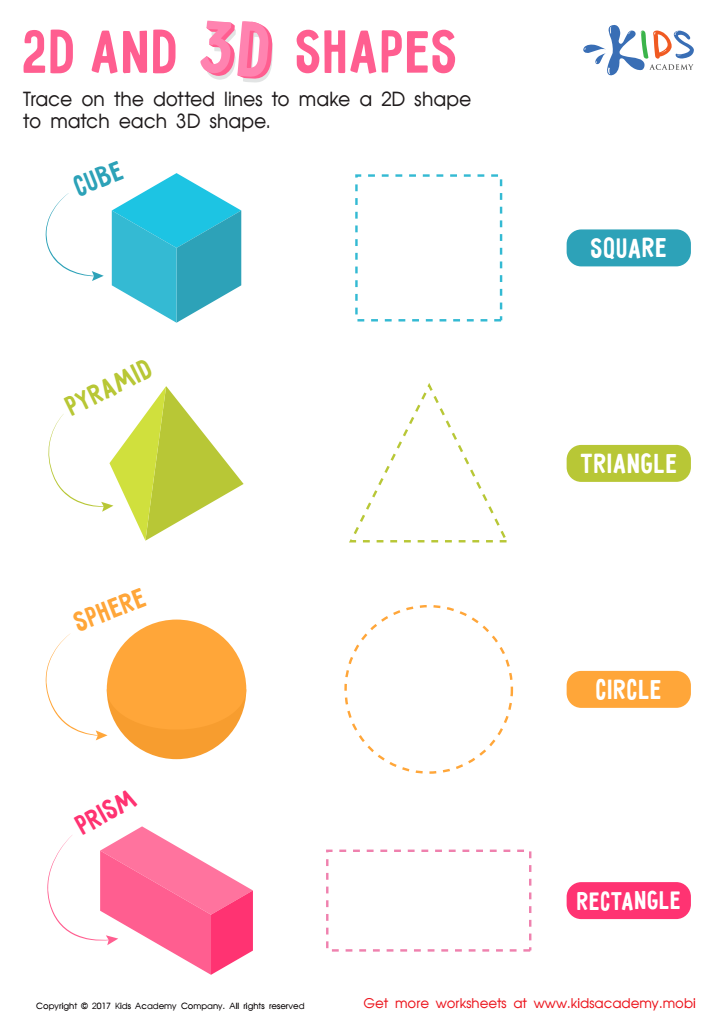
2D and 3D Shapes Worksheet
Introduce your child to 3D and 2D with this traceable worksheet. With dotted lines, help them trace and make a 2D shape for each 3D shape: square, triangle, rectangle, and circle. Show them there's more than one way to draw! You may have taken them to a 3D movie, or they've seen some fantastic 3D art. Now they can wonder no more.
2D and 3D Shapes Worksheet
Worksheet
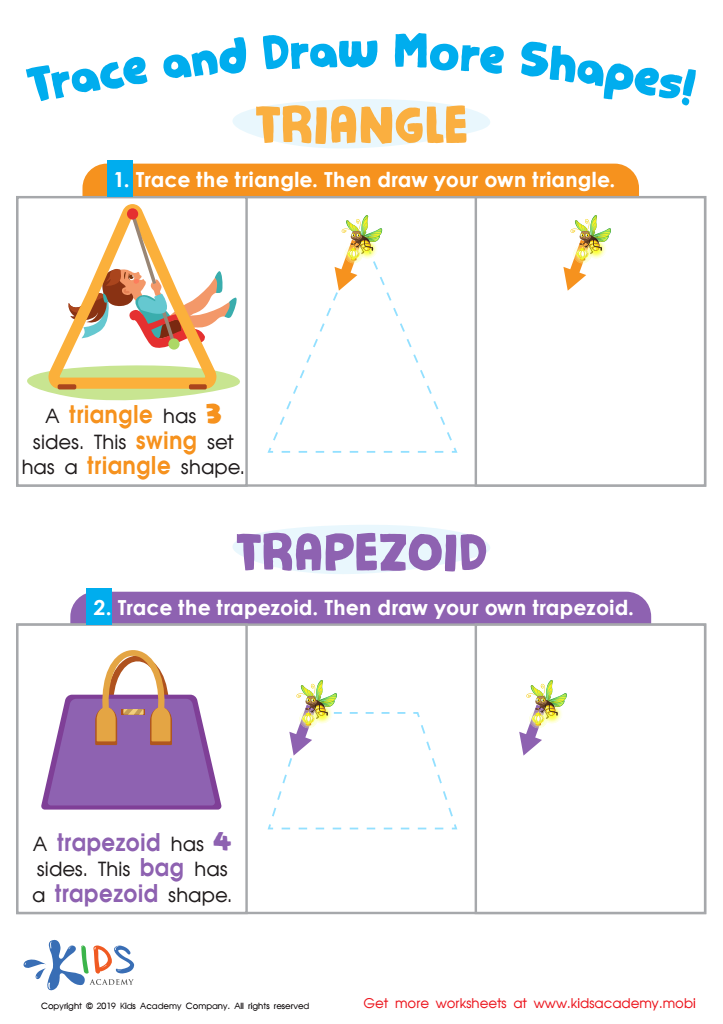
Trace and Draw More Shapes Worksheet
Help your kids with more learning! Look at images in the worksheet, read facts about the shapes, then help your kids trace and draw. This reinforces that learning is never done; use this simple worksheet to help your kids with school homework and more!
Trace and Draw More Shapes Worksheet
Worksheet
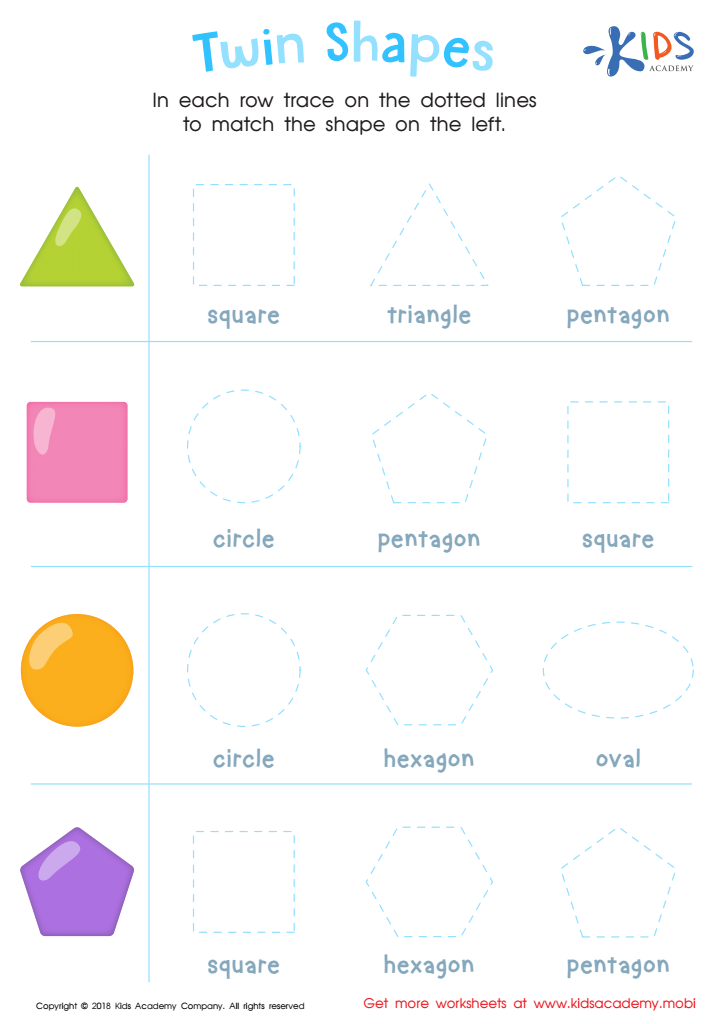
Twin Shapes Dot-to-Dot Worksheet
Test your child's ability to copy with this worksheet. Ask them to find and name the four shapes on the left. Then, they must match each with the dotted lines on the right. Help your child with all four shapes in this fun exercise.
Twin Shapes Dot-to-Dot Worksheet
Worksheet
Join Kids Academy for Free
Who is primarily going to use this learning content?






Shape recognition is fundamental for kindergarten students as it sets the groundwork for more advanced mathematical and cognitive skills. By providing extra challenges in 2D shapes, teachers and parents stimulate children's critical thinking and problem-solving abilities, which are significant for their overall development.
Understanding different shapes helps children in spatial awareness, an ability important not just in geometry but in everyday tasks such as navigating spaces and understanding the concept of distance and proportions. Recognizing shapes also boosts language and vocabulary as children learn terms like "circle," "square," "rectangle," and "triangle." This enhancement in verbal skills amplifies their ability to describe the world around them more precisely.
Moreover, these exercises cultivate fine motor skills through activities like drawing or tracing shapes, enhancing hand-eye coordination. Cognitively, differentiating shapes sharpens their analytical abilities as they compare and contrast features, such as the number of sides or angles.
Incorporating extra challenges keeps learning exciting and engaging, thereby reducing the likelihood of children becoming disinterested. Parents and teachers who promote such activities provide a strong educational foundation, encouraging a lifelong appreciation and curiosity for learning, ultimately paving the way for academic success in future mathematical concepts like symmetry, fractions, and geometry.