Develops hand-eye coordination Worksheets for Kids
1 filtered results
Difficulty Level
Grade
Age
-
From - To
Subject
Activity
Standards
Developing hand-eye coordination is essential for enhancing children's motor skills and overall cognitive development. Our "Develops Hand-Eye Coordination Worksheets" provide a fun and engaging way for children to improve this important skill. These worksheets encompass a range of activities, such as connecting dots, tracing lines, matching objects, and coloring inside the lines, all designed to enhance their hand-eye coordination abilities.
Favorites
With answer key
Interactive
Question/Answer

How to test a Grade 2 student’s Develops hand-eye coordination skills?
To test a Grade 2 student's hand-eye coordination skills, engage them in activities such as catching a ball, threading beads, playing simple video games that require precise movements, or completing puzzles. Observe their ability to accurately and efficiently coordinate their hand movements with what they see, noting both their speed and precision during these tasks.
Why is the Develops hand-eye coordination skill important for Grade 2 students?
Developing hand-eye coordination is crucial for Grade 2 students as it underpins their ability to perform everyday tasks, such as writing, cutting, and tying shoelaces. It also supports sports participation, enhances visual tracking needed for reading, and improves overall fine motor skills. This foundational skill contributes to academic success and independence in various school activities.
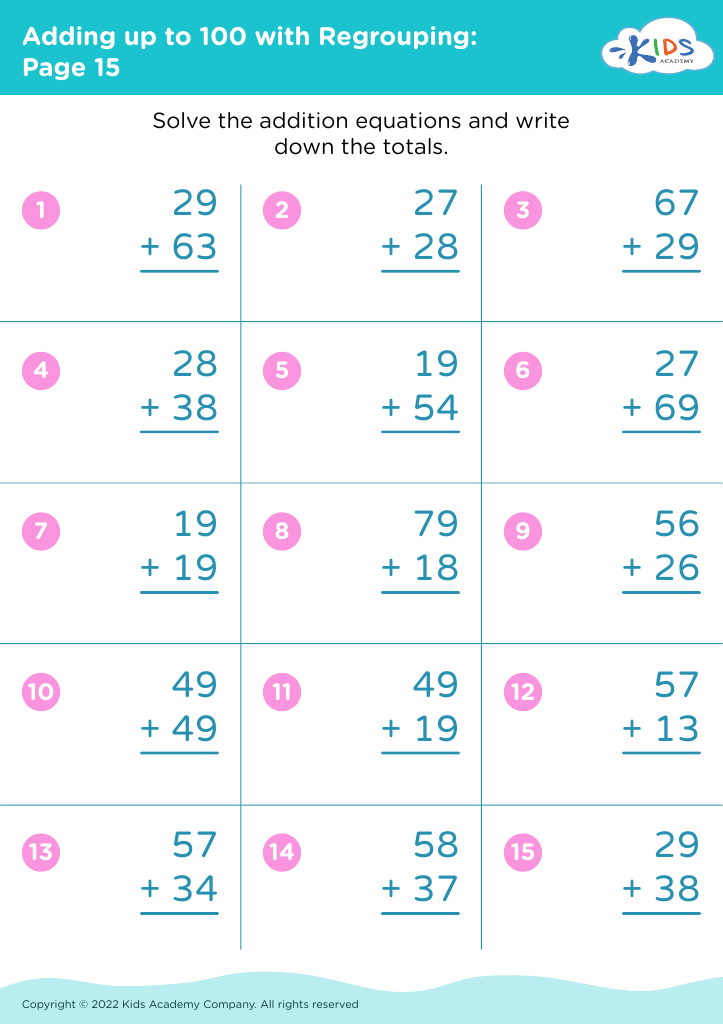
What are some effective activities to train students’ Develops hand-eye coordination skill when teaching them about Adding up to 100 with Regrouping?
To develop hand-eye coordination while teaching adding up to 100 with regrouping, consider activities like interactive number line hops, where students physically jump to numbers as they add; bead threading for visualizing addition problems; and using manipulatives like blocks or coins to group and regroup numbers. These tactile, movement-based activities enhance understanding while improving coordination.
Join Kids Academy for Free
Who is primarily going to use this learning content?


.jpg)


.jpg)