Differentiating day/night Worksheets for Kids
1 filtered results
Difficulty Level
Grade
Age
-
From - To
Subject
Activity
Standards
Differentiating day/night worksheets are a valuable educational tool designed to teach children about the concept of night and day and how they differ from each other. These worksheets offer a variety of activities and exercises that help students understand the characteristics of these two periods, such as the presence or absence of sunlight, changes in temperature and natural lighting, and the activities typically done during each time period.
Favorites
With answer key
Interactive
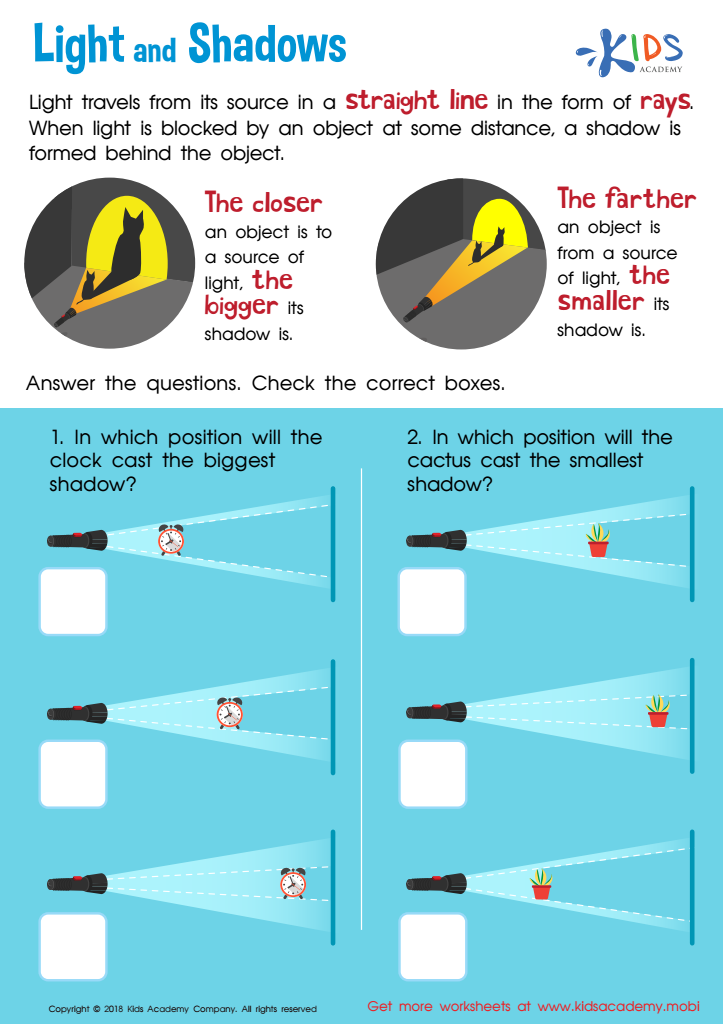
Light and Shadow Worksheet for Grade 3
Kids are often scared of shadows, but they can learn that they're not so scary! This worksheet helps grade 3 kids understand how light rays and objects create shadows, and how they can be large or small. Teach your child with this interesting worksheet!
 Assign to My Students
Light and Shadow Worksheet for Grade 3
Worksheet
Question/Answer

What are some effective activities to train students’ Differentiating day/night skill when teaching them about Physical Science?
Effective activities for training students' Differentiating day/night skill in Physical Science include: 1. **Observation Journal:** Students record daily sunrise and sunset times, noting changes. 2. **Shadow Tracking:** Measure and track the length and direction of shadows at different times. 3. **Creating Day/Night Models:** Use globes and lamps to simulate Earth’s rotation, illustrating day and night. 4.
How does the mastery of the Differentiating day/night skill affect a student's performance at an early age?
Mastery of the Differentiating day/night skill at an early age significantly enhances a student's cognitive and conceptual development. It aids in understanding time concepts, improves observational skills, and fosters a sense of routine and time management. This foundational knowledge supports learning in science, enhances language and communication skills, and contributes to overall academic performance and daily life understanding.
How to test a Grade 3 student’s Differentiating day/night skills?
To test a Grade 3 student's skills in differentiating day from night, present a series of images or scenarios, asking the student to categorize each as day or night based on observable clues (e.g., position of the sun, moon, stars, activities people are doing). Include a mix of clear and ambiguous examples to assess their understanding and reasoning abilities.
Join Kids Academy for Free
Who is primarily going to use this learning content?