Formulating equations Worksheets for Kids
1 filtered results
-
From - To
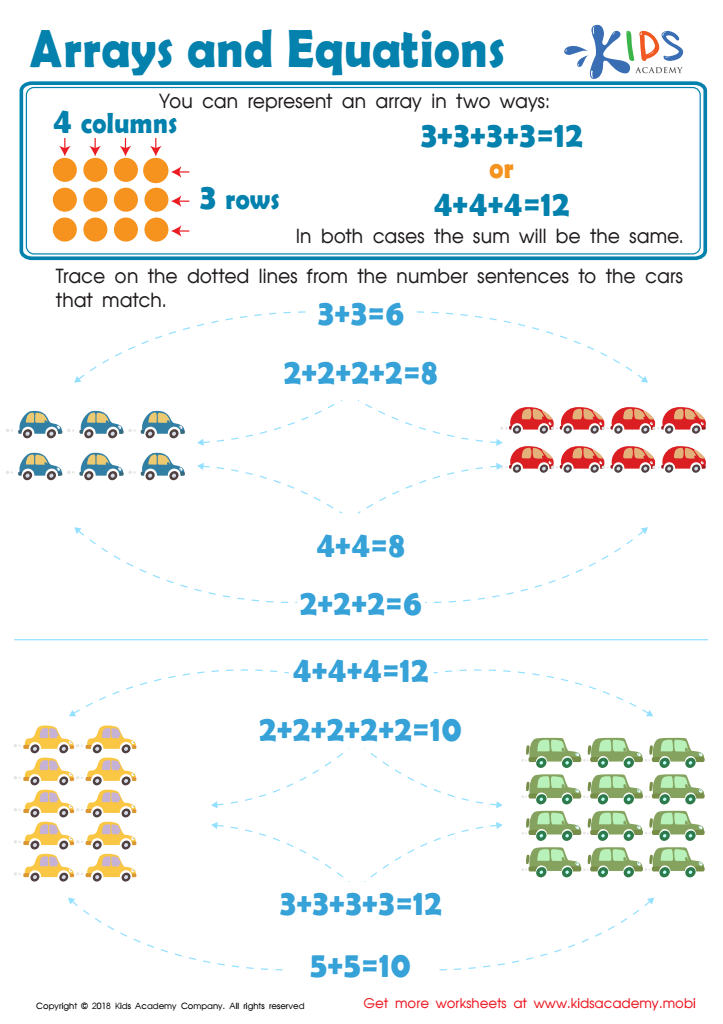
Arrays and Equations Worksheet
 Assign to My Students
Question/Answer

How to test a Grade 2 student’s Formulating equations skills?
To test a Grade 2 student's skills in formulating equations, present simple word problems that involve addition or subtraction within their comprehension level. Ask the student to translate the problem into a mathematical equation using numbers and symbols. This can involve scenarios like combining groups of objects or separating them, ensuring the problems are relatable to their everyday experiences.
How does the mastery of the Formulating equations skill affect a student's performance at an early age?
Mastery of the formulating equations skill at an early age significantly enhances a student's mathematical thinking, problem-solving abilities, and logical reasoning skills. This foundational competency enables students to effectively interpret and solve word problems, laying a solid groundwork for advanced mathematical concepts and applications, thereby positively impacting their overall academic performance and confidence in mathematics.
What are some effective activities to train students’ Formulating equations skill when teaching them about Numbers?
Effective activities to train students in formulating equations include: 1) Word problem challenges that require translating scenarios into equations, 2) Equation scavenger hunts where students find and create equations that match different criteria, 3) Puzzles that require setting up and solving equations for completion, and 4) Interactive games that dynamically adjust difficulty and encourage equation formulation in playful contexts.





.jpg)