Practical science application Worksheets for Kids
1 filtered results
Difficulty Level
Grade
Age
-
From - To
Subject
Activity
Standards
Practical science application worksheets offer an engaging and interactive way for students to learn and apply scientific concepts. With these worksheets, students have the opportunity to delve into hands-on experiments, observe real-life scenarios, and analyze data to gain a better understanding of practical science. By working through these activities, students develop critical thinking skills as they formulate hypotheses, analyze data, and draw conclusions. This approach to learning science fosters active participation and boosts retention. Moreover, these worksheets promote independent learning, as students can work at their own pace, review concepts as needed, and reinforce key scientific principles. Ultimately, incorporating practical science application worksheets in the classroom enhances student comprehension, cultivates curiosity, and ignites a passion for scientific inquiry.
Favorites
With answer key
Interactive
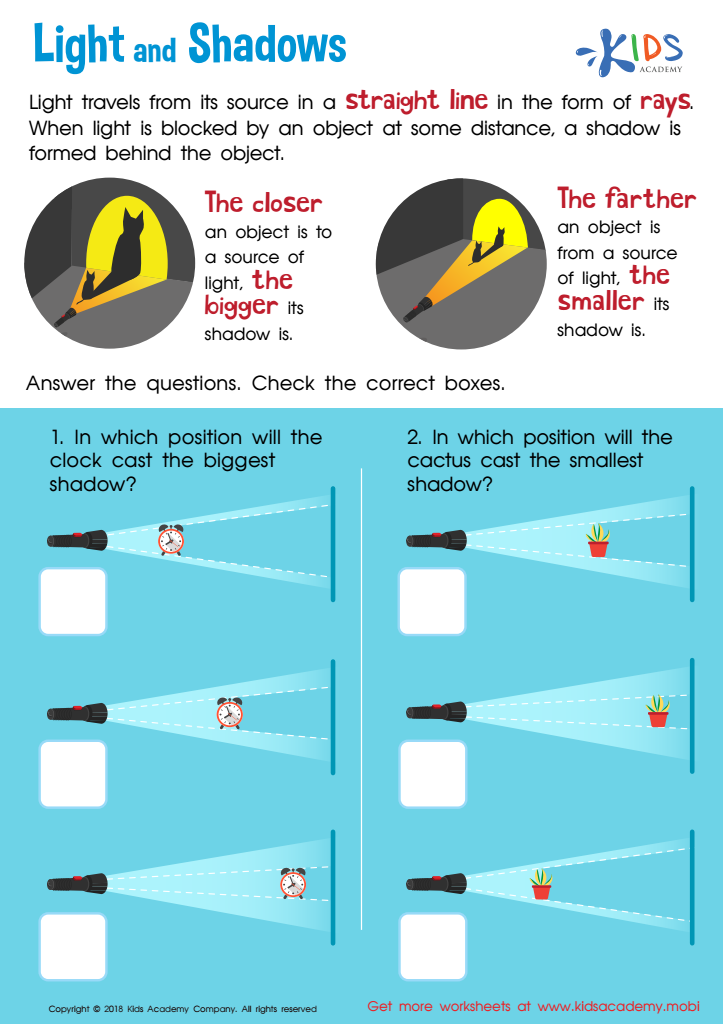
Light and Shadow Worksheet for Grade 3
Kids are often scared of shadows, but they can learn that they're not so scary! This worksheet helps grade 3 kids understand how light rays and objects create shadows, and how they can be large or small. Teach your child with this interesting worksheet!
 Assign to My Students
Light and Shadow Worksheet for Grade 3
Worksheet
Question/Answer

What are some effective activities to train students’ Practical science application skill when teaching them about Physical Science?
Effective activities for training students in practical science application skills include conducting hands-on experiments, engaging in collaborative group projects, implementing inquiry-based learning tasks, utilizing virtual or augmented reality simulations, organizing field trips to science centers or industries, and promoting problem-solving through real-world scenario analyses. These activities help connect theoretical knowledge to practical applications, enhancing understanding and engagement.
Why is the Practical science application skill important for Grade 3 students?
Practical science application skills are important for Grade 3 students as they foster critical thinking, creativity, and problem-solving abilities. These hands-on experiences make science concepts more tangible and engaging, helping students understand the relevance of science in daily life. Additionally, early exposure to practical science nurtures curiosity and encourages a lifelong interest in learning and exploring the world scientifically.
How to test a Grade 3 student’s Practical science application skills?
To test a Grade 3 student's practical science application skills, engage them in simple, hands-on experiments or projects that allow them to observe, predict, and conclude. For instance, growing plants under different conditions, mixing safe chemicals to observe reactions, or using simple tools to measure and compare. This approach assesses their ability to apply scientific concepts in real-world situations.
Join Kids Academy for Free
Who is primarily going to use this learning content?