Silent "e" recognition Worksheets for Kids
1 filtered results
Difficulty Level
Grade
Age
-
From - To
Subject
Activity
Standards
Silent "e" recognition worksheets are an excellent tool to help young learners develop essential phonics skills. These worksheets focus on identifying and understanding the role of the silent "e" in words. With various engaging exercises, these worksheets provide effective practice opportunities for recognizing and utilizing silent "e" in spelling and reading.
Favorites
With answer key
Interactive
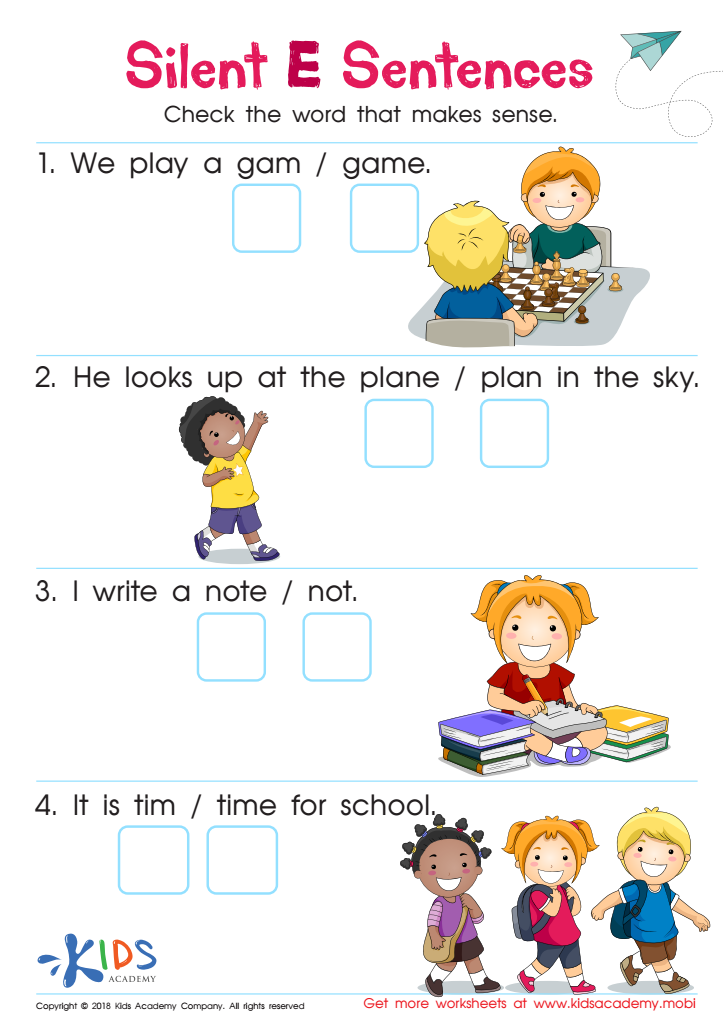
Silent E Sentences Worksheet
Young readers can find learning Silent E tricky, so this helpful worksheet can help! It teaches them to distinguish words that look the same but for the Silent E and choose the right word for sentence blanks. Kids can mark the correct answer and become familiar with closed syllables and words that require the E.
 Assign to My Students
Silent E Sentences Worksheet
Worksheet
Question/Answer

How does the mastery of the Silent "e" recognition skill affect a student's performance at an early age?
The mastery of the Silent "e" recognition skill significantly improves a student's reading and spelling abilities at an early age. It enhances their understanding of vowel sounds and word patterns, leading to increased reading fluency and comprehension. This foundational skill also boosts their confidence and encourages a positive attitude towards learning and literacy development.
What does the Silent "e" recognition skill mean when it comes to Grade 1 Silent Vowels learning?
The Silent "e" recognition skill in Grade 1 Silent Vowels learning refers to the ability of students to identify and understand the role of a silent "e" at the end of words, which often makes the vowel within the word say its name (long vowel sound) rather than its sound (short vowel sound).
What are some effective activities to train students’ Silent "e" recognition skill when teaching them about Silent Vowels?
Effective activities for training students in Silent "e" recognition include: using word lists for reading and sorting activities, implementing interactive games like bingo with Silent "e" words, engaging in word-building exercises with magnetic letters or letter tiles, practicing word dictation, and incorporating engaging online resources and apps focused on Silent "e" words.
Join Kids Academy for Free
Who is primarily going to use this learning content?