Understanding bird anatomy Worksheets for Kids
1 filtered results
-
From - To
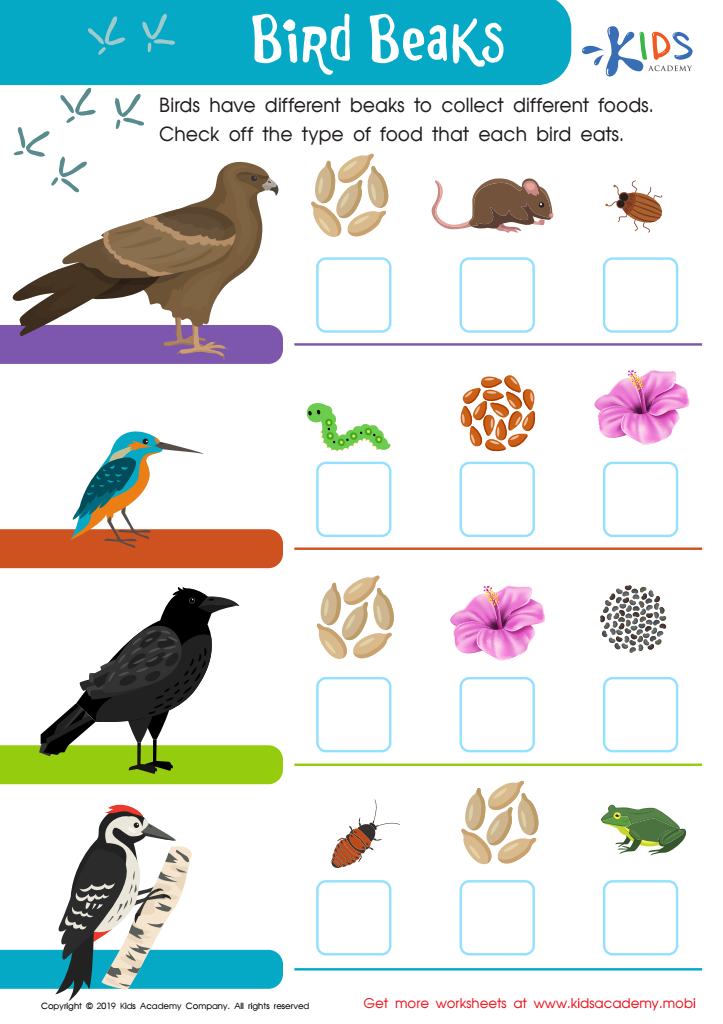
Bird Beaks Worksheet
 Assign to My Students
Question/Answer

How to train the Understanding bird anatomy skill in Grade 1 students learning about Our Planet and Environment?
To train Grade 1 students in understanding bird anatomy, start with simple, interactive activities. Use a basic, colorful diagram of a bird highlighting key parts like the beak, feathers, wings, and feet. Incorporate hands-on crafts, such as building a model bird or drawing and labeling parts. Engage students with storytelling about birds, emphasizing their body parts' functions and importance.
How to test a Grade 1 student’s Understanding bird anatomy skills?
To test a Grade 1 student's understanding of bird anatomy, use simple, visual assessments. Provide labeled diagrams of a bird and ask the student to match names to parts of the body (like beak, wings, feathers) with assistance. Alternatively, use a toy or model bird, point to different parts, and ask the student to name them.
How does the mastery of the Understanding bird anatomy skill affect a student's performance at an early age?
Mastery of the Understanding bird anatomy skill at an early age can significantly enhance a student's observational skills, critical thinking, and scientific inquiry abilities. It fosters curiosity about the natural world, improves classification and comparison skills, and lays a foundation for more advanced biological sciences learning.