Understanding consumer habits Worksheets for Kids
1 filtered results
Difficulty Level
Grade
Age
-
From - To
Subject
Activity
Standards
Understanding consumer habits worksheets are a valuable learning tool that helps individuals grasp the intricacies of consumer behavior. By studying these worksheets, learners can gain insights into the decision-making and purchasing patterns of consumers. These worksheets offer numerous benefits, such as providing a practical approach to exploring and analyzing consumer habits, allowing learners to recognize trends and patterns, and honing critical thinking skills. By actively engaging with these worksheets, individuals can learn how factors like personal preferences, external influences, and marketing tactics shape consumer behavior. Ultimately, understanding consumer habits through worksheets equips learners with the ability to make informed decisions in business, marketing, or any aspect of life that involves understanding and addressing the needs and desires of consumers.
Favorites
With answer key
Interactive
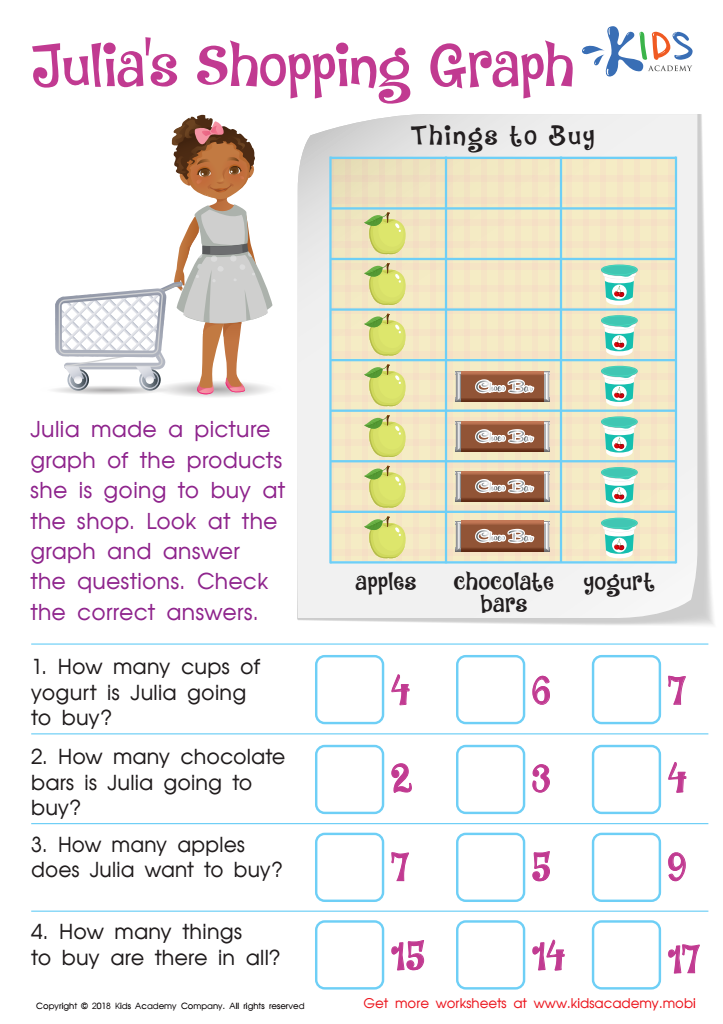
Julia's Shopping Graph Worksheet
This fun PDF worksheet provides little mathematicians with practice using pictographs. They will answer questions about Julia's graph, helping to assess their understanding of reading and interpreting data. Counting and choosing the correct answer is sure to be an enjoyable experience!
 Assign to My Students
Julia's Shopping Graph Worksheet
Worksheet
Question/Answer

How does the mastery of the Understanding consumer habits skill affect a student's performance at an early age?
Mastering the skill of Understanding Consumer Habits at an early age can significantly enhance a student's performance by improving their decision-making, critical thinking, and financial literacy. It fosters awareness of market influences, advertising tactics, and the importance of sustainable consumption, thereby promoting responsible and informed choices that can contribute positively to their current and future academic, personal, and social success.
What are some effective activities to train students’ Understanding consumer habits skill when teaching them about Numbers?
Effective activities include creating surveys to gather data on consumer preferences, analyzing shopping patterns through case studies, role-playing as consumers to discuss decision-making processes, interpreting graphs and charts of market trends, and conducting mini-experiments like A/B testing with classmates to observe different responses. These activities help students apply numerical analysis to understand and predict consumer behavior.
How to train the Understanding consumer habits skill in Grade 1 students learning about Numbers?
To train Grade 1 students in understanding consumer habits through numbers, integrate simple, relatable purchasing scenarios into math lessons. Use activities like role-playing a store where they buy and sell items using play money. Focus on counting, basic addition, and subtraction to facilitate making purchases and giving change, thereby connecting numeracy skills with everyday consumer transactions in an engaging manner.
Join Kids Academy for Free
Who is primarily going to use this learning content?