Understanding parts of a whole Worksheets for Kids
1 filtered results
-
From - To
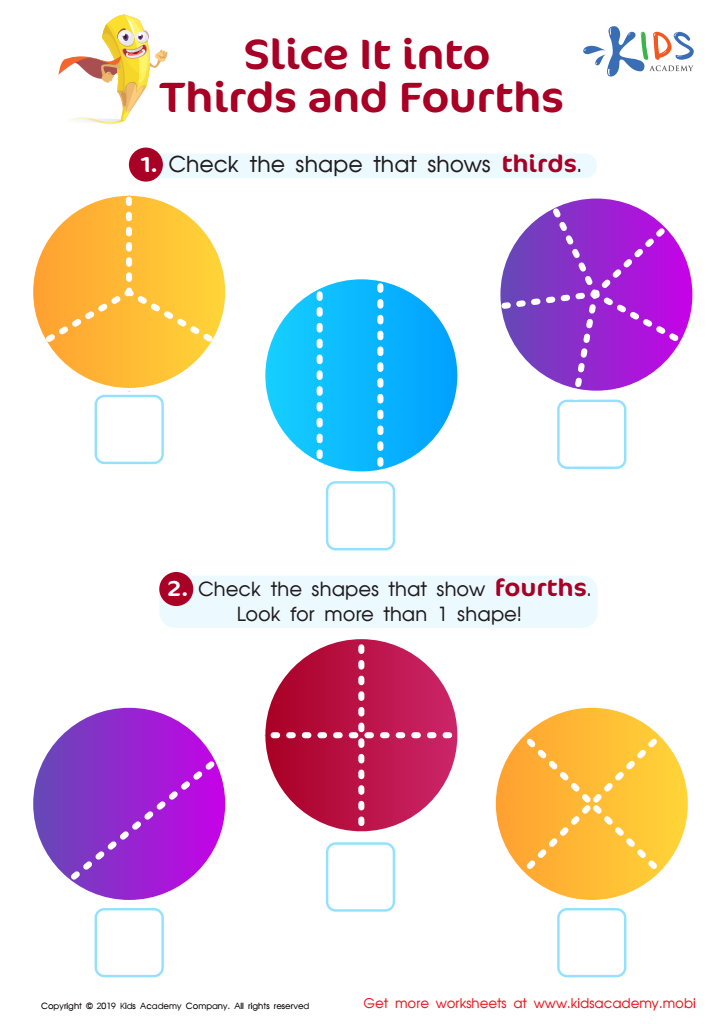
Slice in Thirds Fourths Worksheet
 Assign to My Students
Question/Answer

How to train the Understanding parts of a whole skill in Grade 2 students learning about Geometry?
To train Grade 2 students in understanding parts of a whole in Geometry, introduce them to simple shapes (like circles, squares) and tangible items (like pizza or pie) that can be divided into parts.
Why is the Understanding parts of a whole skill important for Grade 2 students?
The Understanding parts of a whole skill is crucial for Grade 2 students because it lays the foundation for essential math concepts such as fractions, division, and percentage. It helps students grasp relationships between parts and wholes, fostering logical thinking and problem-solving abilities.
What does the Understanding parts of a whole skill mean when it comes to Grade 2 Geometry learning?
The Understanding parts of a whole skill in Grade 2 Geometry involves recognizing and identifying how shapes can be divided into equal parts and describing those parts using terms such as halves, thirds, and fourths. It lays the foundation for understanding fractions by relating them to familiar geometric shapes.