Critical Thinking Adding 2-digit Numbers Worksheets
3 filtered results
-
From - To
Unlock your child's potential with our "Critical Thinking Adding 2-Digit Numbers Worksheets." Designed to enhance mathematical skills while fostering analytical thinking, these worksheets challenge students to solve addition problems through engaging activities and real-world scenarios. By encouraging kids to approach math thoughtfully, they develop perseverance and curiosity. Our rich variety of problems will not only improve their addition skills but also integrate critical thinking strategies essential for overall success in academics. Ideal for classroom use or at-home practice, these worksheets make learning enjoyable and effective. Start empowering your child with critical thinking skills today!
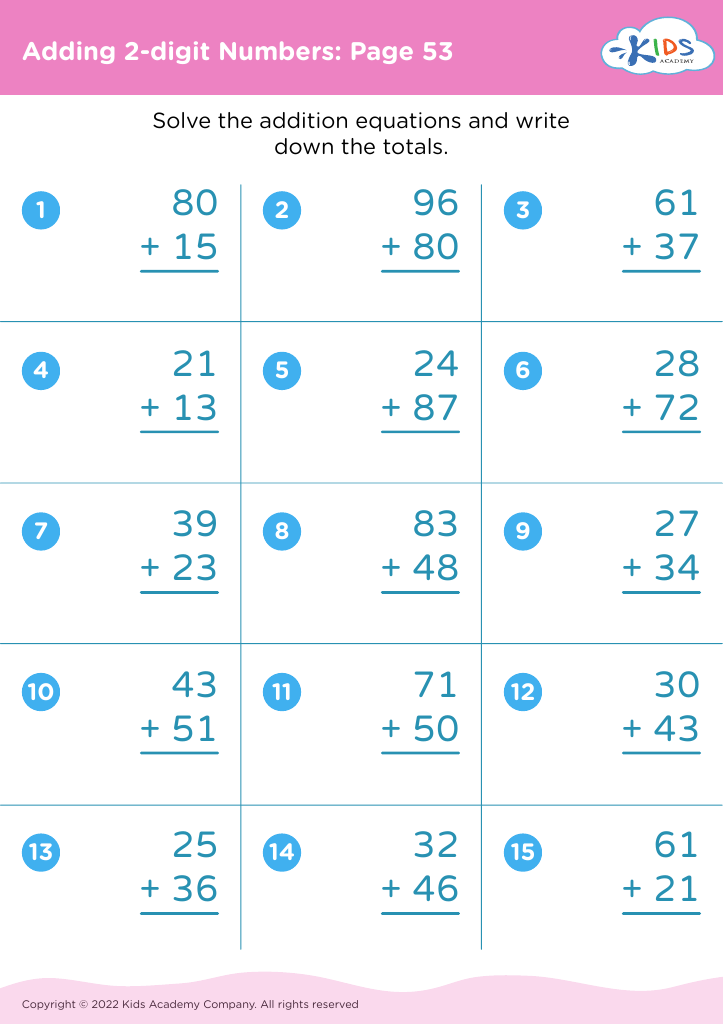
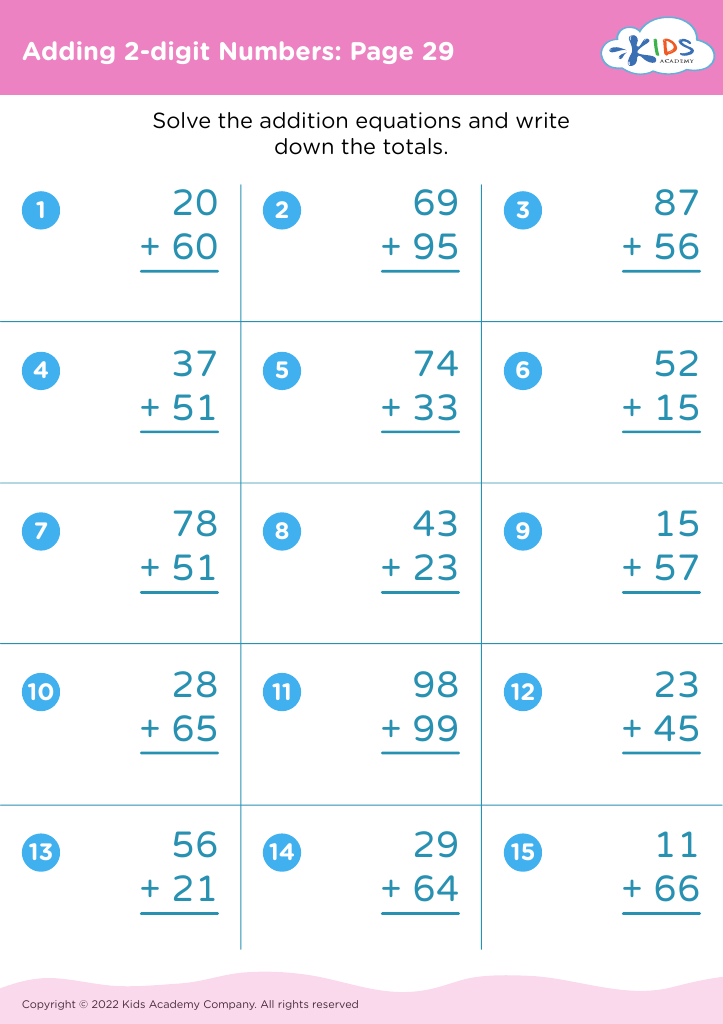
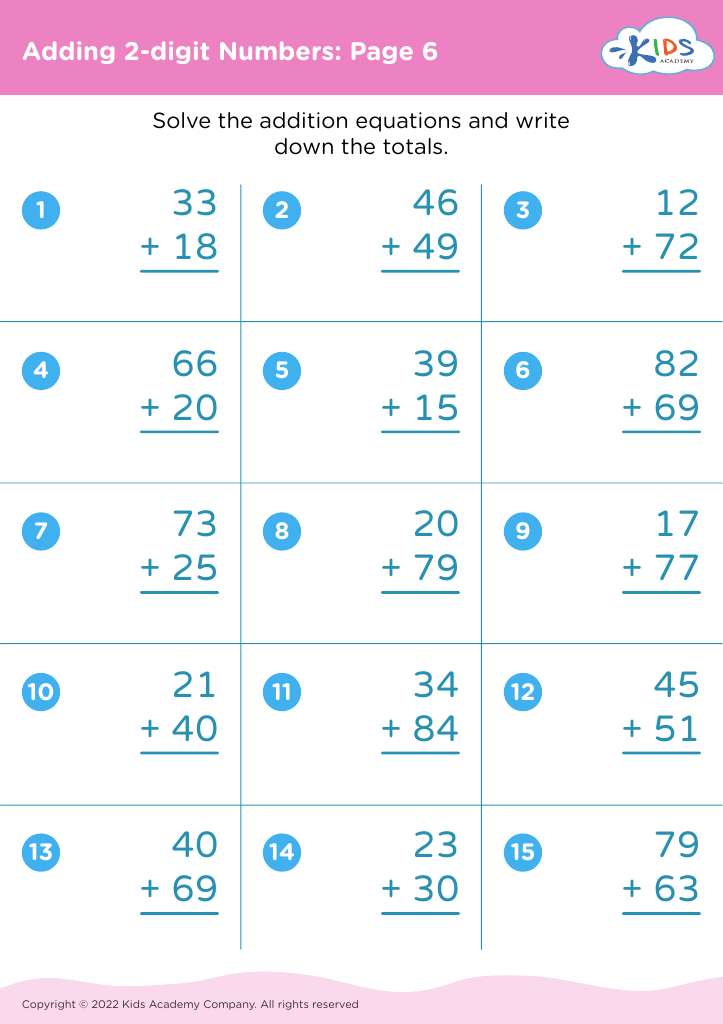








Critical thinking is a vital skill in today’s fast-paced world, especially when it comes to effectively adding 2-digit numbers. Parents and teachers should prioritize nurturing this skill because it fosters deeper understanding and engagement in mathematics.
First, critical thinking encourages students to explore various strategies for adding numbers, such as using mental math, drawing number lines, or decomposing numbers (breaking them down into tens and ones). This not only enhances their understanding but also promotes flexibility in problem-solving.
Moreover, when children learn to justify and communicate their thinking processes, they develop essential reasoning skills. This helps them become more confident learners who can tackle increasingly complex mathematical concepts in the future. Encouraging students to think critically as they perform addition tasks also aids in developing self-assessment skills. They learn to review their work, identify mistakes, and correct them independently, fostering resilience.
Beyond mathematics, the habits of critical thinking acquired while adding 2-digit numbers positively influence other areas of learning and daily decision-making. By nurturing these skills early on, parents and teachers are equipping children with life-long tools that lead to informed, reasoned, and effective problem-solving. Hence, fostering critical thinking in early mathematics is an investment in a child’s academic success and overall cognitive growth.








