Improve number recognition Adding up to 100 Misc Worksheets
3 filtered results
-
From - To
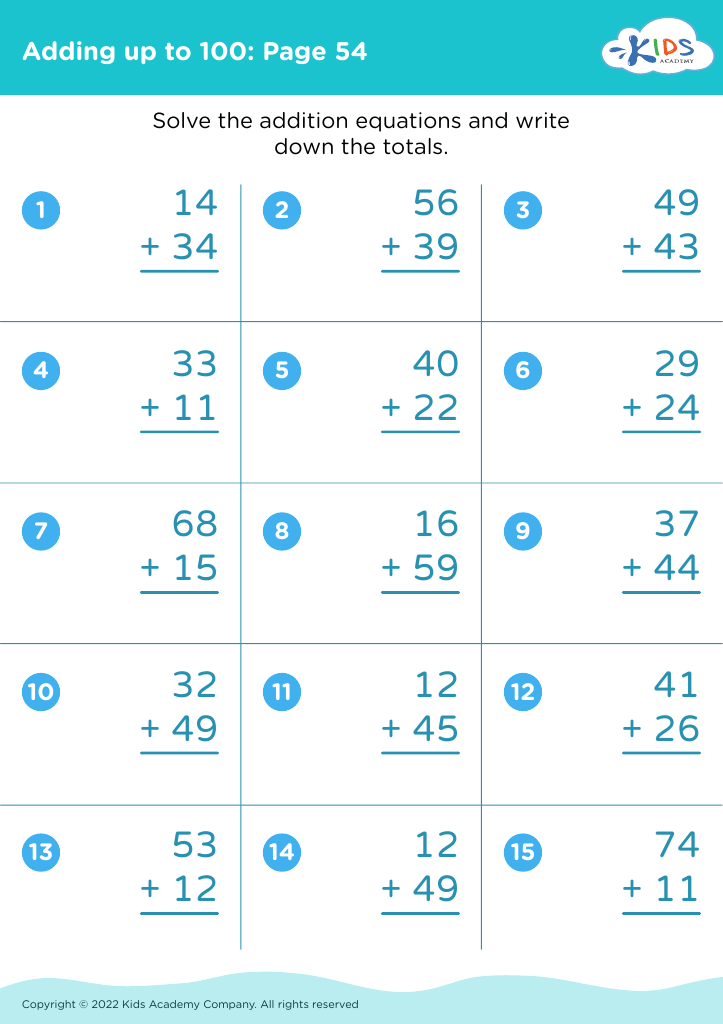
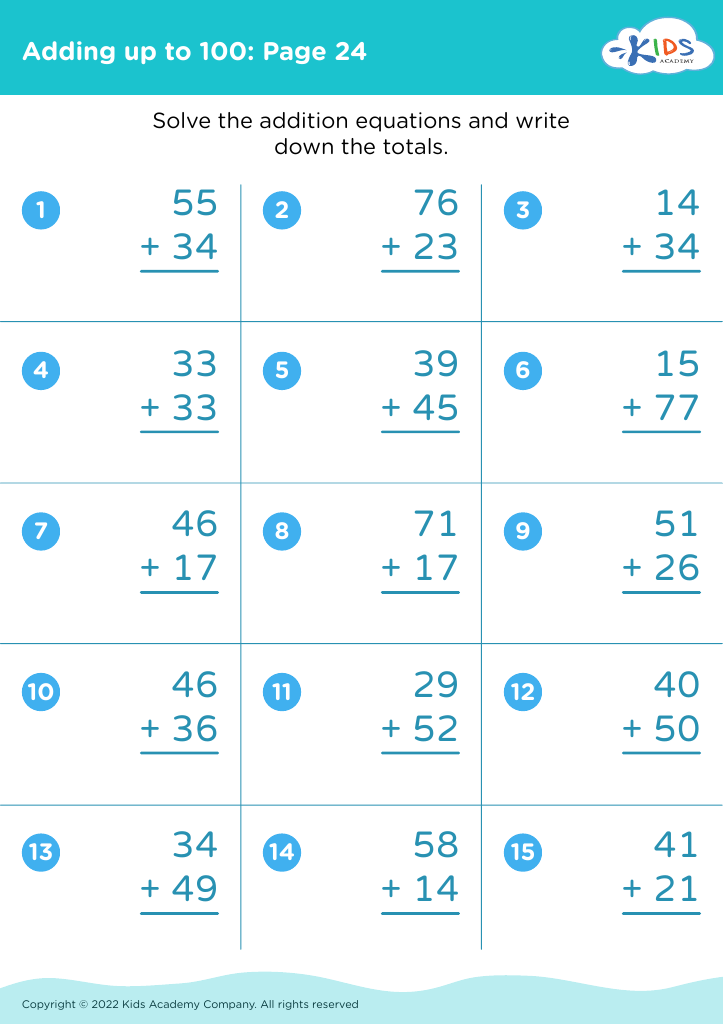
Enhance your child's number recognition and addition skills with our meticulously crafted worksheets focused on adding up to 100. Designed for young learners, these worksheets offer a delightful range of activities that bolster numeric understanding and arithmetic proficiency. Each sheet presents engaging exercises, such as matching numbers, simple addition problems, and interactive number games. Whether practiced at home or in the classroom, our worksheets enable children to develop confidence and accuracy with numbers in a fun and educational manner. Unlock your child's potential and make math mastery enjoyable with our comprehensive number recognition addition worksheets!
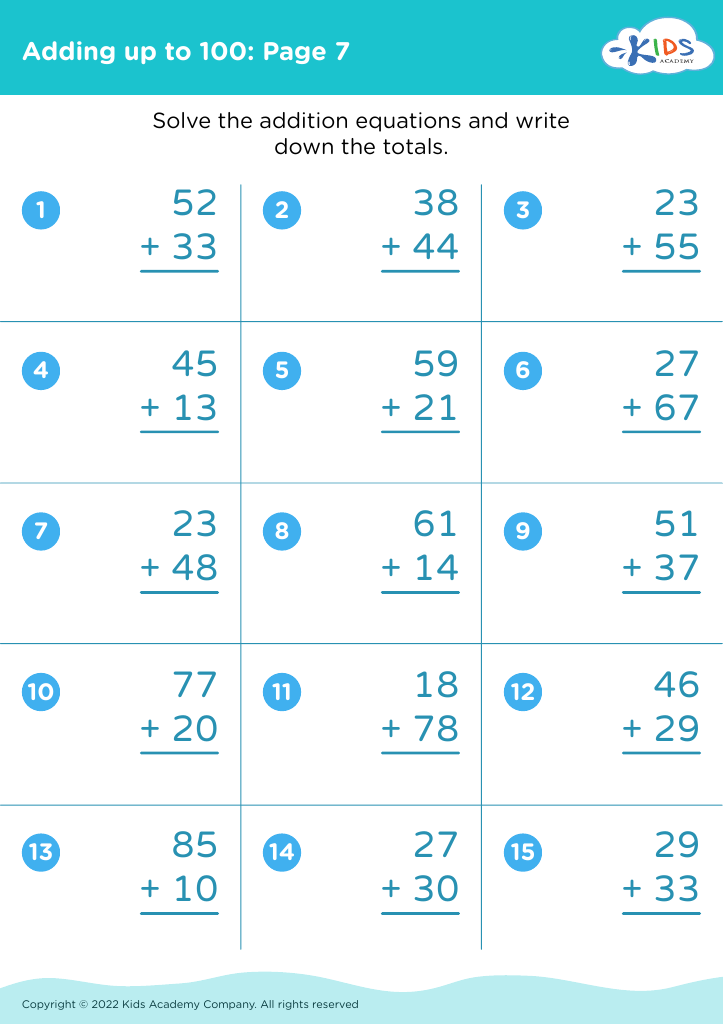


Improving number recognition and basic addition skills up to 100 in young children is foundational to their mathematical development and overall cognitive growth. Number recognition is the ability to identify and name numbers correctly. This skill is crucial because it forms the basis for more complex mathematical concepts and operations, including addition, subtraction, multiplication, and division.
When children have a strong grasp of number recognition, they can more easily understand the relationship between numbers and quantities. This cognitive link is essential for developing a deeper understanding of math. Adding up to 100 is particularly important as it builds on this foundational understanding and introduces children to early computational skills, problem-solving, and numerical reasoning.
Furthermore, these skills have practical applications in everyday contexts. For instance, recognizing and adding numbers are necessary for tasks such as shopping, cooking, and managing time. Fostering these abilities early on also helps develop children's confidence in their math skills, promoting a positive attitude toward learning and reducing math anxiety later in life.
Moreover, research has shown that early math skills are strong predictors of academic success not only in mathematics but across other subjects as well. Thus, parents and teachers who emphasize number recognition and addition set children on a path toward long-term academic achievement and practical life skills.