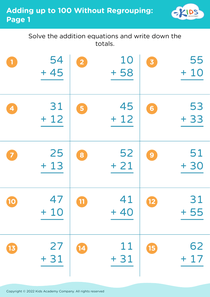
Practice problem-solving Adding up to 100 with Regrouping Worksheets
3 filtered results
-
From - To
Boost your child's math skills with our "Practice Problem-Solving: Adding up to 100 with Regrouping Worksheets". Created by expert educators, these worksheets provide engaging and effective exercises to master addition within 100. Through diverse problems and regrouping challenges, children develop critical logical thinking and problem-solving abilities. Perfect for reinforcing classroom lessons, these printable worksheets cater to different learning styles with interactive features and clear instructions. Ideal for both classroom and home practice, ensure your child builds a strong math foundation, confidence, and a love for learning. Explore today and watch their math skills soar!
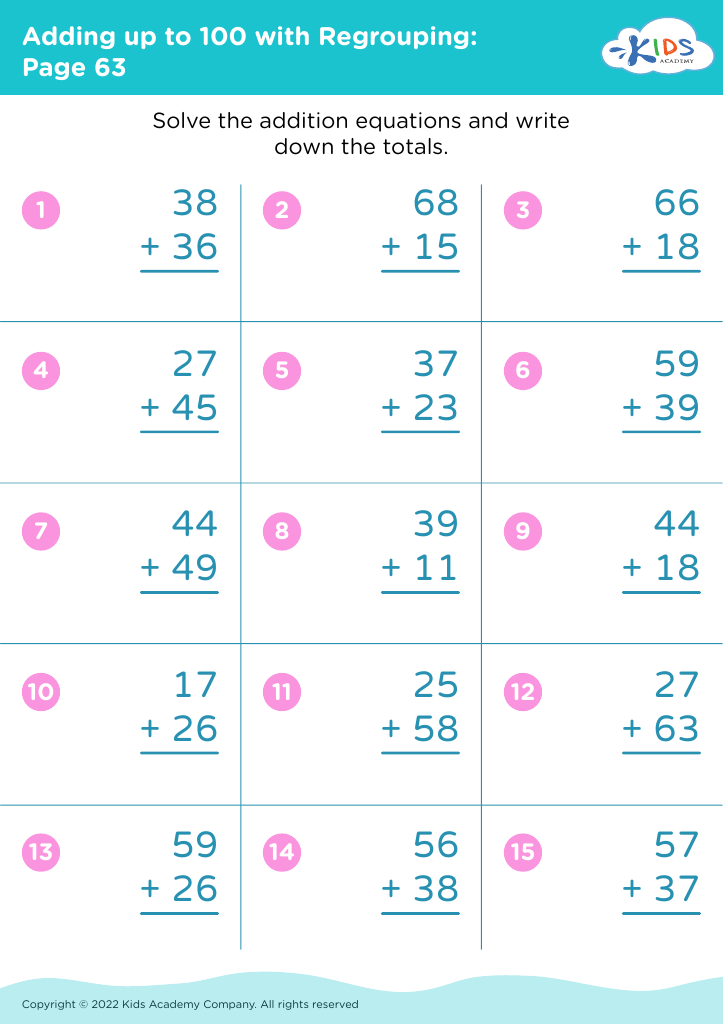
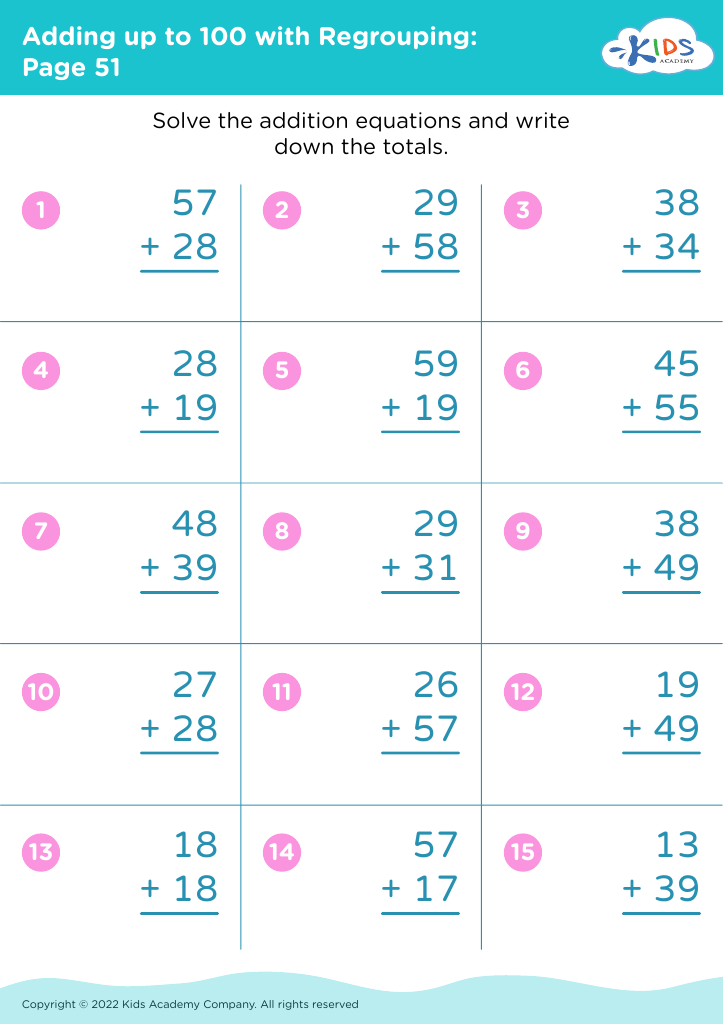
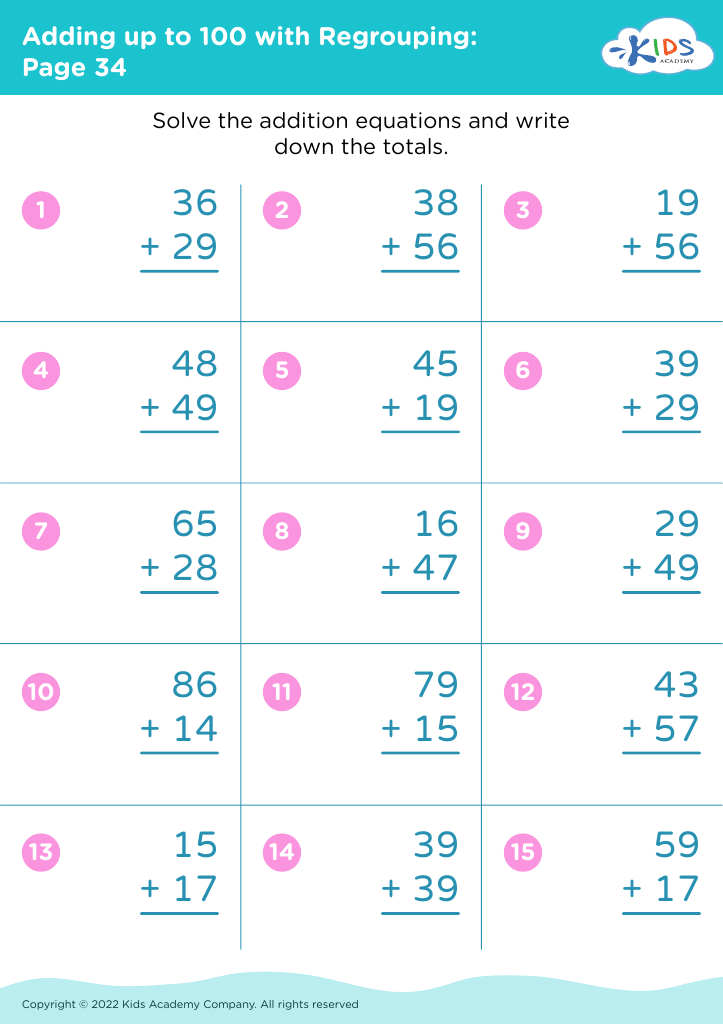




As parents and teachers, it's vital to foster strong numerical and problem-solving skills in children, as these are foundational competencies for lifelong success. Practicing problem-solving by adding up to 100 with regrouping is essential because it directly reinforces critical mathematical concepts and cognitive abilities.
First, understanding and mastering this operation enhances a child's grasp of place value, which is the cornerstone of all higher mathematics. Children learn to recognize that digits in different places represent different values, a skill that's paramount in ensuring accuracy and fluency in computation.
Second, regrouping, or carrying over, is a practical skill that aids in building efficiency and speed while performing arithmetic operations. This practice helps children to manage larger and more complex numbers, easing their transition to more advanced math topics.
Furthermore, problem-solving exercises encourage logical reasoning, analytical thinking, and perseverance. They prompt students to think methodically, explore various strategies, and reach solutions confidently. These skills extend beyond mathematics and are useful in everyday decision-making and problem-solving scenarios.
Lastly, consistent practice instills a sense of achievement and builds mathematical confidence, reducing anxiety and promoting a positive attitude towards learning. By prioritizing these exercises, parents and teachers equip children with the essential tools to excel academically and face real-world challenges competently.