Mathematical reasoning Adding up to 100 Without Regrouping Worksheets
3 filtered results
-
From - To
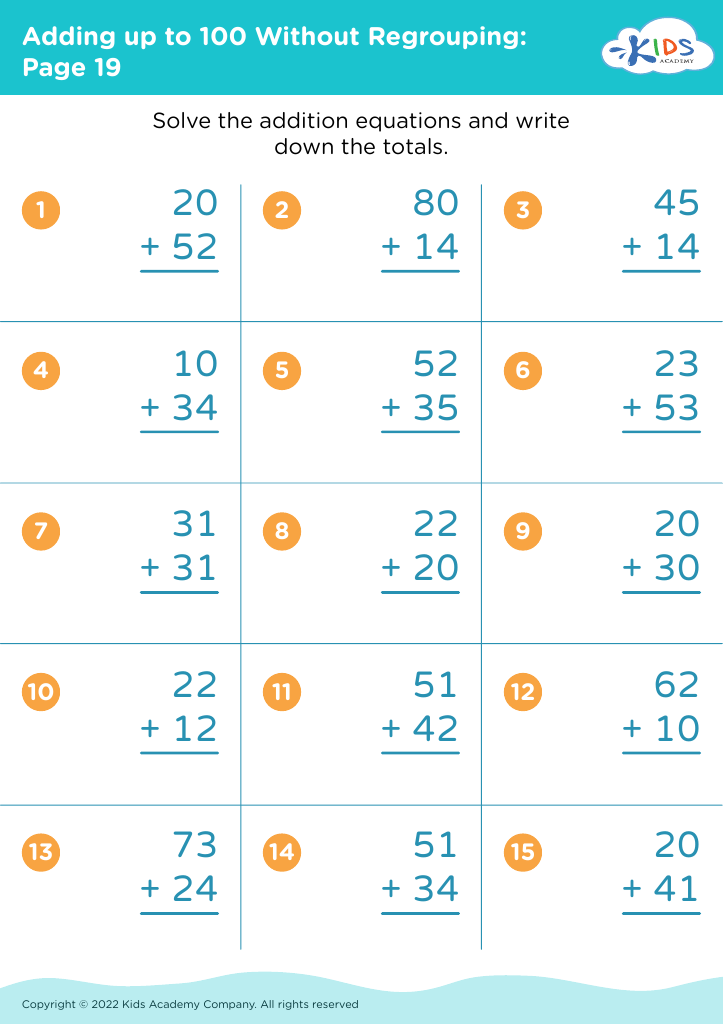
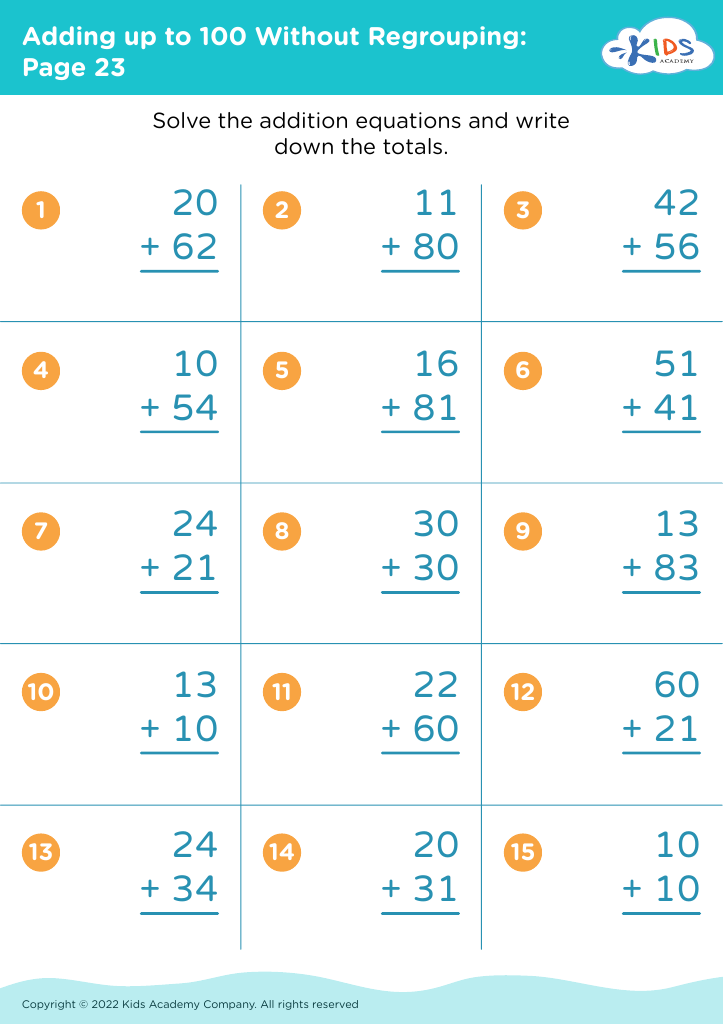
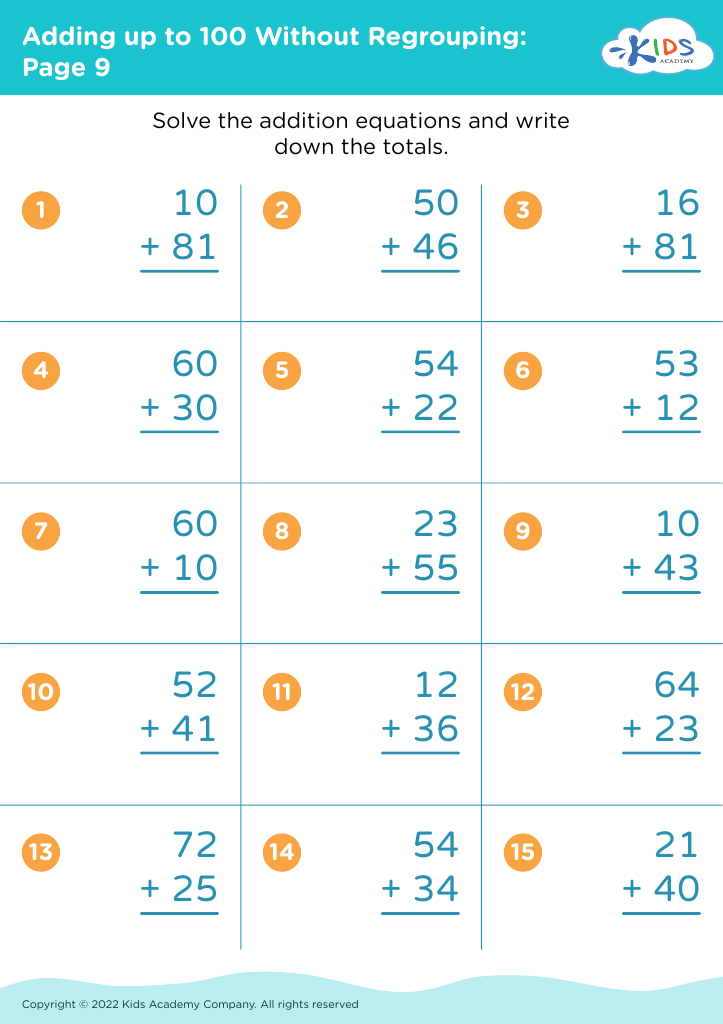
Enhance your students' mathematical reasoning with our engaging "Adding Up to 100 Without Regrouping Worksheets." These specially designed worksheets focus on helping young learners practice addition skills, enabling them to confidently add numbers up to 100 without the need for regrouping. Each worksheet features vibrant visuals and varied exercises, fostering a fun and interactive learning environment. As children work through different problem types, they'll develop essential numerical understanding and improve their problem-solving abilities. Perfect for classroom activities or homework assignments, these worksheets are an invaluable resource for early grade teachers aiming to cultivate math fluency and confidence in their students.




Mathematical reasoning, particularly skills like adding up to 100 without regrouping, is crucial for children's cognitive development and everyday problem-solving abilities. For parents and teachers, fostering these skills equips children with a strong foundation in arithmetic, promoting confidence in their mathematical abilities.
When children learn to add numbers to 100 without regrouping, they simultaneously enhance their number sense and mental visualization of quantities. This skill is vital not just for basic math but also for understanding more complex concepts later, such as carrying in addition or borrowing in subtraction. It encourages logical thinking, pattern recognition, and critical reasoning—benefits that extend beyond math into other disciplines.
Furthermore, these skills promote independence and resilience in learning. Children who find joy in mastering such tasks are likely to develop a positive attitude toward mathematics, making them more willing to engage with future concepts. With practical applications in daily life, understanding how to efficiently add without regrouping helps children make informed decisions in real-world scenarios, such as budgeting or planning. By emphasizing mathematical reasoning, parents and teachers help cultivate a generation that views math not just as a subject, but as a useful tool for lifelong success.