Logical thinking Adding up to 50 Worksheets
3 filtered results
-
From - To
Unlock the power of logical thinking with our "Adding Up to 50 Worksheets"! Specifically designed for early learners, these engaging worksheets help children develop essential math skills while enhancing their ability to solve problems logically. Featuring a variety of thought-provoking puzzles and exercises, students will practice addition in a fun and interactive way. Perfect for classroom activities or at-home learning, these worksheets promote critical thinking and reinforce mathematical concepts up to 50. Foster a love for math and imagination as kids embark on an exciting educational journey. Download and inspire your young learners today!
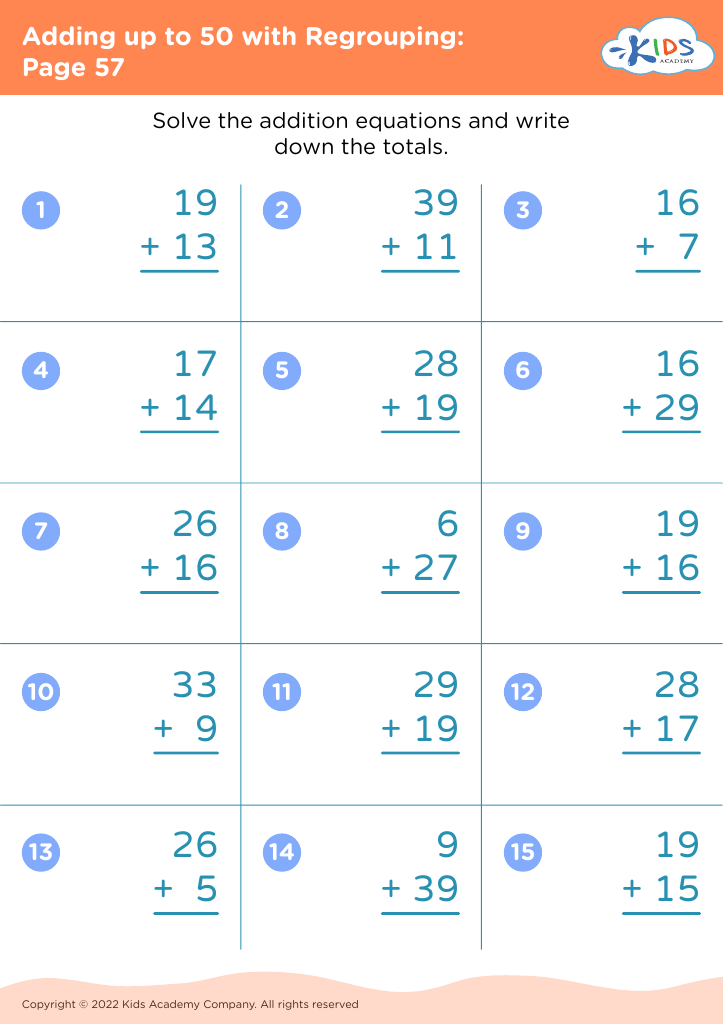
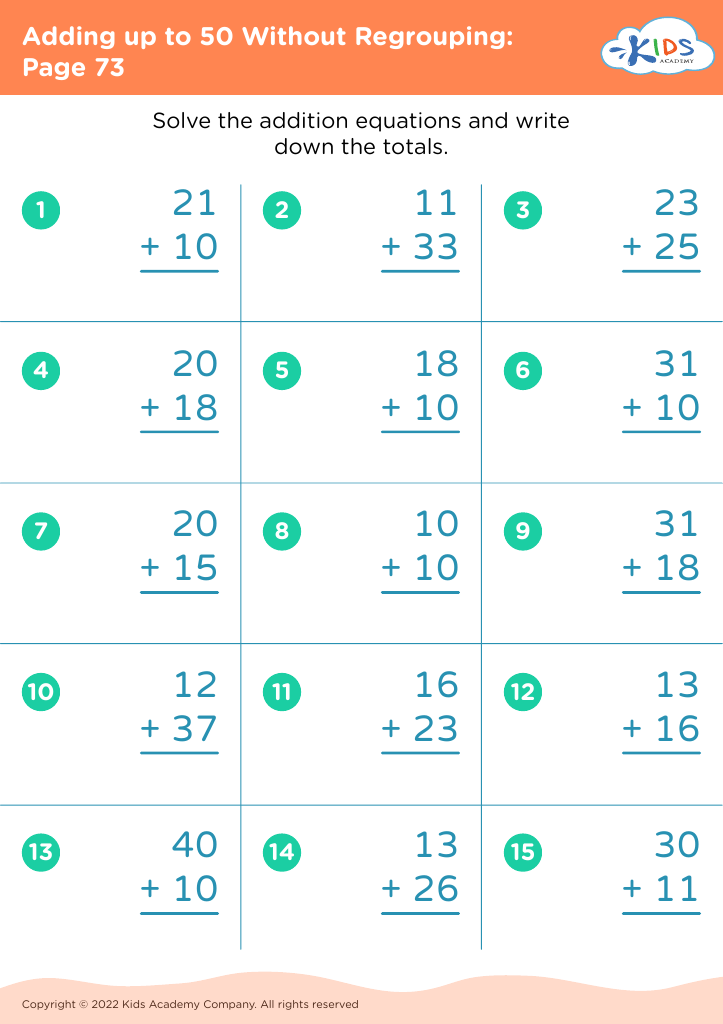
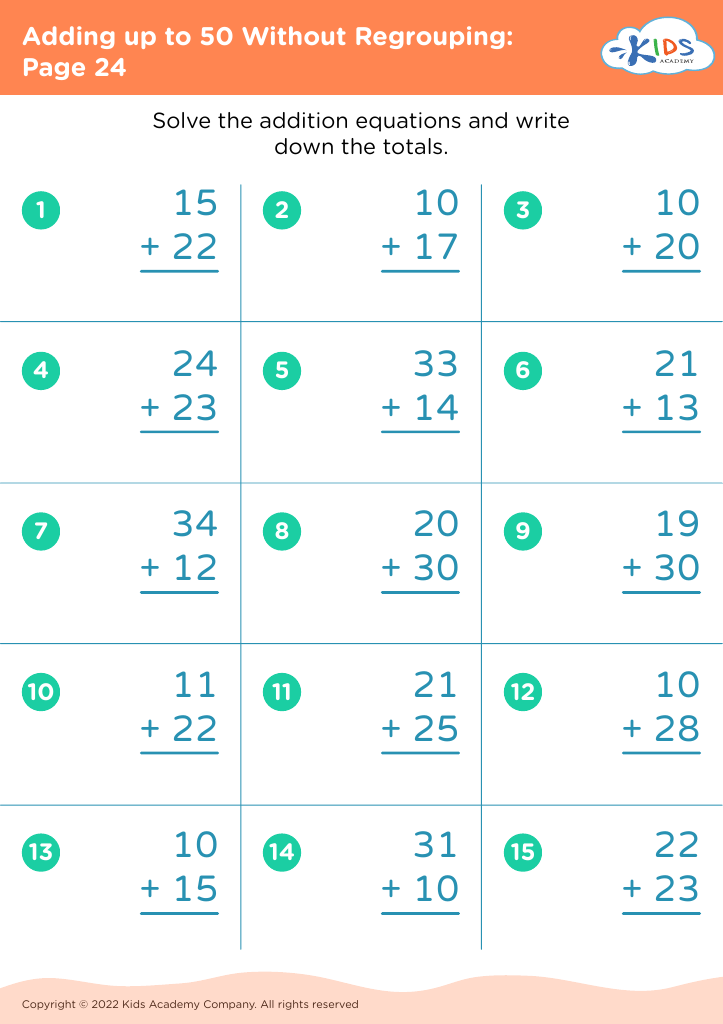




Logical thinking is a vital skill for children, as it lays the foundation for problem-solving and critical thinking throughout their lives. Teachers and parents should care about fostering this ability, especially in the context of mathematical concepts like "Adding up to 50", as it promotes not only mathematical proficiency but also cognitive development.
Encouraging logical thinking in children helps them understand relationships between numbers and enhances their ability to analyze and make connections. For instance, exploring combinations that result in 50 allows students to engage with addition in a meaningful way, recognizing patterns and developing strategies for mental math.
Moreover, logical reasoning strengthens decision-making. When children learn to approach problems methodically—whether in math or real-life situations—they cultivate a mindset that allows them to evaluate options and consequences effectively.
Implementing activities that enhance logical thinking—like puzzles, games, and collaborative problem-solving—encourages curiosity and resilience. Parents and teachers, therefore, play a crucial role in nurturing these skills, as fostering an environment that values reasoning and exploration prepares children for future academic challenges and everyday situations, leading to well-rounded and capable individuals.








