Problem Solving Adding up to 50 Worksheets
3 filtered results
-
From - To
Discover a collection of engaging "Problem Solving Adding up to 50 Worksheets" designed to enhance your child's math skills! These worksheets focus on addition challenge exercises, helping students develop critical thinking and problem-solving abilities while practicing their addition skills up to 50. Each worksheet features a variety of fun scenarios and real-life applications, encouraging young learners to apply their math knowledge in meaningful ways. Perfect for classroom use or at-home learning, these resources are tailored to support early grade students on their math journey. Unlock the joy of learning math and watch your child gain confidence in their problem-solving capabilities!
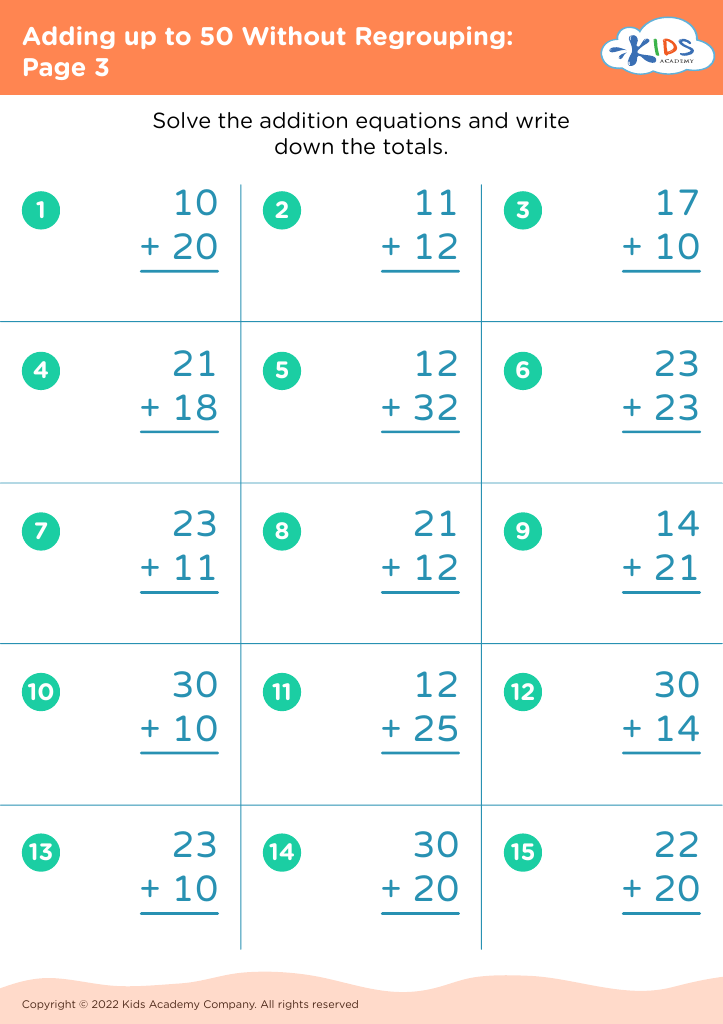
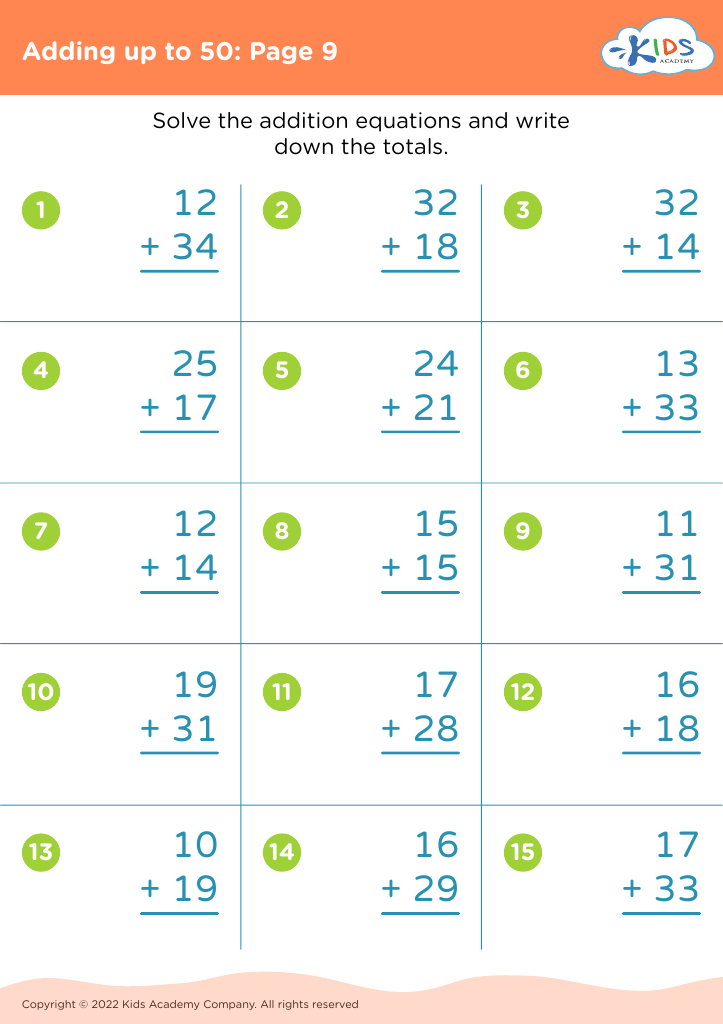
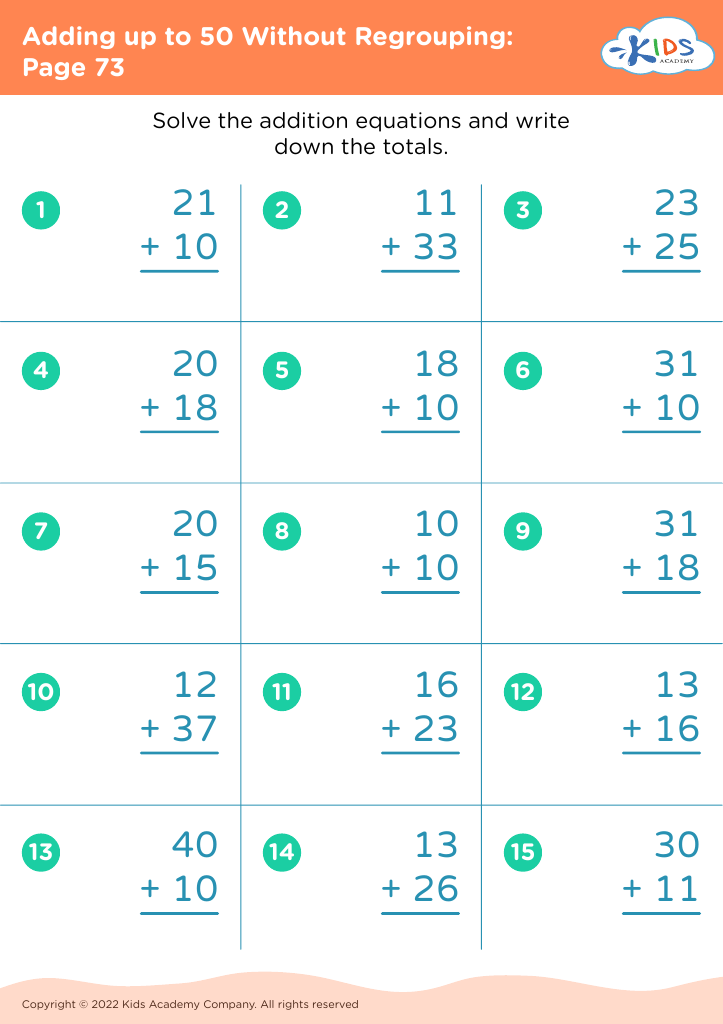




Problem solving is a vital skill for children, and focusing on tasks like adding up to 50 is fundamental in early education. This exercise helps develop critical thinking and mathematical skills, which serve as the foundation for more complex concepts in the future. By engaging children in problem-solving activities, parents and teachers encourage logical reasoning, enabling them to tackle challenges with confidence.
Moreover, adding up to 50 introduces children to various strategies, like working with tens or utilizing patterns, fostering flexibility in their thinking. Learning to manipulate numbers not only builds a solid mathematical base but also enhances mental agility. As they practice, children improve their ability to communicate their processes, enhancing their language and reasoning skills.
Additionally, problem-solving helps build resilience. When children encounter difficulties while trying to reach 50, they learn to persist through challenges, an essential life skill. This also cultivates a growth mindset, where they begin to understand that mistakes are opportunities for learning.
Lastly, collaboration during problem-solving activities promotes social skills, as children often learn from one another. Therefore, focusing on such mathematical problems benefits not just cognitive development but also emotional and social growth, making it a crucial aspect of a child's education.








