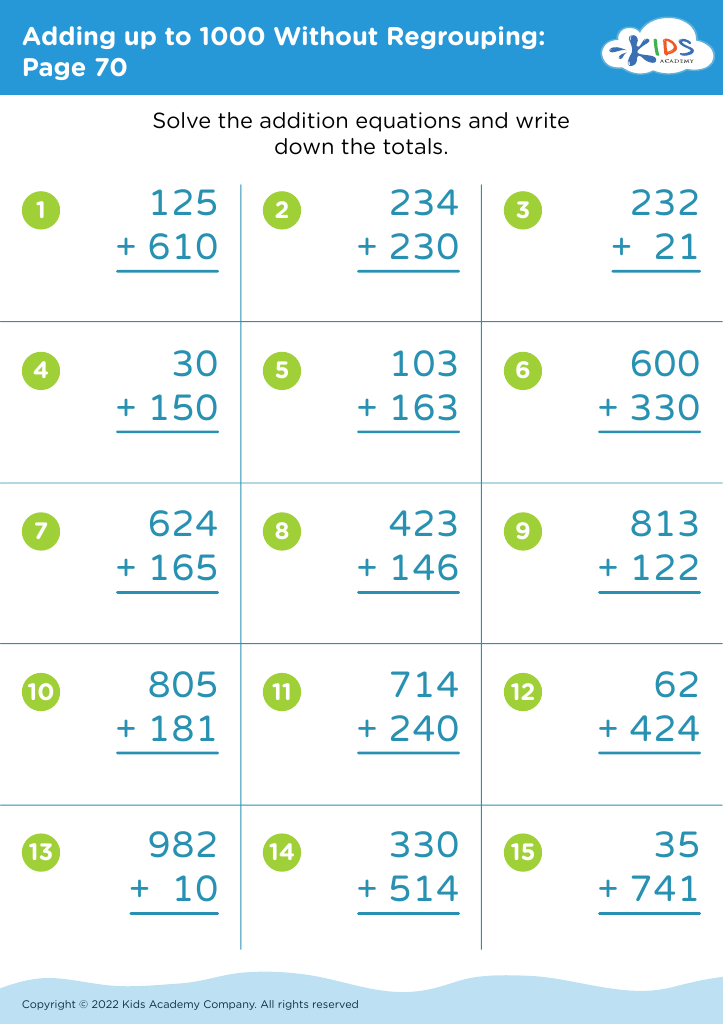








Critical thinking skills, particularly in addition and subtraction, are essential for children's overall cognitive development and problem-solving capabilities. Parents and teachers should prioritize fostering these skills because they go beyond rote memorization and enable children to approach mathematical challenges with reasoning and logic. When students master the critical thinking aspect of basic arithmetic operations, they learn to analyze problems, recognize patterns, and apply different strategies to arrive at solutions.
Furthermore, this deeper understanding lays a strong foundation for more complex mathematical concepts in the future, such as algebra and geometry. Critical thinking in math encourages exploration and the ability to ask relevant questions, assisting children in becoming more independent learners. Additionally, enhancing these skills contributes to emotional and social development; by tackling challenging problems collaboratively, students learn teamwork and effective communication.
In an increasingly data-driven world, the ability to process information critically is invaluable. By nurturing critical thinking in addition and subtraction, parents and educators equip children with skills that extend beyond math—preparing them to navigate real-life situations, make informed decisions, and develop a lifelong love for learning. Ultimately, this investment supports their academic success and holistic development.








