
Observation skills Addition Worksheets
3 filtered results
Difficulty Level
Grade
Age
-
From - To
Subject
Activity
Standards
Enhance your child's mathematical abilities with our Observation Skills Addition Worksheets! Specially designed for young learners, these worksheets integrate fun and educational exercises to develop key observational and addition skills. Each sheet combines visually engaging activities with simple addition problems, encouraging children to focus, compare, and analyze. Perfect for early grade students, our worksheets foster critical thinking and attention to detail while building a strong foundation in math. Download and print for an enjoyable, educational experience that transforms basic addition reinforcement into an exciting learning adventure!
Favorites
With answer key
Interactive
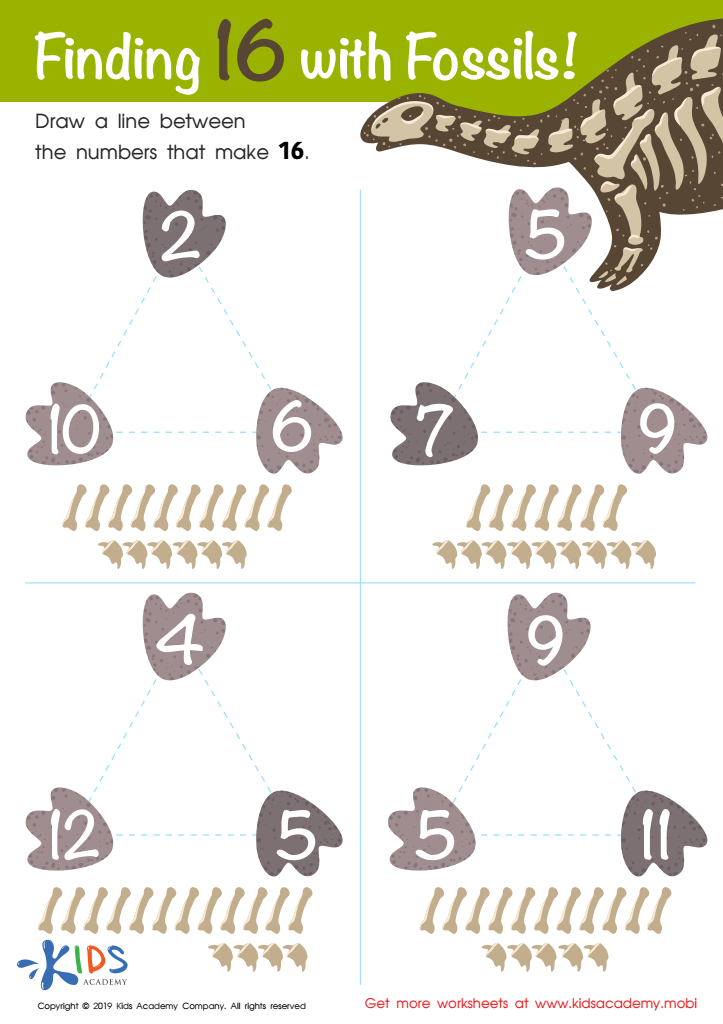
Finding 16 With Fossils Worksheet
Experts hunt for fossils, dig them up, and study them to learn more about past life forms - how they lived, what they looked like, and when they lived. Show kids the picture in this worksheet and point out the fossils. Help them count the bones and draw a line between the numbers that add up to 16 in each triangle.
 Assign to My Students
Finding 16 With Fossils Worksheet
Worksheet
Join Kids Academy for Free
Who is primarily going to use this learning content?








Observation skills are foundational for learning and development, making their enhancement vital for both parents and teachers. When adults cultivate these skills in children, they promote acute awareness and engagement with their environment. Improved observation helps children notice details, patterns, and relationships among objects or events, cultivating curiosity and a love for learning.
In the classroom, strong observational skills sharpen children's abilities to follow instructions, adapt to new information, and engage in problem-solving. For instance, a child who carefully observes a science experiment can understand cause and effect better than one who does not pay close attention. This skill also underpins academic success in all subjects, including reading, as children learn to pick up contextual clues and nuances in texts.
At home, keen observation aids in social development. Children who observe social interactions can mimic positive behaviors and decode emotional cues, improving peer relationships and collaboration skills. Furthermore, by observing their surroundings, they become safety-conscious and more aware of potential hazards.
For parents and teachers, prioritizing the development of observation skills ensures children are not mere passive recipients of information but active learners. This sets the foundation for lifelong learning, critical thinking, and well-rounded personal growth. Thus, investment in enhancing these skills is essential for shaping independent, observant, and curious individuals.








