Pattern identification Addition Worksheets
3 filtered results
-
From - To
Unlock your child's mathematical potential with our engaging Pattern Identification Addition Worksheets! Designed for early learners, these worksheets offer a fun and interactive way to develop essential skills in recognizing patterns while practicing addition. Each activity combines visual stimulation and hands-on exercises that seamlessly blend learning with play. As children complete these worksheets, they enhance their critical thinking and problem-solving skills, crucial for their mathematical growth. Perfect for classroom use or at-home learning, our worksheets cater to diverse learning styles and make mastering addition exciting. Start your child’s math journey today and watch their confidence soar with every correct answer!
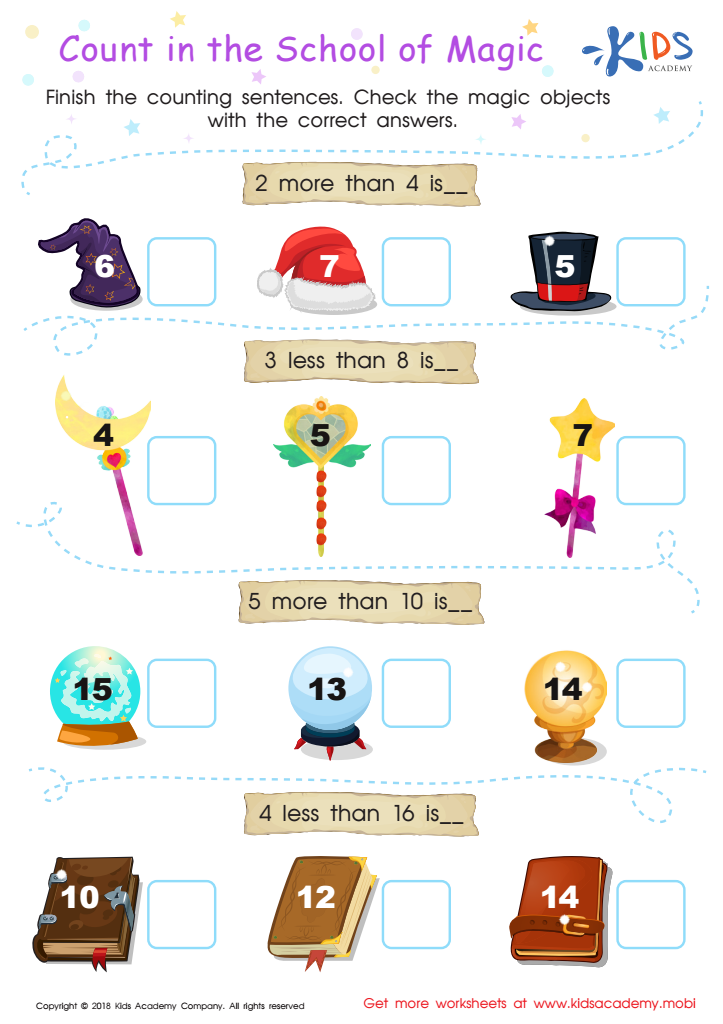
Count in the School of Magic Worksheet
 Assign to My Students








Pattern identification in addition is a crucial skill for young learners as it lays the foundational groundwork for mathematical understanding. When children recognize patterns in numbers, they develop the ability to predict outcomes and understand relationships between quantities. This skill is instrumental in fostering fluency in math, making it easier for students to grasp more complex concepts as they progress.
For parents and teachers, encouraging pattern identification not only makes learning math more engaging but also enhances critical thinking and problem-solving skills. By recognizing patterns, children learn to connect mathematical concepts, which boosts their confidence and interest in the subject. It encourages them to approach mathematical challenges with a positive mindset.
Furthermore, mastery of patterns aids in mental math skills, enabling students to perform calculations more efficiently without relying solely on written methods. It builds a solid foundation for future topics such as multiplication, division, and algebra as children advance in their studies.
Ultimately, prioritizing pattern identification in addition helps create a more robust mathematical framework, essential for a child’s academic success. This foundational skill benefits not just math performance, but also promotes logical reasoning, making it vital for holistic educational development.








