Recognizing equivalent fractions Addition Worksheets
5 filtered results
-
From - To
Welcome to our "Recognizing Equivalent Fractions Addition Worksheets" page, designed to strengthen your child's understanding of fractions! These engaging worksheets help students identify equivalent fractions while mastering addition skills. Through colorful illustrations and interactive exercises, learners can explore various fraction representations and deepen their mathematical comprehension. Perfect for classroom or home use, our worksheets cater to different learning levels, ensuring a fun and educational experience. With clear instructions and a variety of problems, kids will gain confidence in recognizing and adding fractions. Enhance your child's math abilities and pave the way for future success in mathematics with these essential resources!
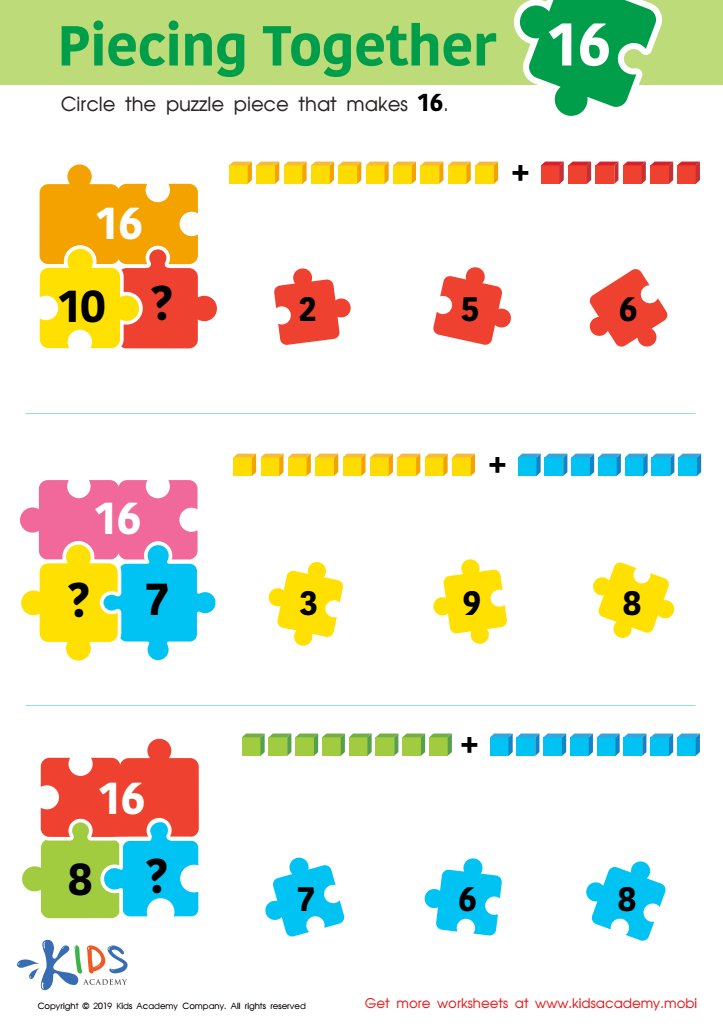
Piecing Together 16 Worksheet
 Assign to My Students








Recognizing equivalent fractions is essential for both parents and teachers because it forms the foundation for a child's understanding of fractions, which are a crucial component of mathematics. Understanding equivalent fractions allows students to see that different fractions can represent the same value. For instance, knowing that 1/2 is equivalent to 2/4 enables them to compare and manipulate these fractions wisely.
Teaching students about equivalent fractions encourages critical thinking and enhances their problem-solving skills. Parents can support their children by providing real-life examples of fractions, such as sharing food items or measuring ingredients in cooking. These activities make learning engaging and applicable.
Furthermore, recognizing equivalent fractions is a building block for more advanced mathematical concepts, including addition and subtraction of fractions. If students are not comfortable with equivalency, they may struggle as they advance to complex topics, hindering their overall mathematical competence.
Ultimately, by fostering an understanding of equivalent fractions, parents and teachers equip students with essential skills and confidence in their mathematical abilities. This foundational knowledge not only aids in academic performance but also helps students appreciate the relevance of mathematics in everyday life.








