Building vocabulary Math Worksheets
3 filtered results
-
From - To
Boost your child’s mathematical language with our "Building Vocabulary Math Worksheets." Tailored for early learners, these engaging sheets introduce key math terms and concepts, enhancing their reading and comprehension skills. Kids will encounter a variety of fun, educational activities that make math vocabulary easy to understand and remember. Through puzzles, matching games, and word problems, our worksheets encourage young minds to explore and grasp essential math language, laying a solid foundation for future success. Ideal for classroom use or homeschooling, each worksheet is designed to foster a love for math while expanding your child’s vocabulary and critical thinking abilities.
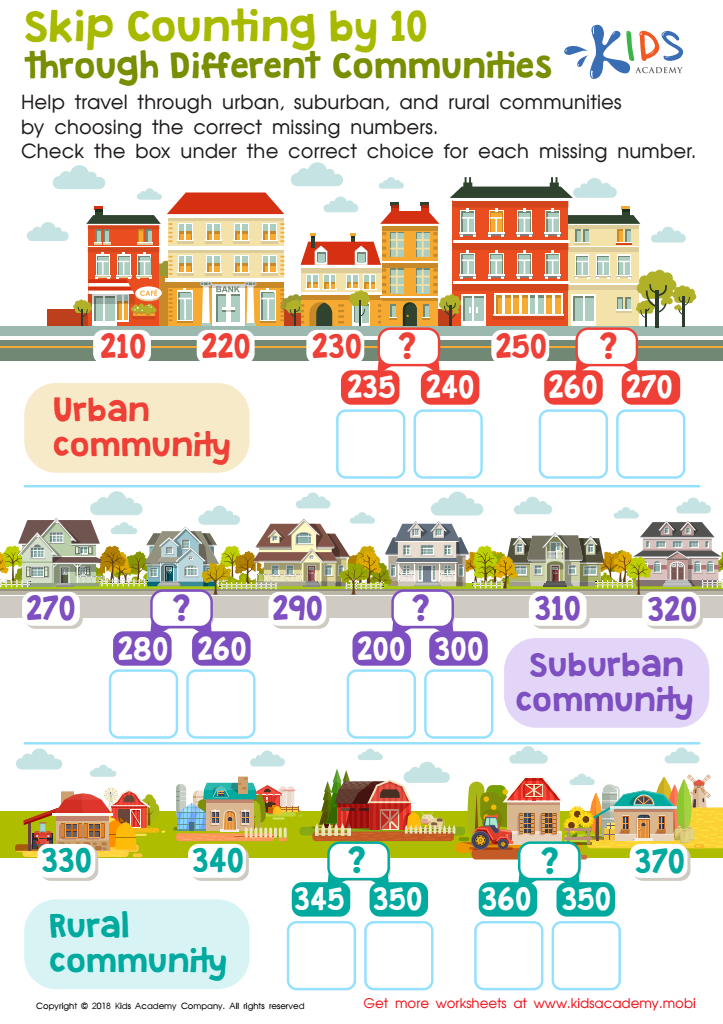
Skip Counting by 10 through Different Communities Worksheet
 Assign to My Students







Building math vocabulary is essential for students' overall success in mathematics, setting a solid foundation for their future learning and understanding. When parents and teachers focus on enhancing vocabulary in math, they help children grasp key concepts and instructions more easily, reducing frustration and fostering a positive attitude towards the subject. Math has its unique language, filled with specific terms and concepts that, when clearly understood, enable students to follow lessons, participate in class, and efficiently solve problems.
A strong math vocabulary aids in critical thinking and problem-solving skills. When students understand terms like "sum," "difference," "product," and "quotient," they can more smoothly navigate through various math operations, leading to improved performance and confidence. Moreover, vocabulary forms the bridge to advanced topics: early familiarity with terms such as “fraction,” “decimal,” and “percent” simplifies future learning of more complex ideas.
Involving both parents and teachers in building this vocabulary ensures a supportive learning environment across school and home. Engaging family members in math-related discussions and activities reinforces the terminology, making learning more consistent and embedded in students’ daily lives. Ultimately, investing time in building math vocabulary equips children with the tools they need to excel in math, paving the way for academic enthusiasm and achievement.








