Cognitive skill development Math Worksheets
3 filtered results
-
From - To
Unlock your child's potential with our engaging cognitive skill development math worksheets! Designed for early learners, these worksheets focus on enhancing critical thinking, problem-solving, and analytical skills through fun and interactive math activities. Each worksheet is crafted to challenge young minds while building a strong foundation in mathematical concepts. Perfect for home or classroom use, our resources support cognitive growth and academic success. Explore various topics and complexity levels to customize learning experiences that suit your child's needs. Foster a love for learning with our thoughtfully designed worksheets that make math both enjoyable and beneficial for cognitive development. Start your journey today!
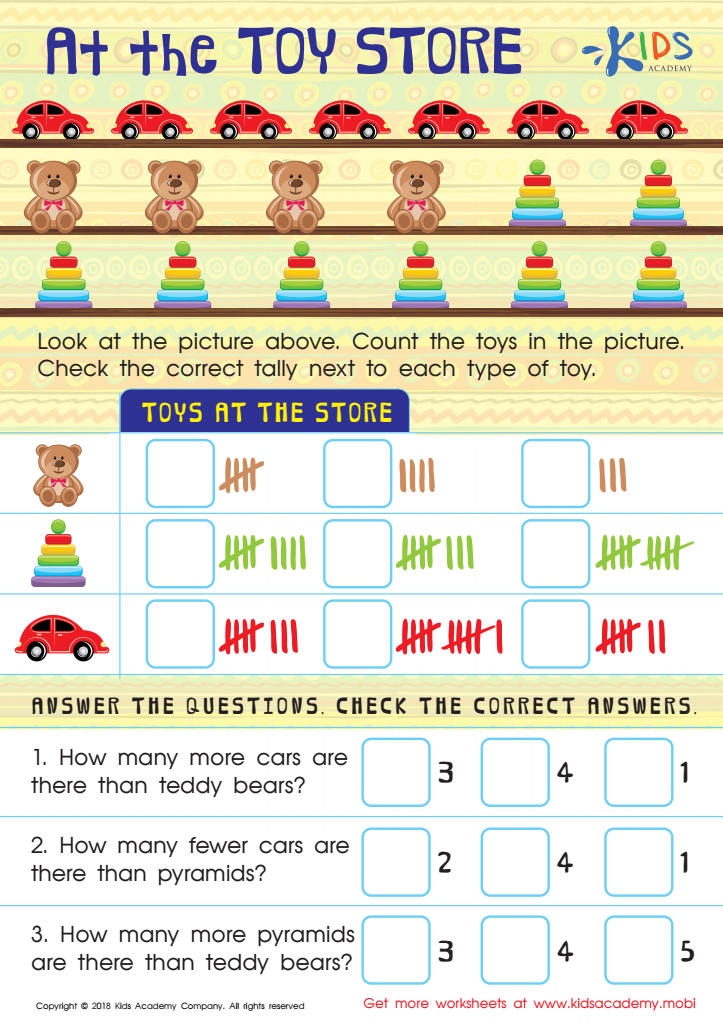
Tally Chart: At the Toy Store Worksheet
 Assign to My Students








Cognitive skill development in math is crucial for young children, as it lays the foundational groundwork for future learning and problem-solving abilities. Parents and teachers should care about this area of development because strong cognitive skills enhance a child's critical thinking, reasoning, and analytical abilities, which are essential not just in math, but across all subjects and real-life situations.
Math is often viewed as just a series of operations and formulas, yet it requires a comprehensive understanding of patterns, relationships, and concepts that stimulate cognitive processes. Engaging children in activities that develop these skills, such as puzzles, games, and practical problem-solving, helps improve their memory, attention span, and processing speed.
Investing time and resources into fostering these skills from an early age can also build confidence and enthusiasm for learning. Children who struggle with math sometimes develop negative attitudes towards the subject, which can hinder their academic performance. When parents and teachers collaboratively focus on enriching cognitive skills in math, they not only enhance children's academic abilities but also equip them with essential life skills. Therefore, proactive encouragement and supportive learning environments are fundamental for nurturing successful, resilient learners.








