Improving observational skills Math Worksheets
3 filtered results
-
From - To
Enhance your child's mathematical prowess with Kids Academy's "Improving Observational Skills" Math Worksheets. These engaging resources are specifically designed to sharpen observational and analytical skills, laying a strong foundation for young learners. Through visually appealing exercises, children will practice recognizing patterns, identifying differences, and solving problems with ease. Each worksheet fosters critical thinking and attention to detail, essential for math success and overall cognitive development. Ideal for both classroom and home use, these printable activities not only make learning fun but also reinforce key math concepts effectively. Start your child’s journey to better math skills today!
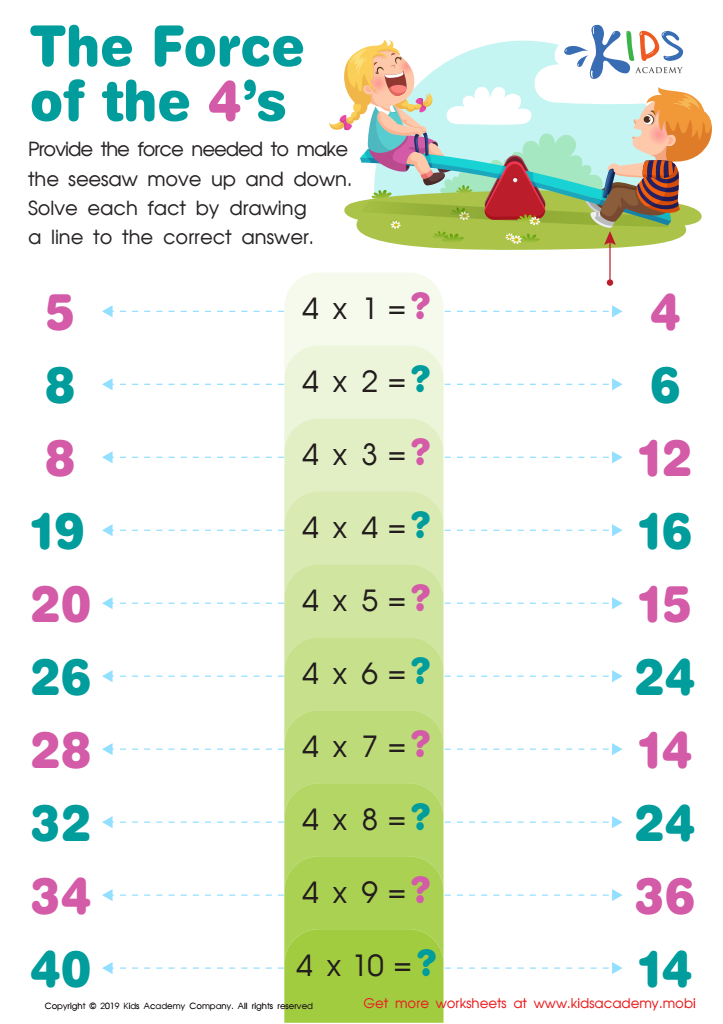
The Force of the 4's Worksheet
 Assign to My Students







Improving observational skills in math is crucial for young learners, and both parents and teachers should take an active role in fostering these abilities. Observational skills help children notice details, patterns, and relationships, which are foundational concepts in mathematics. By nurturing these skills early on, children can develop a more intuitive and thorough understanding of mathematical concepts, making problem-solving easier and more intuitive.
For parents, encouraging observational skills at home can turn everyday activities into learning opportunities. For example, counting objects in a grocery store, recognizing shapes in the environment, or measuring ingredients while cooking can all reinforce mathematical principles in a natural context. These experiences help children to see math as part of their daily life, rather than as an isolated subject at school.
Teachers, on the other hand, can incorporate activities and lessons that challenge students to observe and reflect on mathematical patterns and problems daily. Visual aids, manipulatives, and interactive exercises can make learning more dynamic and engaging, helping children refine their observational skills through practical application.
By focusing on improving these skills, both parents and teachers equip children with the tools needed for academic success and critical thinking, paving the way for advanced mathematical understanding and a lifelong appreciation of learning.








