Recognizing equivalent fractions Math Worksheets
5 filtered results
-
From - To
Discover an engaging selection of "Recognizing Equivalent Fractions" math worksheets on Kids Academy. These expertly designed worksheets help young learners understand and identify equivalent fractions through fun, interactive activities. Ideal for boosting math skills in grades 3 to 5, these printables offer a variety of exercises, such as coloring, matching, and fill-in-the-blank problems. Aligned with Common Core standards, our worksheets support essential fraction concepts and foster a strong mathematical foundation. Perfect for classroom or home practice, these resources make learning fractions enjoyable and effective. Download now and watch your child’s confidence in math soar!
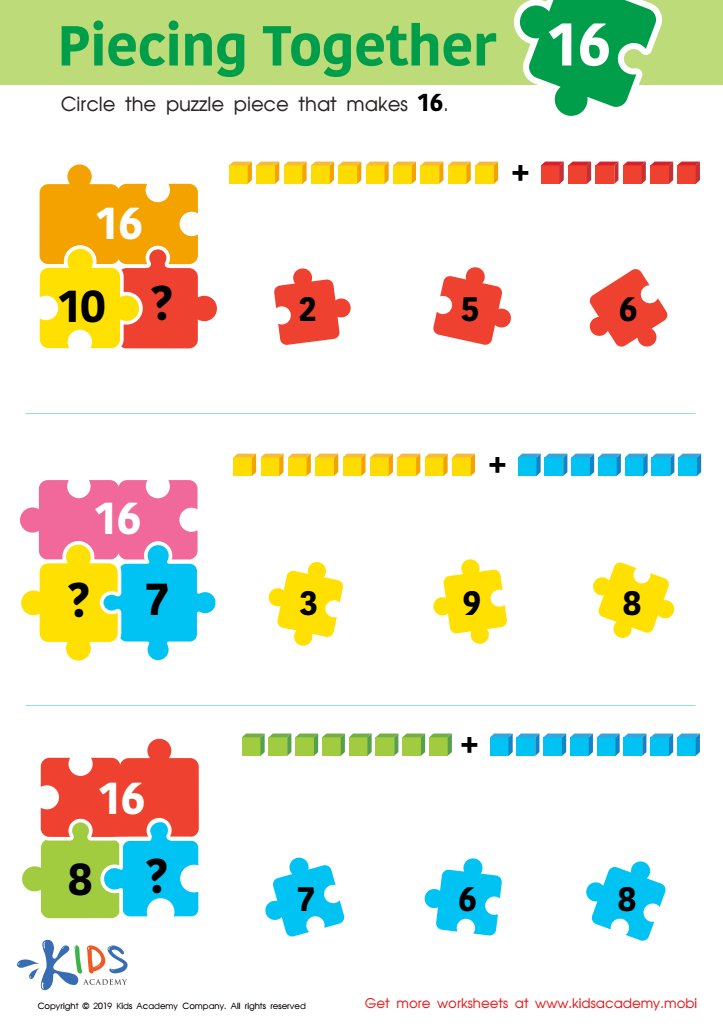
Piecing Together 16 Worksheet
 Assign to My Students








Recognizing equivalent fractions is essential for early math education because it builds the foundational understanding of fractions, which is crucial for more advanced mathematics and everyday problem solving. For parents and teachers, imparting this knowledge has numerous benefits.
Firstly, understanding equivalent fractions allows children to grasp the concept that fractions, though they may look different, can actually represent the same value. This lays the groundwork for simplifying fractions, which is vital for performing operations such as addition, subtraction, multiplication, and division of fractions.
Secondly, recognizing equivalent fractions enhances number sense and reasoning skills. It encourages students to engage in critical thinking and makes them more adept at comparing and ordering fractions, recognizing patterns, and solving problems logically.
Moreover, mastering equivalent fractions aids in real-life applications. For example, understanding how to find different ways to represent quantities is useful in activities such as cooking, sharing, and planning.
Finally, early mastery of these skills can boost a child's confidence in math, leading to higher achievement and a more positive attitude toward the subject overall. For these reasons, parents and teachers should prioritize the teaching and reinforcement of recognizing equivalent fractions in early math education.








