Understanding fact families Subtraction Worksheets
3 filtered results
-
From - To
Welcome to our "Understanding Fact Families Subtraction Worksheets" page! Here, you’ll find a variety of engaging worksheets designed to help young learners grasp the concept of fact families in subtraction. Fact families illustrate the relationship between addition and subtraction through connected numbers, promoting a solid understanding of these operations. Our resources include clear explanations, visual aids, and exercises tailored for different skill levels. These worksheets are perfect for enhancing your child’s math skills, boosting their confidence, and making learning enjoyable. Start exploring our printable worksheets today and watch your child's aptitude in subtraction flourish!
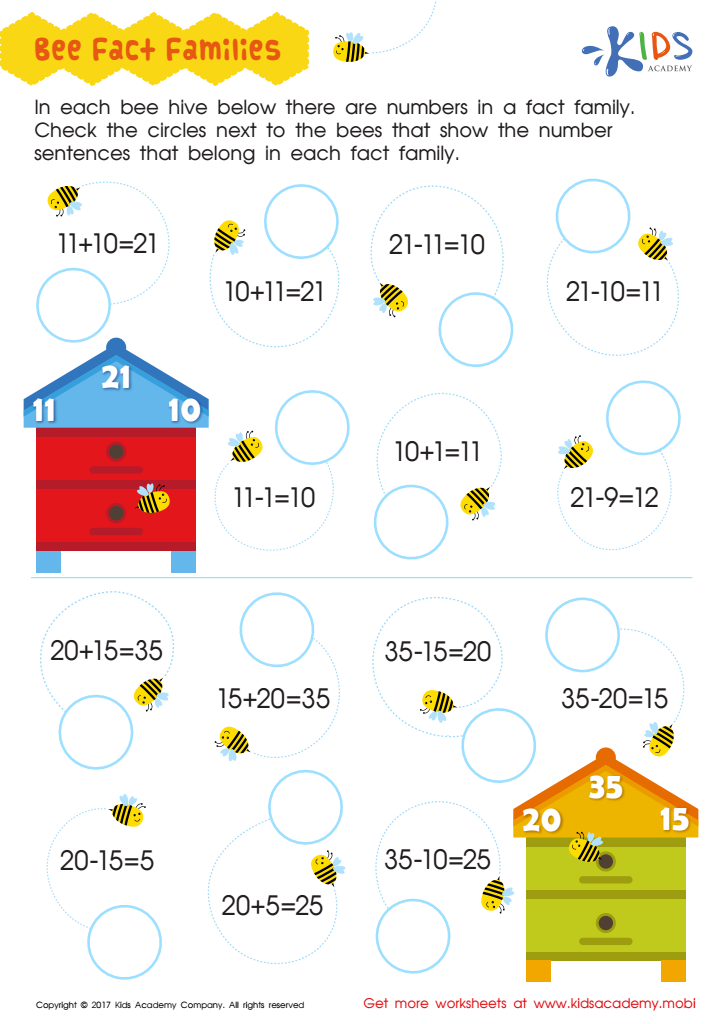
Fact Families Worksheet
 Assign to My Students
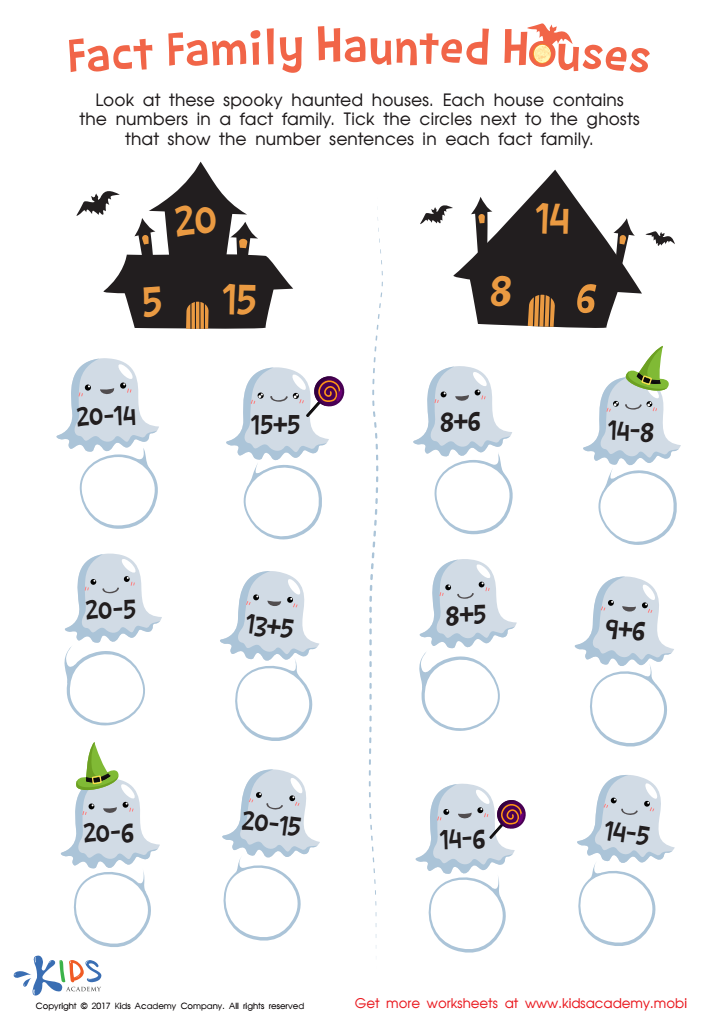
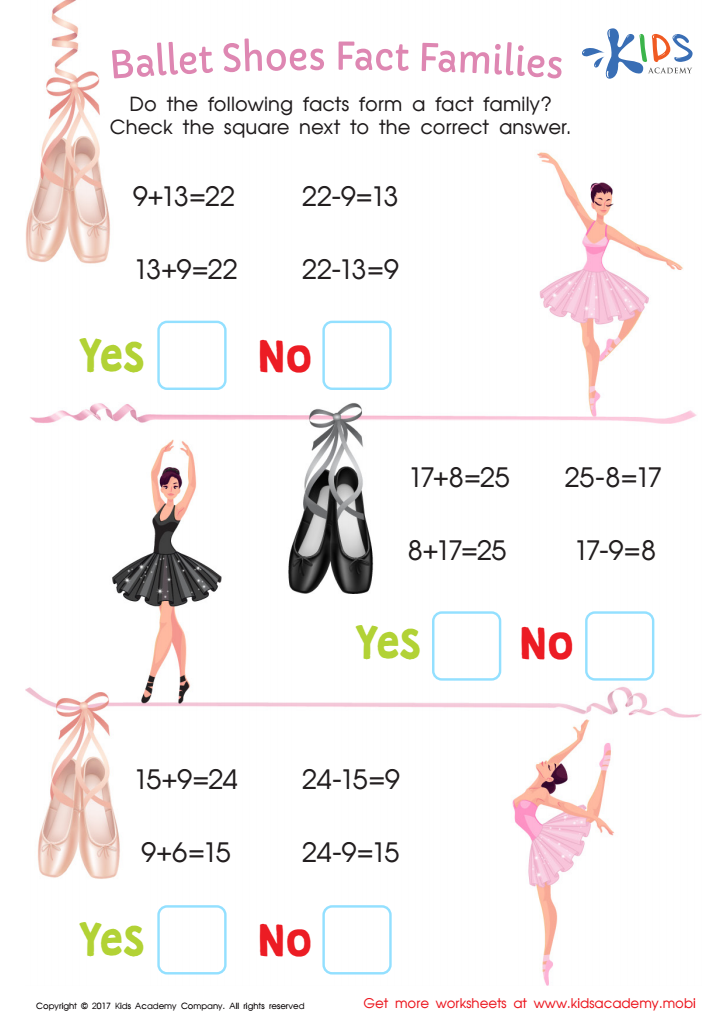
Ballet Shoes Fact Family Printable




.jpg)



Understanding fact families, particularly in relation to subtraction, is crucial for both parents and teachers as it lays the foundation for children’s mathematical reasoning. A fact family consists of related addition and subtraction facts involving the same numbers, enabling children to see the relationships between these operations. For example, with the numbers 3, 4, and 7, the fact family includes the equations 3 + 4 = 7, 4 + 3 = 7, 7 - 3 = 4, and 7 - 4 = 3.
When students grasp this relationship, it promotes not just mechanical memorization, but also a deeper understanding of numbers and their interactions. This understanding is vital for problem-solving and helps students improve their mathematical flexibility.
Moreover, teaching students about fact families fosters critical thinking skills as they learn to see patterns and relationships within math. Parents and teachers who encourage this understanding can help students develop confidence in their abilities, which is essential for lifelong learning. In essence, recognizing the significance of fact families is a crucial step in helping children acquire fundamental mathematical skills, enhancing their overall academic success, and fostering a positive attitude towards math.








