Spatial awareness Normal Worksheets for Ages 3-7 - Page 2
25 filtered results
-
From - To
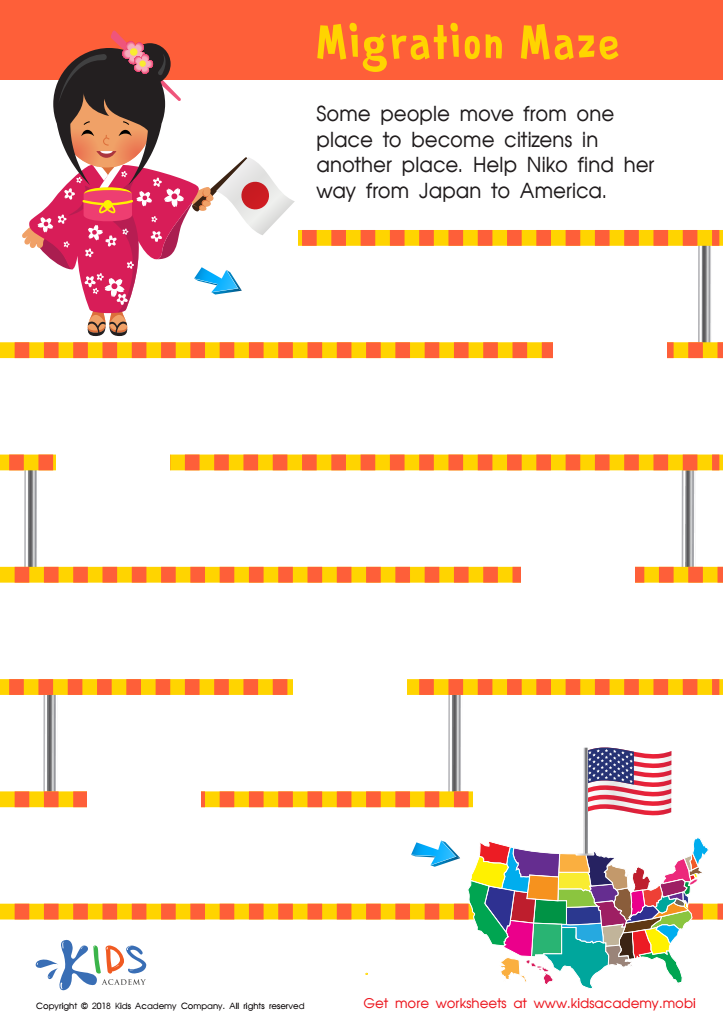
Migration Maze Worksheet
 Assign to My Students






.jpg)
Spatial awareness is the understanding of one’s own body in relation to the surrounding environment and objects. For children aged 3-7, developing spatial awareness is crucial as it lays the foundation for both cognitive and physical development. Parents and teachers should pay attention to this skill for several key reasons.
Firstly, spatial awareness is fundamental for motor skills development. Activities like crawling, walking, running, and jumping require children to understand distances and spatial relationships. This skill also helps in sports and physical play, building coordination and confidence.
Secondly, spatial awareness is closely linked to academic learning. Basic mathematical concepts such as shapes, sizes, measurements, geometry, and even reasoning require an understanding of spatial relations. Early competence in these areas forms a solid groundwork for future academic achievement in subjects like mathematics and science.
Thirdly, it enhances daily life skills. Understanding spatial concepts is essential for tasks such as dressing (knowing front from back), organizing spaces, and navigating the environment (like crossing the street safely).
Lastly, spatial awareness facilitates social interactions and emotional development. Recognizing personal space and navigational cues from others helps in forming cooperative play and effective communication.
Therefore, encouraging activities that promote spatial awareness, such as puzzles, building blocks, and guided physical play, can profoundly impact a child's holistic growth.








