
Map reading skills Normal Our Planet and Environment Worksheets for Ages 3-8
1 filtered results
Difficulty Level
Grade
Age
-
From - To
Subject
Activity
Standards
Explore our collection of engaging "Map Reading Skills" worksheets designed for children aged 3-8, focusing on our planet and environment. These interactive activities help young learners develop essential map reading skills, enhance spatial awareness, and foster a love for geography. With vibrant illustrations and age-appropriate exercises, children will navigate through fun challenges as they learn to interpret maps, identify landmarks, and understand directions. These worksheets promote critical thinking and encourage environmental awareness, making them perfect for classrooms or at-home learning. Equip your child with vital skills for their educational journey while discovering the wonders of our world!
Favorites
With answer key
Interactive
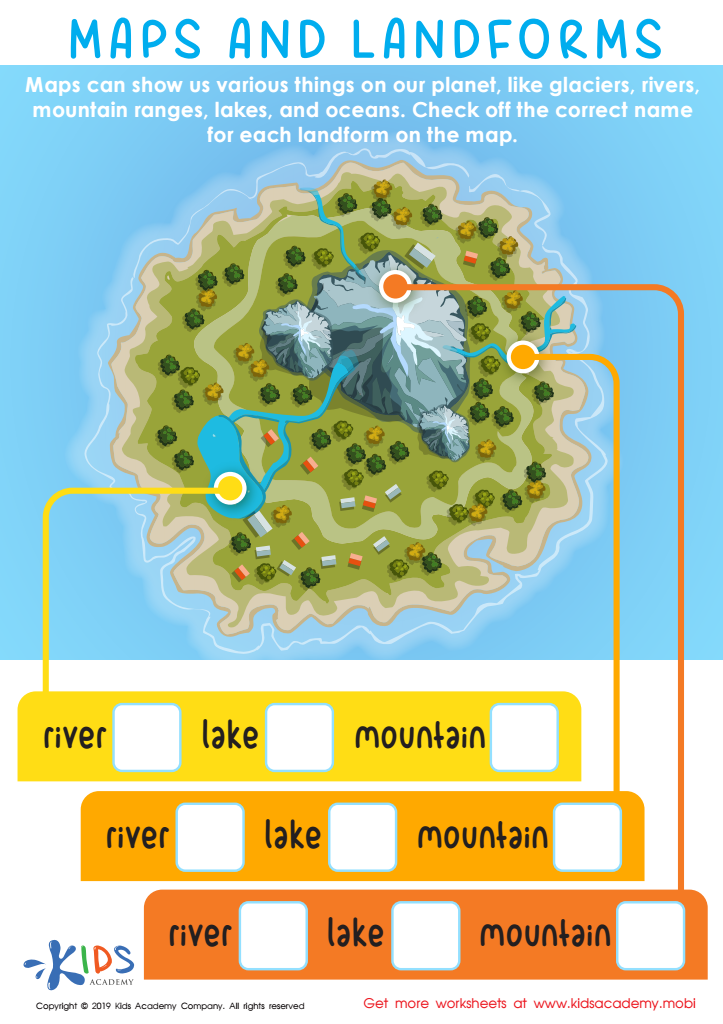
Maps and Landforms Worksheet
We can educate our kids on the world and its landforms by showing them a map. Point out mountains, rivers, and oceans, and help them identify each correctly. With this knowledge, they will better understand our planet.
 Assign to My Students
Maps and Landforms Worksheet
Worksheet
Join Kids Academy for Free
Who is primarily going to use this learning content?



Map reading skills are essential for children aged 3-8 as they foster spatial awareness, critical thinking, and an understanding of the world around them. At this developmental stage, young learners are naturally curious and eager to explore their environment; teaching them how to read maps can enhance their sense of adventure and discovery.
For parents and teachers, fostering map reading skills contributes to cognitive growth by helping children develop problem-solving abilities. It allows them to make connections between symbols, locations, and real-world contexts, enhancing their comprehension of geography and promoting an understanding of our planet and environment. Through discussions about maps, children learn to orient themselves, recognize landmarks, and interpret geographical information, which are vital life skills as they grow.
Moreover, map reading skills encourage teamwork and collaboration when children work together on navigating during outdoor activities or community exploration. This collaborative aspect builds social skills and fosters a sense of community. Ultimately, nurturing these skills helps instill a sense of responsibility towards the environment, promoting awareness about conservation and sustainability as they understand the places they inhabit. By prioritizing map reading abilities, parents and teachers equip children with tools that aid in navigation—both literally and metaphorically—through life.







