
Enhancing problem-solving abilities Normal Worksheets for Ages 3-9
3 filtered results
Difficulty Level
Grade
Age
-
From - To
Subject
Activity
Standards
"Enhancing Problem-Solving Abilities Normal Worksheets for Ages 3-9" offers a variety of engaging and educational resources designed to help children develop critical thinking and problem-solving skills. Tailored to different age groups, these printable worksheets feature activities ranging from matching and sorting to puzzles and logical challenges. By offering a structured yet enjoyable approach, kids are encouraged to think independently and creatively, providing a strong foundation for academic success and real-world problem-solving. Perfect for parents and teachers seeking to nurture young minds, these worksheets turn learning into a fun and rewarding experience.
Favorites
With answer key
Interactive
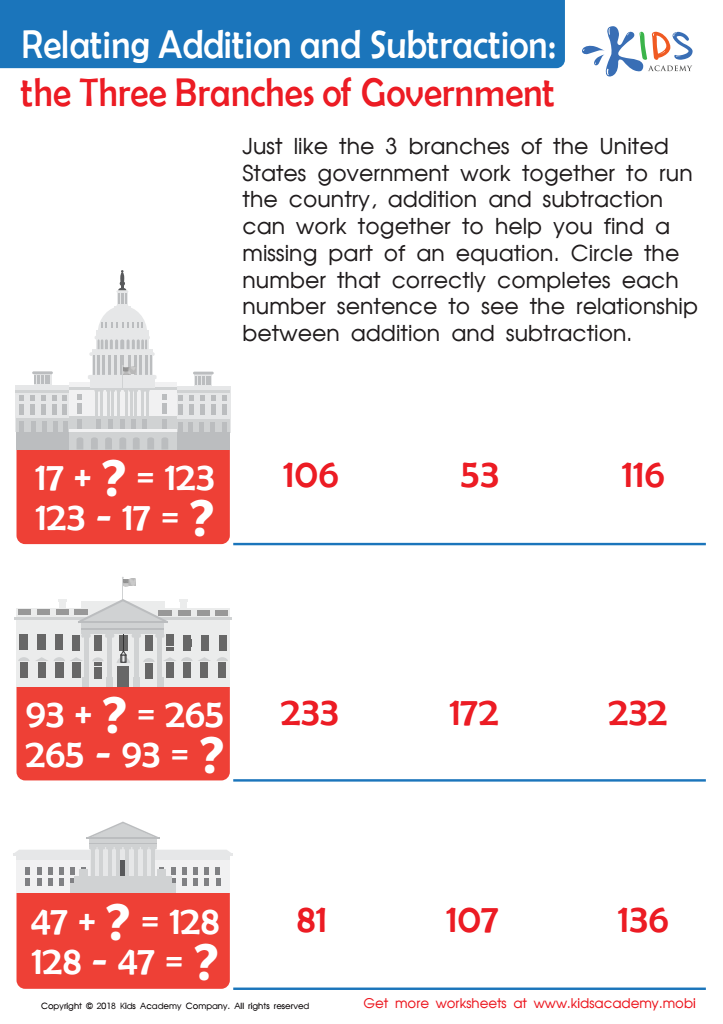
The Three Branches of Government Worksheet
Students learn best when they can relate ideas, like the three branches of government working together and addition and subtraction working together. This worksheet pairs math and social studies to help learners make an analogy. Help your child discover the relationship between addition and subtraction by completing the number sentences under each national landmark. This will help them solve tricky problems!
 Assign to My Students
The Three Branches of Government Worksheet
Worksheet
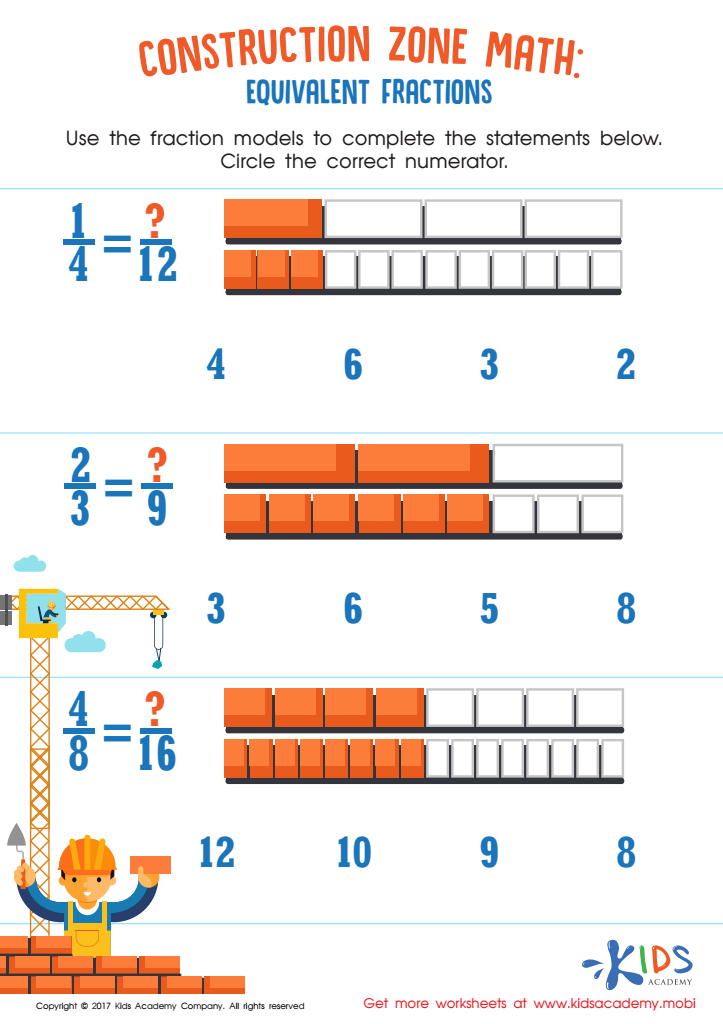
Equivalent Fractions Worksheet
Kids can easily learn fractions with pictures! This worksheet uses colorful bricks in a construction zone to help 3rd graders understand and compare fractions to find the numerator. Visuals make it simpler for kids to grasp fractions.
Equivalent Fractions Worksheet
Worksheet
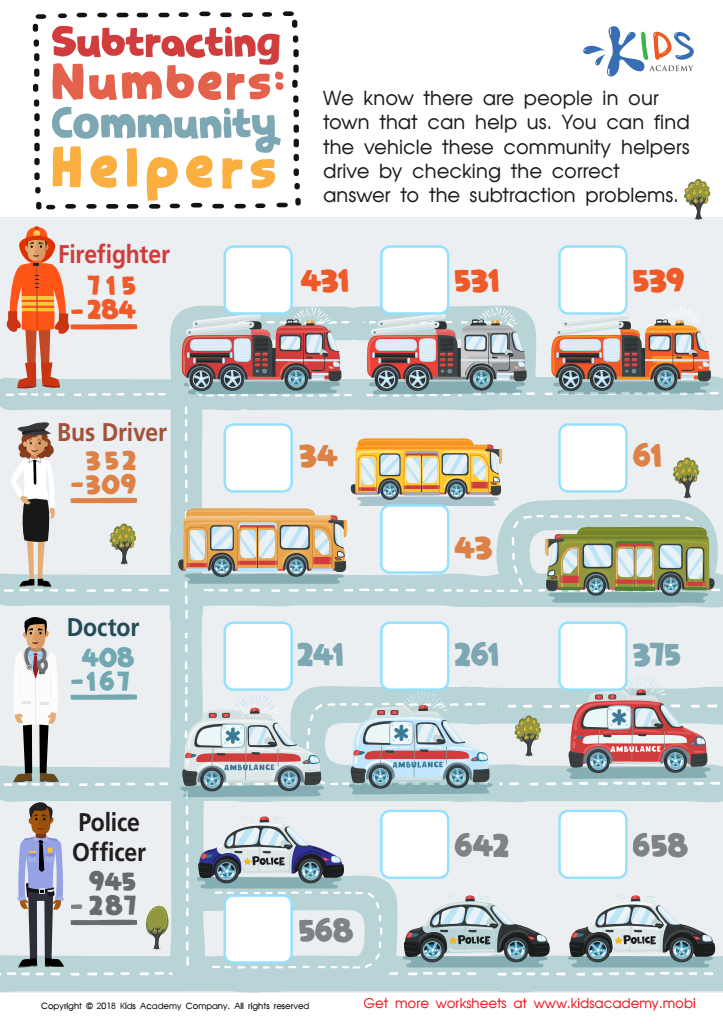
Subtracting Numbers: Community Helpers Worksheet
A community is an area of different people, buildings and other elements. People in a community have varied roles and work together to make it thrive. Ask your child what community helpers they know and how they help. Match the helpers to their vehicles by solving subtraction problems!
Subtracting Numbers: Community Helpers Worksheet
Worksheet
Learning Skills
Enhancing problem-solving abilities
Addition and subtraction skills
Boosting numerical fluity
Understanding mathematical relationships
Improving cognitive skills
Enhancing arithmetic knowledge
Understanding equivalent fractions
Boosting mathematical reasoning
Improving fraction visualization
Practicing Arithmetic Skills
Join Kids Academy for Free
Who is primarily going to use this learning content?







Enhancing problem-solving abilities in children aged 3-9 is vital for their overall development and lifelong success. At this formative stage, young minds are incredibly receptive, and their early experiences shape their future learning and thinking patterns. Cultivating problem-solving skills helps children become independent thinkers who can approach challenges confidently and creatively.
First, problem-solving enhances cognitive development by encouraging logical thinking and reasoning. It requires children to analyze situations, consider different perspectives, and arrive at thoughtful conclusions, thereby strengthening their brain's executive functions.
Second, these skills are closely linked to academic success. From mathematics to reading comprehension and science, the ability to solve problems is fundamental across subjects. It fosters a love for learning, curiosity, and perseverance, qualities necessary for academic achievement.
Moreover, fostering problem-solving in early childhood supports social and emotional growth. It teaches kids to handle frustration, share ideas, and collaborate, all of which are essential for building strong interpersonal relationships. Children who can solve problems are also more adaptable, resilient, and better equipped to handle the complexities of life.
In conclusion, by prioritizing problem-solving abilities, parents and teachers not only enhance children’s cognitive and academic skills but also contribute to their emotional wellbeing and social development, creating a solid foundation for their future.








