
Word identification Normal Building Vocabulary Worksheets for Ages 3-9
3 filtered results
Difficulty Level
Grade
Age
-
From - To
Subject
Activity
Standards
Enhance your child's reading journey with our Word Identification Building Vocabulary Worksheets for ages 3-9. Designed by education experts, these engaging printables boost young learners' ability to recognize and read new words confidently. Perfect for preschoolers and early graders, our worksheets incorporate fun activities such as picture matching, word tracing, and simple sentence creation. Each task is tailored to progressively build vocabulary skills, making learning enjoyable and effective. Whether used in the classroom or at home, these resources support early literacy and complement various learning styles. Set the foundation for lifelong reading success with our specially crafted worksheets!
Favorites
With answer key
Interactive
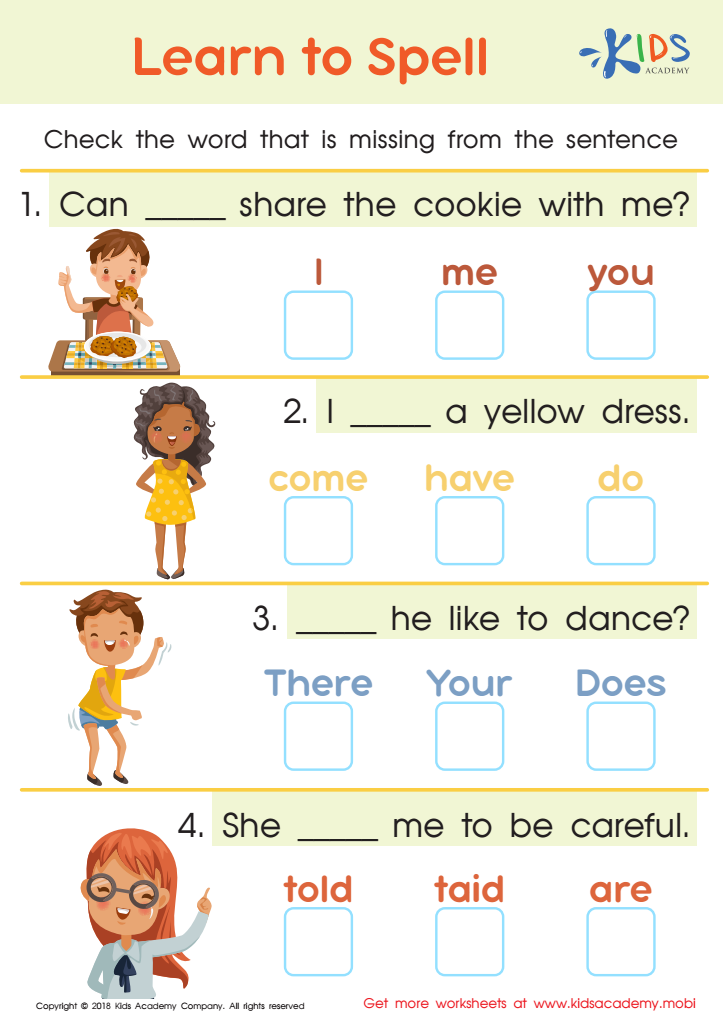
Learn to Spell Worksheet
Help sharpen spelling skills with a simple worksheet. Read sentences aloud and show which word is missing. Ask students to pick the correct word from the options. Ensure they check the missing word for accuracy.
 Assign to My Students
Learn to Spell Worksheet
Worksheet











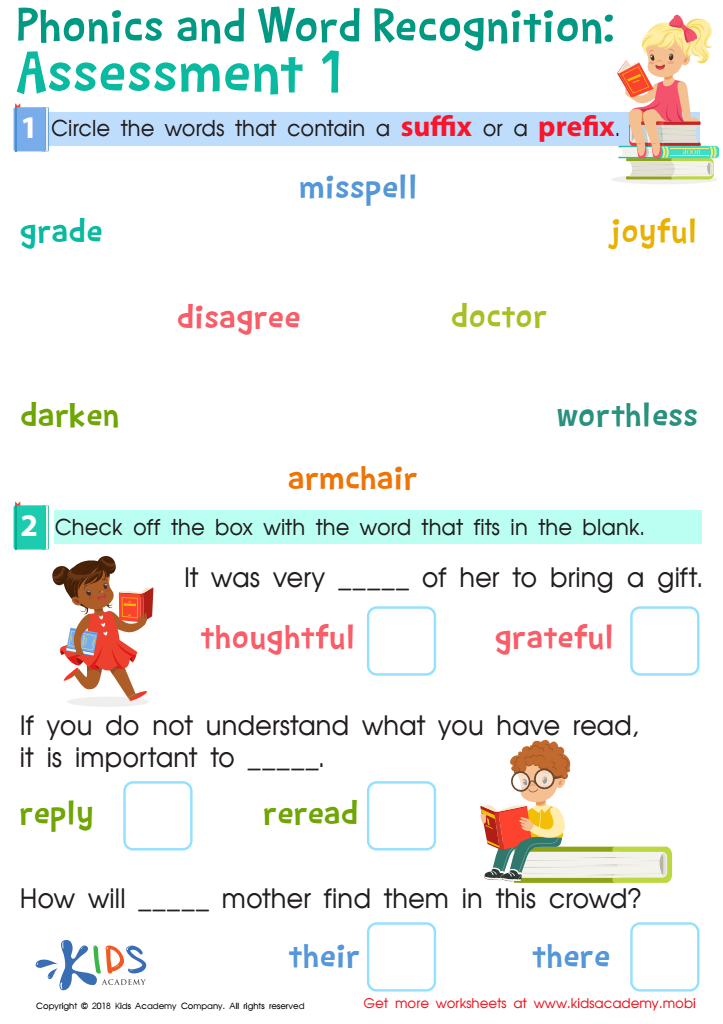
Phonics and Word Recognition: Assessment 1 Worksheet
Explain prefixes (words added to start of another word to give it a new meaning) and suffixes (added to end of word to change its meaning) to your kids with examples like 'unhappy' (prefix) and 'forgetful' (suffix). Now, help your child complete this worksheet, including circling words and checking boxes.
Phonics and Word Recognition: Assessment 1 Worksheet
Worksheet
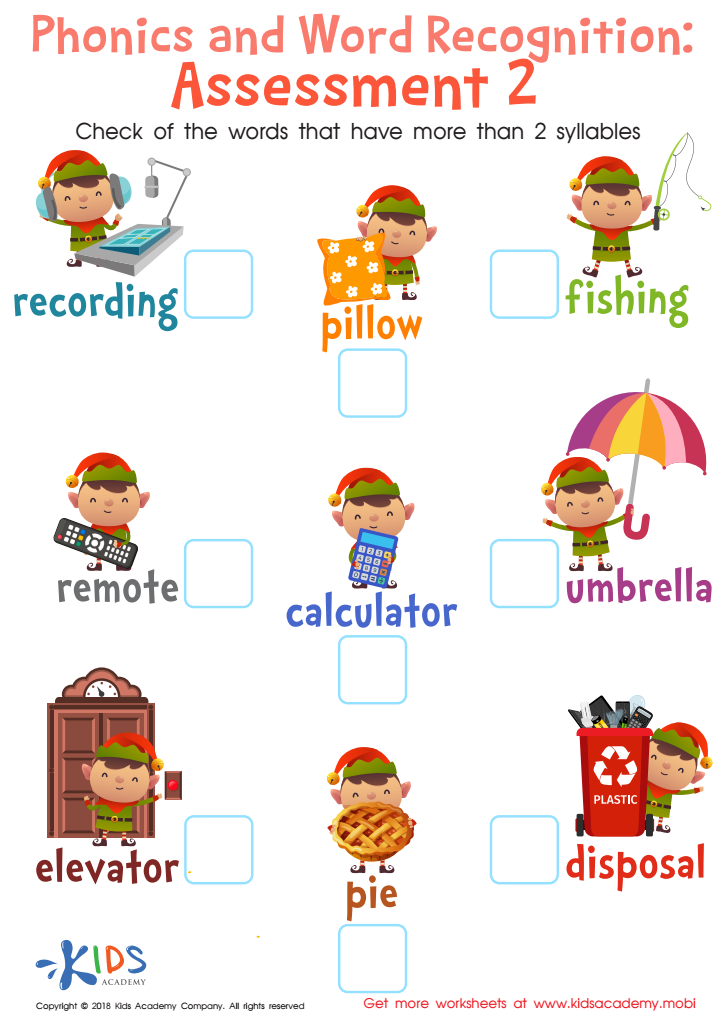
Phonics and Word Recognition: Assessment 2 Worksheet
Help your kids learn proper pronunciation by counting syllables. Most words they'll encounter have 1-3 syllables, making them simple to say. Have them repeat the words in your worksheet after you. Focus on longer words with more than two syllables.
Phonics and Word Recognition: Assessment 2 Worksheet
Worksheet
Join Kids Academy for Free
Who is primarily going to use this learning content?




.jpg)



Word identification and vocabulary building in children aged 3-9 are crucial for several reasons. At this stage, children are at their prime learning age, often referred to as the "language explosion" phase. Developing a strong foundation in word recognition and vocabulary significantly influences their reading and overall academic performance.
Firstly, proficiency in word identification aids in reading fluency. When children can recognize words accurately and quickly, they spend less cognitive energy deciphering individual words and more on understanding the text. This fluency is essential for reading comprehension, which is the ability to understand and interpret meaning from text.
Secondly, a robust vocabulary directly enhances communication skills. A broad vocabulary allows children to express their thoughts, feelings, and ideas more clearly and effectively. This is vital not only for academic success but also for social interactions and emotional development.
Thirdly, early vocabulary acquisition sets the stage for lifelong learning. Numerous studies have shown a strong correlational relationship between early vocabulary and later academic achievement. Children with a rich vocabulary are better equipped to absorb new information, understand complex concepts, and engage in higher-order thinking.
In conclusion, prioritizing word identification and vocabulary development in children aged 3-9 is fundamental. It boosts reading fluency, enhances communication abilities, and impacts overall educational outcomes, setting the stage for lifelong learning and success.








