
Categorization skills Normal Animals Worksheets for Ages 4-5
3 filtered results
Difficulty Level
Grade
Age
-
From - To
Subject
Activity
Standards
Enhance your child’s learning journey with our "Categorization Skills Normal Animals Worksheets" tailored for ages 4-5. These engaging worksheets are designed to develop early categorization skills through the exploration of familiar animals. Young learners will enjoy activities that prompt them to sort and classify animals based on various characteristics, fostering critical thinking and cognitive skills. With colorful illustrations and simple instructions, these worksheets make learning fun and interactive, helping children understand the connections between different animal groups. Perfect for home or classroom use, our resources support essential science concepts, laying a solid foundation for future academic success. Download now and make learning exciting!
Favorites
With answer key
Interactive
 Assign to My Students
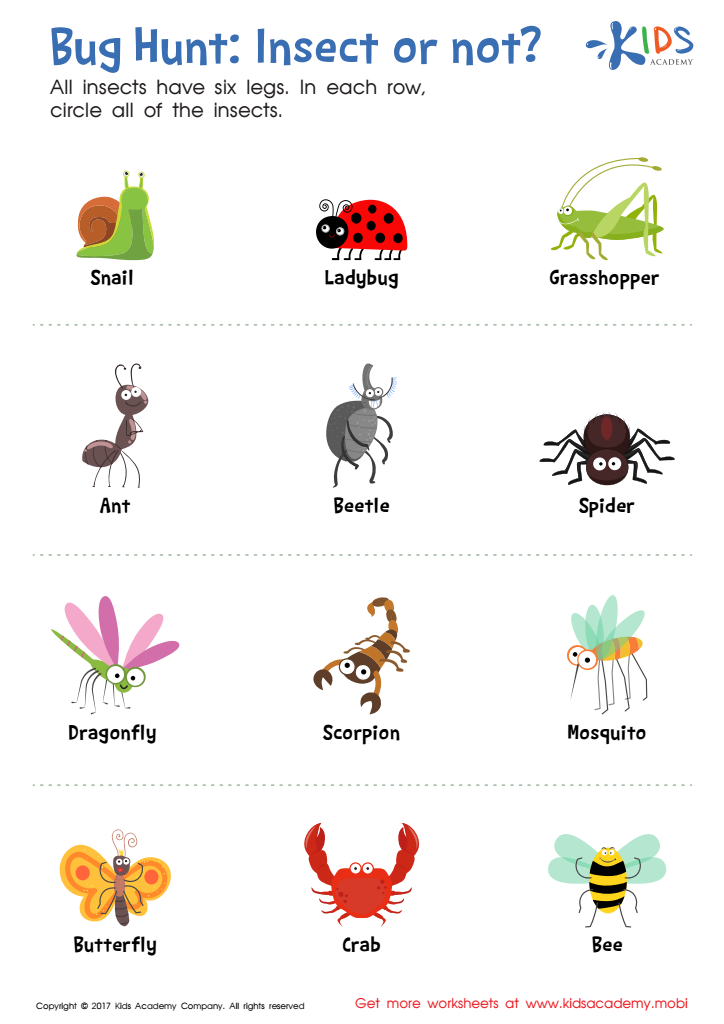
Insect or Not? Worksheet
Worksheet
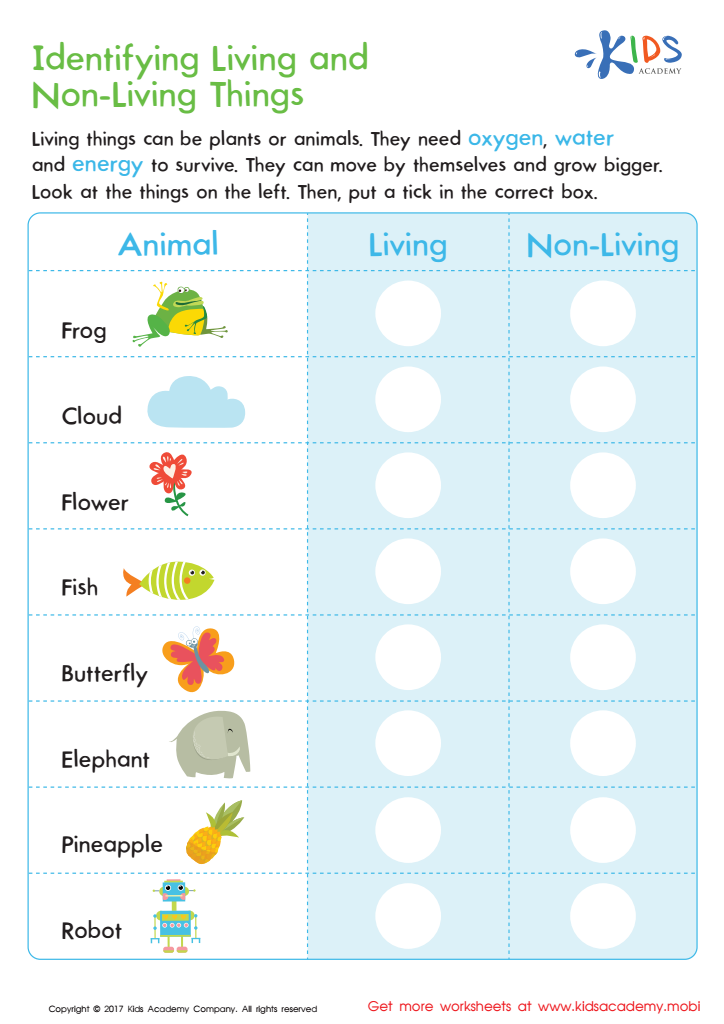
Identifying Living or Non–living Worksheet
Help your child learn to sort and categorize in a new way! Teach them to classify things as living or non-living using this worksheet. It's the perfect way to build their scientific understanding, and to have some learning fun! Print this worksheet and watch them discover the world of science!
Identifying Living or Non–living Worksheet
Worksheet
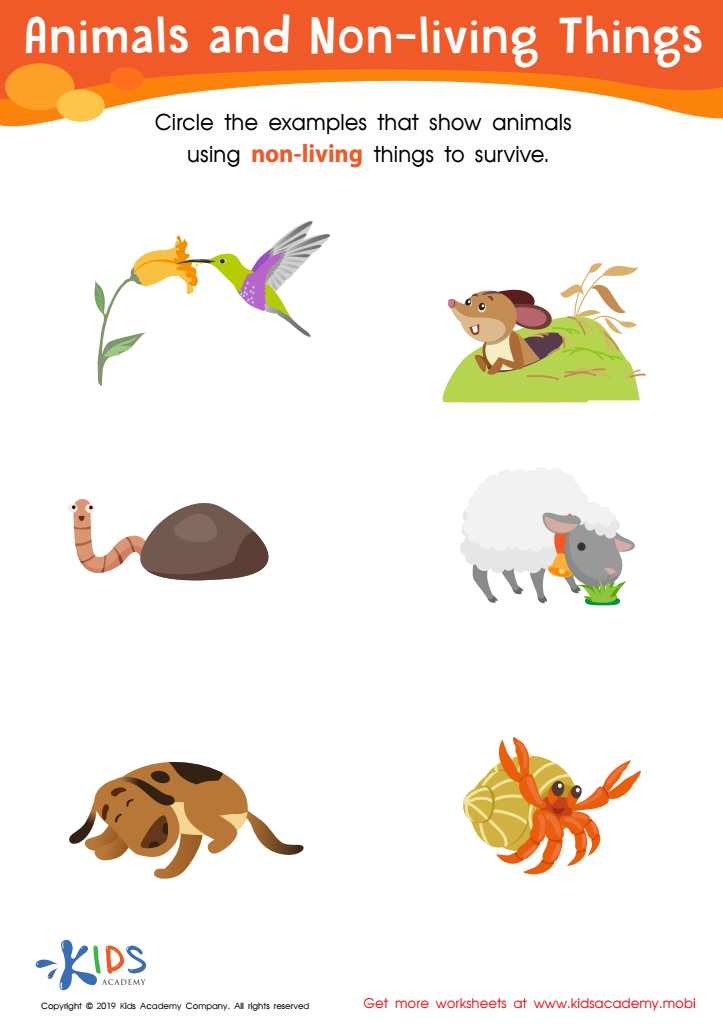
Animals and Non-Living Things Worksheet
People and animals both require more than food to survive. We need shelter, clothing and water, while animals use non-living things like rocks and trees. Ask your kids what else is necessary to survive - then have them identify the objects in the worksheet and circle the examples of animals using non-living things.
Animals and Non-Living Things Worksheet
Worksheet
Join Kids Academy for Free
Who is primarily going to use this learning content?







Categorization skills are essential for children aged 4-5, particularly when it comes to understanding normal animals. These skills involve grouping objects or ideas based on shared characteristics, which helps strengthen critical thinking and problem-solving abilities. For parents and teachers, fostering these skills is crucial as they lay the foundation for early cognitive development.
At this age, children are naturally curious and increasingly aware of their environment. Teaching them to recognize and categorize normal animals fosters their observation skills and enhances their vocabulary. As they learn to distinguish between different species, such as mammals, birds, and reptiles, they also gain insights into biological concepts like habitats and adaptations.
Moreover, categorization promotes social interaction and communication. Activities that involve sorting animals—like classifying them by their size, color, or diet—encourage cooperative play, turn-taking, and discussions among peers, fostering valuable social skills.
By supporting the development of categorization skills, parents and teachers are not only teaching children about the animal kingdom but also preparing them for more complex understanding in subjects like science and mathematics in the future. Ultimately, these foundational skills are instrumental in nurturing lifelong learners equipped to navigate and make sense of the world around them.








