
Understanding fact families Normal Addition & Subtraction Worksheets for Ages 4-6
3 filtered results
Difficulty Level
Grade
Age
-
From - To
Subject
Activity
Standards
Explore our engaging "Understanding Fact Families" worksheets designed for young learners aged 4-6! These interactive resources focus on normal addition and subtraction concepts, helping children grasp the relationships between numbers. Each worksheet simplifies the learning process by introducing fact families, showing how two addition and two subtraction equations are interconnected. Suitable for both classroom and home use, these worksheets promote numerical fluency and critical thinking. Fun activities ensure that children not only comprehend math essentials but also enjoy learning. Empower your child's math journey today by providing them with tools that foster understanding and confidence in their mathematical abilities!
Favorites
With answer key
Interactive
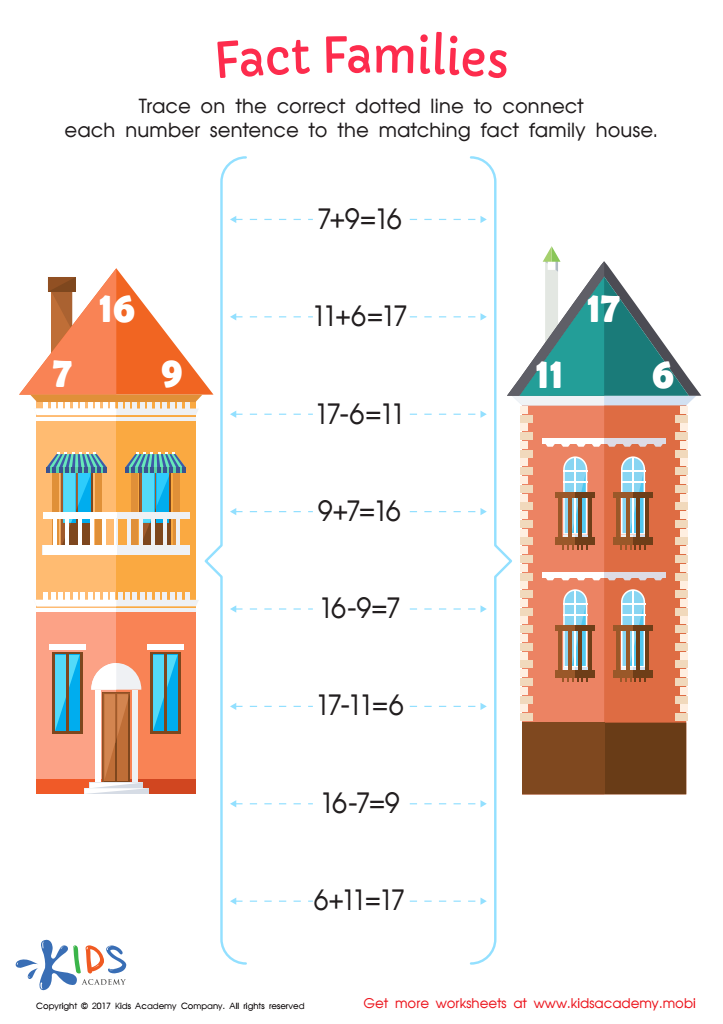
Fact Families — Add and Subtract Worksheet
Kids will love seeing how families of numbers "live" in their own houses!
 Assign to My Students
Fact Families — Add and Subtract Worksheet
Worksheet
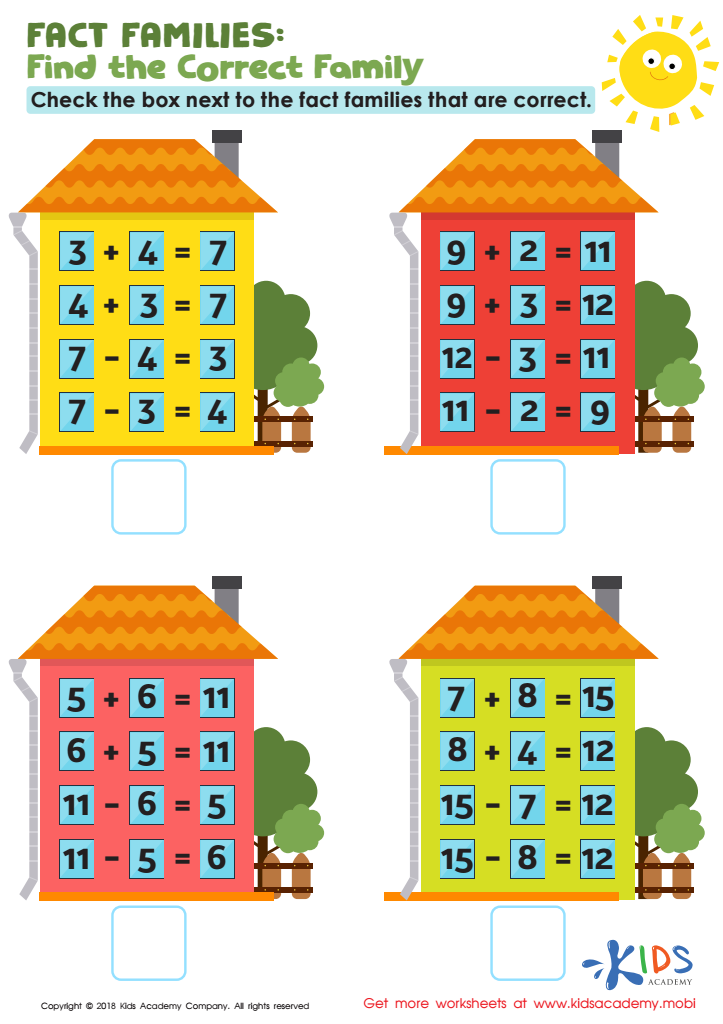
Fact Families: Find Correct Family Worksheet
Test your students' math and reasoning skills with this worksheet. It features 4 houses, each with a group of fact families on it. Some are correct, some are wrong - help students identify which are correct and circle the box next to them. This will help them progress in school.
Fact Families: Find Correct Family Worksheet
Worksheet
Join Kids Academy for Free
Who is primarily going to use this learning content?








Understanding fact families in normal addition and subtraction is essential for children aged 4-6, as it lays a strong foundation for mathematical learning. At this early stage, children begin to grasp the relationships between numbers. Fact families consist of a set of three numbers that can create simple addition and subtraction equations. For instance, in the fact family of 2, 3, and 5, you can create the equations 2 + 3 = 5 and 5 - 3 = 2.
By understanding these relationships, children learn to recognize that addition and subtraction are interconnected processes, enhancing their problem-solving skills. This understanding also fosters numerical fluency, allowing young learners to perform calculations more readily and confidently.
Additionally, knowledge of fact families supports comprehension of larger mathematical concepts, such as the inverse relationship between addition and subtraction. When parents and teachers engage children with fact families, they effectively build cognitive connections that will aid in more complex mathematics in later years.
Ultimately, emphasizing fact families during early math education helps develop a child's critical thinking skills, lays the groundwork for a lifelong appreciation of math, and equips them with the necessary tools to succeed academically. Thus, parents and teachers should prioritize this foundational concept.








