
Understanding pollination Normal Math Worksheets for Ages 4-8
3 filtered results
Difficulty Level
Grade
Age
-
From - To
Subject
Activity
Standards
Our "Understanding Pollination Normal Math Worksheets" are designed for children ages 4-8 to explore the fascinating world of plants while developing fundamental math skills. Engaging and beautifully illustrated, these worksheets introduce young learners to basic math concepts through themes related to pollination. Kids will enjoy counting bees, matching flowers with their pollinators, and solving simple addition and subtraction problems, all while gaining a deeper appreciation for the vital role of pollination in nature. Ideal for classroom use or at-home learning, these worksheets make math fun and interactive, helping children connect nature and mathematics in a meaningful way. Discover the flowers of learning with us!
Favorites
With answer key
Interactive
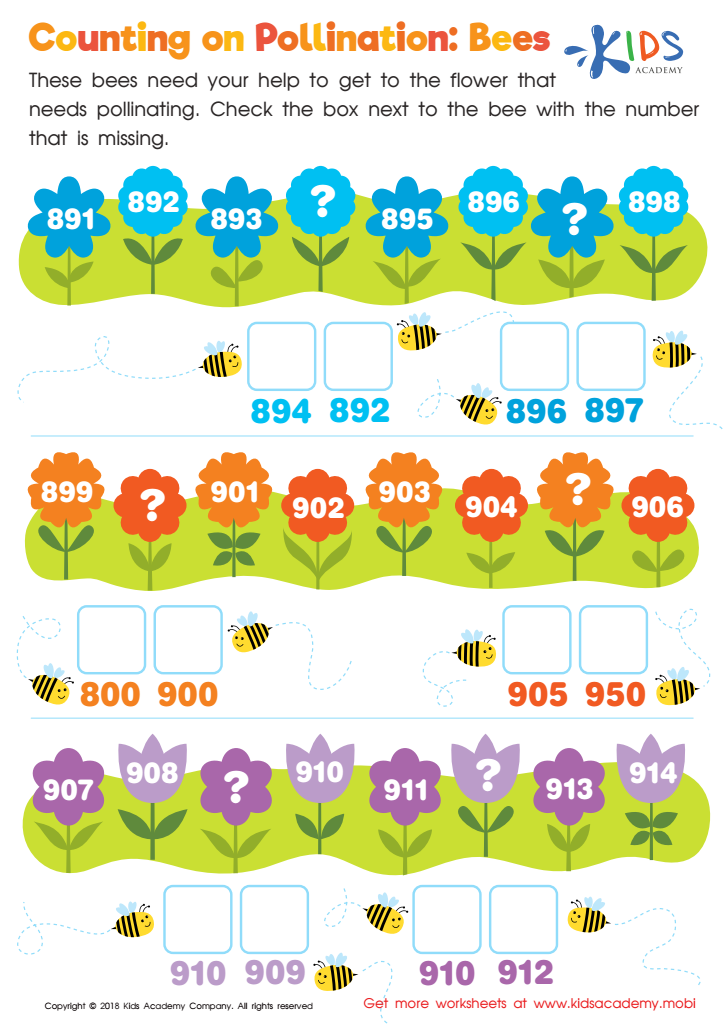
Counting on Pollination: Bees Worksheet
This downloadable worksheet helps kids improve their math skills while having fun - they'll help the bees pollinate the flowers by finding the missing number. It's an entertaining way to practice number patterns, sequences and number line skills, aiding in fast and efficient math computations.
 Assign to My Students
Counting on Pollination: Bees Worksheet
Worksheet
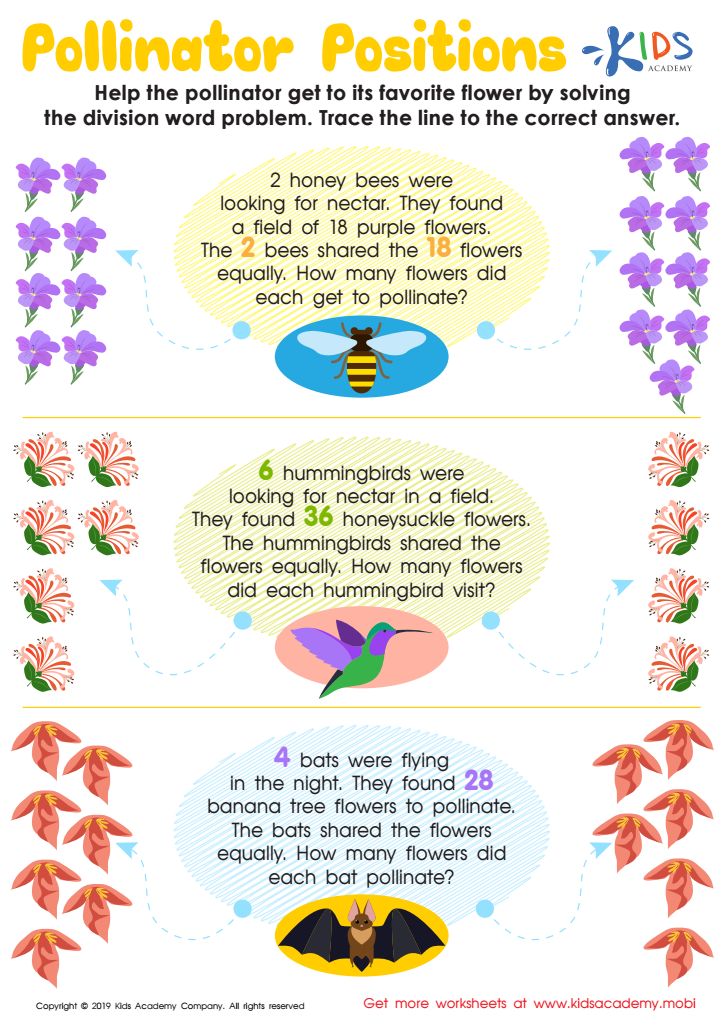
Pollinator Positions Worksheet
Kids will love learning about pollinators and how vital they are. Help their favorite friends get to the right flowers with this fun PDF. Children can solve the problems without even knowing they're doing division; just read the word problems and use the highlighted numbers. Finish by tracing the lines to the correct quotient!
Pollinator Positions Worksheet
Worksheet
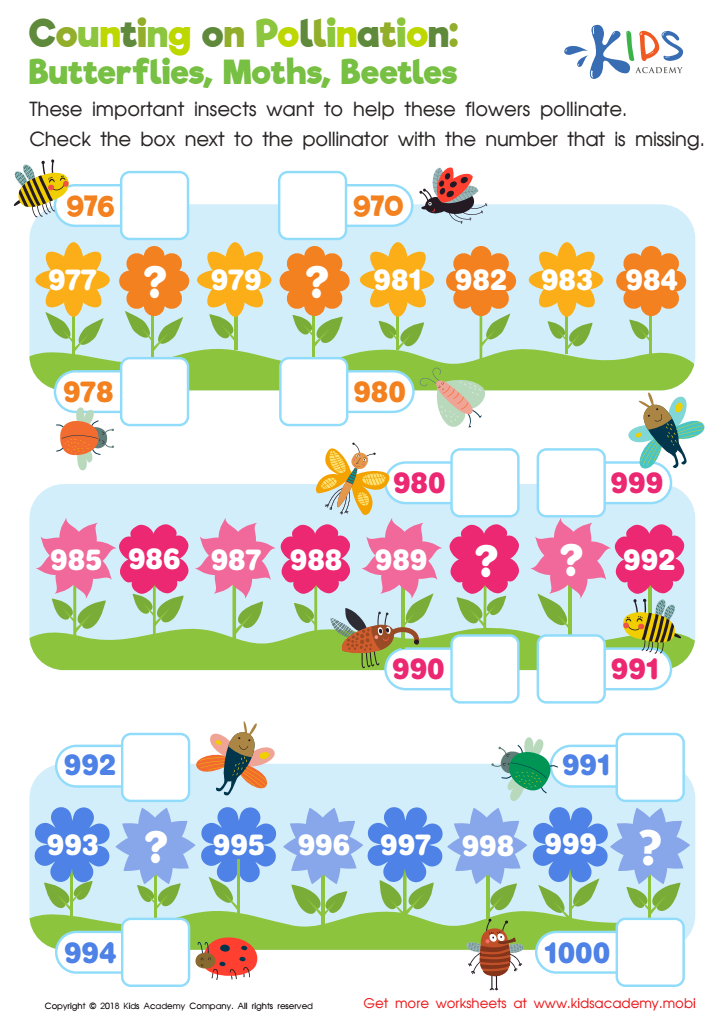
Counting on Pollination: Butterflies, Moths, Beetles Worksheet
A number line can help boost computation accuracy and efficiency. It can also be used with more advanced numbers. Help your child practice by having them identify missing numbers in sequences. This fun worksheet lets them help the pollinators in the process, as they strengthen their number sense.
Counting on Pollination: Butterflies, Moths, Beetles Worksheet
Worksheet
Join Kids Academy for Free
Who is primarily going to use this learning content?






Understanding pollination is crucial for children aged 4-8 as it lays the foundation for their comprehension of ecosystems, food production, and environmental stewardship. By teaching young learners about pollination, parents and teachers can help foster curiosity about nature and inspire a sense of responsibility towards protecting the environment.
Pollination is a vital process that enables plants to reproduce, resulting in fruits, vegetables, and flowers, which are essential for maintaining biodiversity and ecosystems. Through engaging lessons on pollination, teachers can integrate math skills in a fun manner, such as counting different types of flowers, measuring distances bees travel, or comparing the amounts of fruits produced by different pollinated plants.
Moreover, pollination education can support the cultivation of critical thinking and problem-solving skills, as children learn about the importance of bees, butterflies, and other pollinators to our food supply. Understanding this process promotes mindfulness about the natural world, leading children to be more aware of their actions and the impact these can have on pollinator health.
Ultimately, involving parents and teachers in this educational journey ensures that children not only grasp fundamental scientific concepts but also appreciate and engage with the wonders of nature, promoting lifelong learning and care for our planet.








